
Support Spreads for Athletes 1 Month Ahead of Deaflympics; Public, Private Sectors Step Up Training Resources, Funding
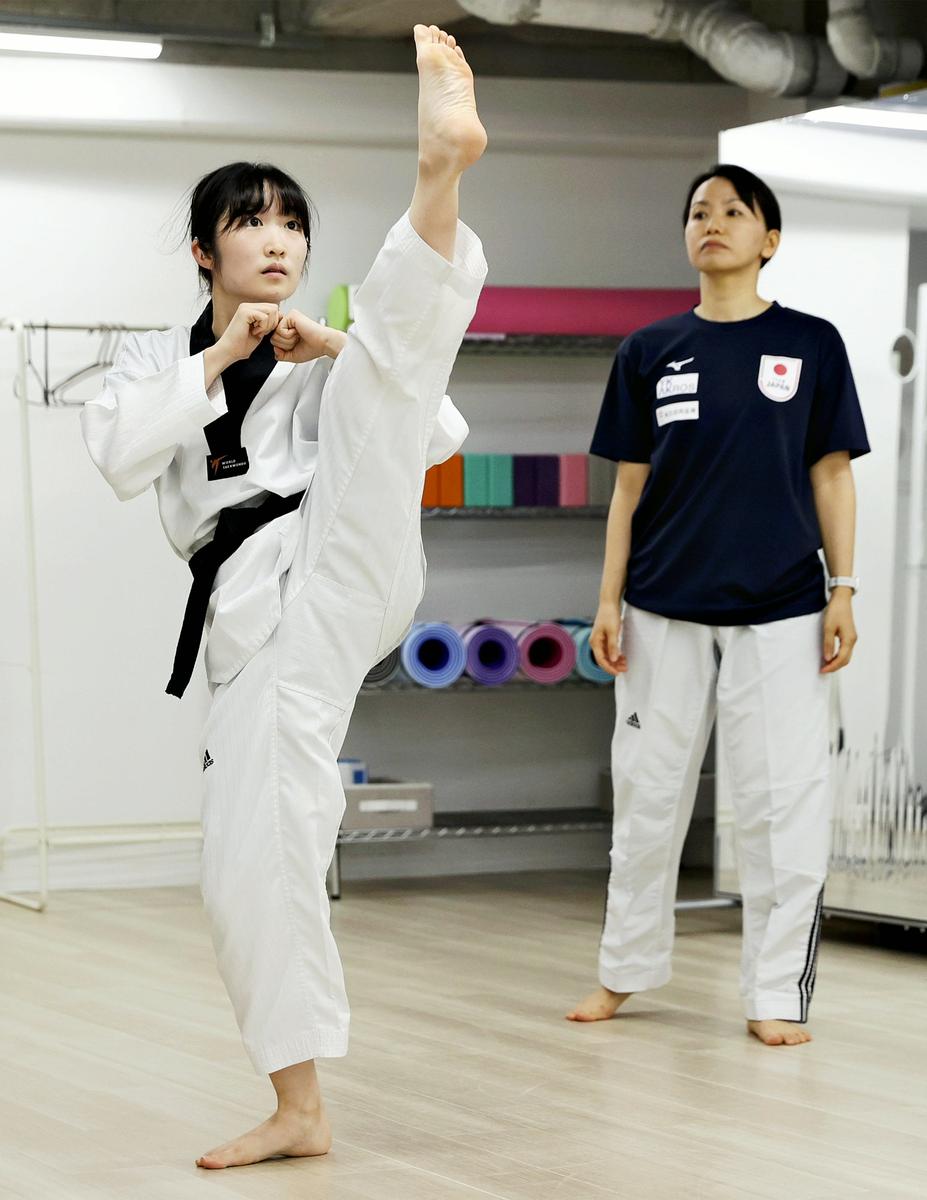
Taekwondo player Moe Hoshino, left, practices under her coach’s guidance in Chiyoda Ward, Tokyo.
13:19 JST, October 23, 2025
Support for deaf athletes is growing with the private and public sectors ahead of the Tokyo 2025 Deaflympics scheduled Nov. 15-26.
A senior at Tsukuba University of Technology, Moe Hoshino rhythmically executed punches and sharp kicks at a rental studio in Chiyoda Ward, Tokyo, on the afternoon of Aug. 18. The 21-year-old has been selected for the women’s taekwondo national team.
She practiced for about three hours, receiving guidance through gestures and hand signals from a coach dispatched by the All Japan Taekwondo Association.
“It was difficult to raise funds and prepare a training environment on my own,” Hoshino said. “It’s reassuring to be able to work together with a coach.”
Many hard-of-hearing athletes have competed alongside hearing athletes while facing challenges such as difficulty hearing coaches’ instructions or starting signals, and keeping balance due to ear conditions.
Hoshino, who began taekwondo in fifth grade, took time to learn techniques by observing others. At competitions, she had sometimes panicked when not understanding the referee’s instructions.
She temporarily stepped away from the sport in high school, but resumed training after entering a university, where students who are hard of hearing and seeing attend. She learned of taekwondo being an event in the Deaflympics and that Japan had never competed. That knowledge spurred Hoshino “to be the first” to participate.
Tryouts
Hoshino secured the opportunity through tryouts held by the Tokyo metropolitan government in June 2024.
The trials recruited athletes in four sports without prior Japanese national team participation — taekwondo, handball, shooting and wrestling — attracting 43 athletes. Based on practical skills and athletic ability tests, 21 athletes, including Hoshino, qualified and were selected for training at respective sports federations.
The Tokyo government provides qualified athletes with an annual subsidy of up to ¥2.5 million to cover coach salaries and practice venue fees. To date, 10 athletes have been selected for national teams.
“Having Japanese athletes excel in more sports will help build excitement for the Games,” an official said.
Focus on Promotion
Similar initiatives are seen in other municipalities and companies.
Saitama Prefecture dispatches trainers and introduces sports medicine specialists to deaf athletes who have some connection with the prefecture. Originally a program for Paralympic athletes, it expanded its scope following the decision for Japan to host the Deaflympics. The prefecture will support 11 hearing-impaired athletes this fiscal year.
Meanwhile, Kanagawa Prefecture-based apparel manufacturer Venex Co. signed an ambassador contract with deaf basketball player Kaori Maruyama in February 2024. The company provides her with its recovery wear designed to promote fatigue recovery.
“We wanted to support her after seeing her dedication not only to improving her athletic performance, but also to promoting sports for the Deaf,” a Venex spokesperson said.
Said Maruyama: “Training conditions are improving. By performing well at the Games, I hope support and understanding will keep expanding, enabling athletes to train in even better environments.”
About 3,000 athletes will compete in 21 sports in the upcoming Deaflympics.


Related Tags



Most Read
Popular articles in the past 24 hours
-

3,000 Accounts Posting, Spreading Content Critical of Japan on X;...
-

My Spendthrift Mother Constantly Asks Me for Money
-
Japanese Students Use Traditional Pickle to Create Novel Wagashi ...
-

‘Dry Bonsai’ Gives New Life to Withered Trees, Allows Free Artist...
-

A Packed Bus Plunges off a Nepal Highway, Killing 19 and Injuring...
-

1.2 Mil. Rapeseed Flowers Attract Cute Birds, People in Aichi Pre...
-

Astellas Collaborates with Vir to Develop Its Experimental Prosta...
-

Nepal Bus Crash Kills 19 People, Injures 25 Including One Japanes...
Popular articles in the past week
-

Producer Behind Pop Group XG Arrested for Cocaine Possession
-

Japan PM Takaichi’s Cabinet Resigns en Masse
-

Man Infected with Measles Reportedly Dined at Restaurant in Tokyo...
-

Sanae Takaichi Elected Prime Minister of Japan; Keeps All Cabinet...
-

Japan's Govt to Submit Road Map for Growth Strategy in March, PM ...
-

Bus Carrying 40 Passengers Catches Fire on Chuo Expressway; All E...
-

U.S. Firm to Build Training Hub in Fukushima N-plant for Debris R...
-

Japan, U.S. Name 3 Inaugural Investment Projects; Reached Agreeme...
Popular articles in the past month
-
Producer Behind Pop Group XG Arrested for Cocaine Possession
-
Japan PM Takaichi’s Cabinet Resigns en Masse
-

Japan Institute to Use Domestic Commercial Optical Lattice Clock ...
-
Man Infected with Measles Reportedly Dined at Restaurant in Tokyo...
-

Israeli Ambassador to Japan Speaks about Japan’s Role in the Reco...
-

Videos Plagiarized, Reposted with False Subtitles Claiming ‘Ryuky...
-

Man Infected with Measles May Have Come in Contact with Many Peop...
-

Prudential Life Insurance Plans to Fully Compensate for Damages C...
Top Articles in Sports
-

Milano Cortina 2026: Figure Skaters Riku Miura, Ryuichi Kihara Pair Win Gold; Dramatic Comeback from 5th Place in SP
-

Milano Cortina 2026: Kokomo Murase Comes Out on Top After Overcoming Obstacles, Aiming for Greater Heights in Competition
-

Milano Cortina 2026: Riku Miura, Ryuichi Kihara Clinch Japan’s 1st Gold in Pairs Figure Skating, Rebounding from Disappointing Short Program
-

Milano Cortina 2026: Olympics-Torch Arrives in Co-Host Cortina on Anniversary of 1956 Games
-
Milano Cortina 2026: Japan’s Athletes Arrive in Italy for Milano Cortina Winter Olympics; Other Athletes to Arrive from Now
JN ACCESS RANKING
-
Producer Behind Pop Group XG Arrested for Cocaine Possession
-
Japan PM Takaichi’s Cabinet Resigns en Masse
-
Japan Institute to Use Domestic Commercial Optical Lattice Clock to Set Japan Standard Time
-
Man Infected with Measles Reportedly Dined at Restaurant in Tokyo Station
-
Israeli Ambassador to Japan Speaks about Japan’s Role in the Reconstruction of Gaza