
Foreign students return / Support for foreign students helps them adjust to Japanese life
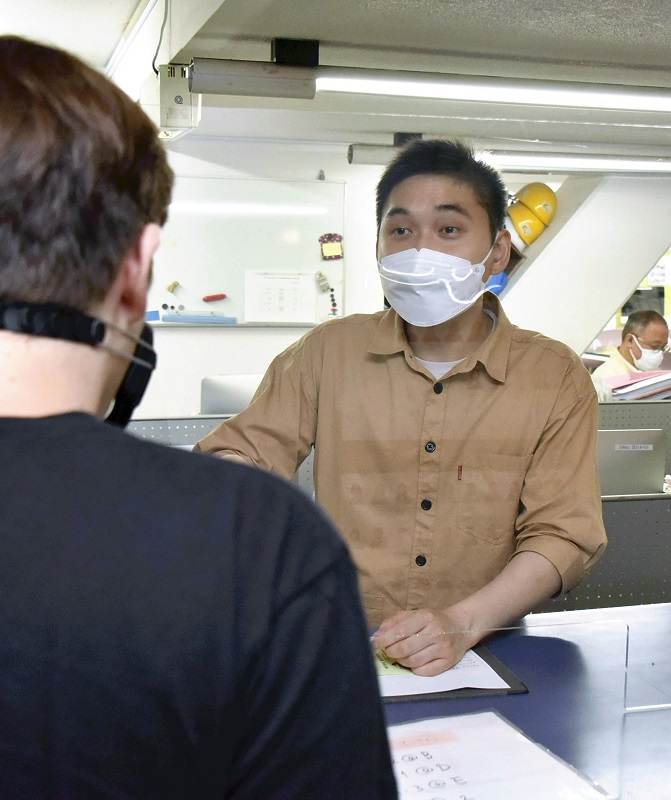
Jasper Lam consults with a foreign student on July 15.
12:03 JST, August 19, 2022
The recent relaxation of entry restrictions for foreigners opened the door again for overseas students to study in Japan. The Yomiuri Shimbun talked with students at Kai Japanese Language School in Shinjuku Ward, Tokyo. This is the fifth and final installment of the series.
***
Sarah Welch, 37, could not believe the sentence she found on a real estate website while searching for a place to live in Japan. Welch, a Briton, came to Japan in late March to study at Kai Japanese Language School. She was searching for a home while she stayed in a hotel.
She browsed information written in Japanese by using translation software and found the phrase, “No foreign nationals.”
She recalled her shock, saying that she was astonished that such direct discriminatory words were displayed on the site.
She found some places that said nothing about foreign nationals being unable to rent, and made inquiries with real estate brokers. Out of six or seven homes she asked the brokers to negotiate for, half of the properties proved unworkable as the landlords replied that they do not rent the properties to foreigners.
Because of the language barrier, too, it took nearly a month before she could settle into a new home in Japan.
She was puzzled that it was so difficult to rent a place for no other reason than being a foreigner, as she had worked as an accountant in Britain and did not lack money.
In the school’s administration office, students from overseas seek advice about various things almost every day.
Issues include, “I don’t know how to get a contract for internet access,” and “Where is a hospital where I can speak English?”
The school has staff members in the office to handle these requests. Jasper Lam, 33, a Singaporean, is one of the staff supporting students.
Lam did research on Japan at the National University of Singapore. Including a period when he was a student at a vocational college, he has been enrolled in schools in Japan a total of three times.
After graduating from the Singaporean university, he came to Japan again as an assistant language teacher, as he wanted to use his language skills.
Following that job, he worked as a contracted official at a university in Tokyo where he was involved in public relations. He was confident that he was essential to the university as he was utilizing his English language skills.
However, when he took an exam to become a permanent employee, the hurdle was too high. There was no exam for foreigners, and he was assessed on the same criteria as Japanese nationals.
The theme of an essay in the exam was “your opinion on making education free of charge.” As he was required to have a native level of Japanese language skill, he could not pass the exam.
He now feels doubt, wondering whether Japan really wants to become more international.
Hiroko Yamamoto, representative of Kai Japanese Language School, began getting to know foreign students about 40 years ago. When she started working as a Japanese language teacher, there was a large number of students from other Asian countries in the classrooms.
“I gradually became able to communicate with them, which was difficult at the beginning. It was fun,” she said.
She established the school in 1987, aiming to create a borderless environment where students do not worry about which countries they come from.
The school holds out the ideal of classrooms where foreign students with diverse backgrounds can respect one another. It has set a goal of accepting students from as many countries as possible, and the number of students from Western countries has grown since the mid-1990s.
In recent years, there has been a marked increase in the number of foreign students in Japan. When Yamamoto sees foreign shop assistants and Japanese customers chatting in convenience stores, she thinks that Japan is becoming a society where foreigners are a matter of course.
On the other hand, prejudice against foreign students is still deep-rooted. “A sense that foreign students are our fellows living alongside us has still not taken root in our society,” she said.
Language schools are like windows that connect foreign students and Japanese society. Yamamoto wants to keep the door of the school open so that the winds of different cultures will blow into society.
Struggles in everyday affairs
The Japan Student Services Organization conducted a survey in 2020 on foreign students who enrolled in schools in Japan at their own expense, and asked about tough experiences they had in a multiple-choice questionnaire.
The highest percentage at 75% was for the response that prices are high. This was followed by 36% who said different customs in daily living, 20% who cited difficulty in finding a place to live, and 13% who said that it was hard to comply with rules for their residence about taking out garbage and other things.
The answers suggest that foreign students find it challenging to adapt to social customs in Japan.
Even if foreigners get jobs in Japan, they often feel dissatisfied in some areas, such as very long working hours and the advanced level of Japanese required.
Yuji Kobayashi, a senior research fellow at private think tank Persol Research and Consulting Co., said: “Highly skilled foreign workers do not hesitate to take jobs overseas. To retain excellent workers in Japan, it is urgent that we improve working conditions to better meet foreign workers’ needs, and improve post-hiring education, rather than requiring them to have too high a level of Japanese.”
Yuriko Sato, an associate professor at Tokyo Institute of Technology and an expert on policies for foreign students, said, “Many foreign students understand Japanese language and culture, and so they are the easiest foreign workers to take on.”
She added, “Japanese people also need to understand foreign cultures and ways of thinking by deepening exchanges in their local communities.”
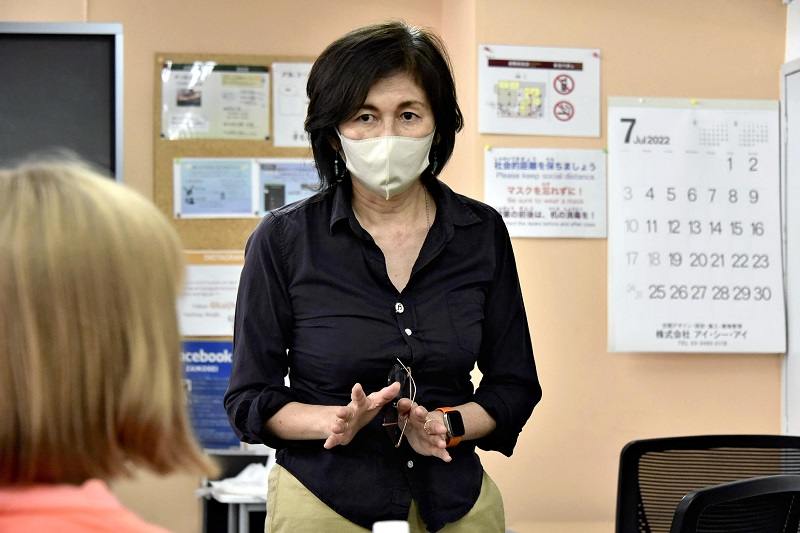
Hiroko Yamamoto speaks about her efforts to help foreign students on July 29.


Related Tags



Most Read
Popular articles in the past 24 hours
-

Japanese Shipping Giants Halt Strait of Hormuz Transit as Iran Co...
-

U.S. Launches Attacks on Iran: Avoid Escalation of Conflict by An...
-

Sawtooth Roof Factory Stands as Monument to Ashikaga Textile Hist...
-
Parents of Japanese Teen Shot in U.S. Strive for Gun Control
-

Disinformation Spreads About Team Mirai, Ballot Readers; Online P...
-
Asahi Breweries to Stage Comeback with New Product in April; Comp...
-

Bank of Japan Deputy Governor Says Rate Hikes Likely to Continue
-

Japanese Government Bonds Rally, Yields Tumble as Iran Strikes Sp...
Popular articles in the past week
-

Nepal Bus Crash Kills 19 People, Injures 25 Including One Japanes...
-
Milano Cortina 2026: Japanese Gold Medalist Figure Skater Miura S...
-

Tokyo Spends Big on Children, Wins Over Parents
-

McDonald's Japan Raises Prices; Big Mac to Cost ¥500, Double Chee...
-

Japan’s Miura, Kihara Announce Withdrawal from Figure Skating Wor...
-

Exhibition Featuring Yoshiharu Tsuge’s Manga World Underway in Ch...
-

Yokohama to Test Out Renewable-Powered Offshore Floating Data Cen...
-

BOJ Keeping Eye on Economy and Takaichi's ‘Proactive Fiscal Polic...
Popular articles in the past month
-

Producer Behind Pop Group XG Arrested for Cocaine Possession
-

Japan PM Takaichi’s Cabinet Resigns en Masse
-

Man Infected with Measles Reportedly Dined at Restaurant in Tokyo...
-

Israeli Ambassador to Japan Speaks about Japan’s Role in the Reco...
-

Videos Plagiarized, Reposted with False Subtitles Claiming ‘Ryuky...
-

Man Infected with Measles May Have Come in Contact with Many Peop...
-

Prudential Life Insurance Plans to Fully Compensate for Damages C...
-

Woman with Measles Visited Hospital in Tokyo Multiple Times Befor...
Top Articles in Society
-
Producer Behind Pop Group XG Arrested for Cocaine Possession
-
Man Infected with Measles Reportedly Dined at Restaurant in Tokyo Station
-
Man Infected with Measles May Have Come in Contact with Many People in Tokyo, Went to Store, Restaurant Around When Symptoms Emerged
-
Woman with Measles Visited Hospital in Tokyo Multiple Times Before Being Diagnosed with Disease
-

Bus Carrying 40 Passengers Catches Fire on Chuo Expressway; All Evacuate Safely
JN ACCESS RANKING
-
Producer Behind Pop Group XG Arrested for Cocaine Possession
-
Japan PM Takaichi’s Cabinet Resigns en Masse
-
Man Infected with Measles Reportedly Dined at Restaurant in Tokyo Station
-
Israeli Ambassador to Japan Speaks about Japan’s Role in the Reconstruction of Gaza
-
Videos Plagiarized, Reposted with False Subtitles Claiming ‘Ryukyu Belongs to China’; Anti-China False Information Also Posted in Japan