
17:00 JST, May 20, 2021
Digital authoritarianism, the use of the internet and artificial intelligence by repressive regimes, is spreading worldwide.
It is believed that military forces and intelligence agencies of some countries regard progress in digital technologies as an opportunity to monitor their citizens and control public opinion.
Detaining activists
In Russia, security cameras with face-recognition functions have been installed for such reasons as security and measures to cope with the novel coronavirus.
Moscow has about 190,000 such cameras and face-recognition devices, and more are planned for 10 other cities.
The Russian Ministry of Internal Affairs is developing a system to identify people by analyzing motion, voice and tattoos. Russian authorities control the cameras, which have been used to detain anti-government activists. However, the cameras have intentionally been turned off in some cases.
Bellingcat, a Britain-based research and investigation group, quoted sources who claimed that Russian authorities have turned off the security cameras to hide their own attacks on activists.
According to a report last year by the U.S. nongovernmental organization Freedom House, authorities of at least 30 countries have obtained data from telecommunication companies and have used the data for monitoring purposes, claiming it was part of coronavirus measures.
The proliferation of technologies from digital superpowers is thought to be behind such moves.
According to the report, Ecuador’s public security information networks, which were mainly built by Chinese companies, have been used for such purposes as contact-tracing during the pandemic.
China exports technology that was developed to monitor its own citizens. It is thought that the number of security cameras in China exceeds 400 million, and the number is still growing.
Involvement by Israel, which raised levels of technologies for public security, is also remarkable. Israeli technology firm NSO Group developed Pegasus, which is thought to be the world’s most intelligent “spyware.”
The technology can retrieve data from mobile phones — including the contents of emails, location information and search history — control the device’s microphone and cameras, and tap calls. Mobile phones can be controlled remotely and users operating the spyware technology can monitor the actions of targets.
According to Israeli newspaper Haaretz, Pegasus was exported to Saudi Arabia, the United Arab Emirates, Bahrain and Oman.
The Gulf countries are good customers. It is estimated that sales from one contract reached $250 million (about ¥27 billion).
According to a report submitted to the U.N. Human Rights Council, it is suspected that the spyware was used in the killing of Saudi journalist Jamal Khashoggi in 2018.
Controlling public opinion
Governments also aim to control public opinion. Governments have posted negative information about anti-government activists on social media using AI bot accounts and human accounts to manipulate public opinion.
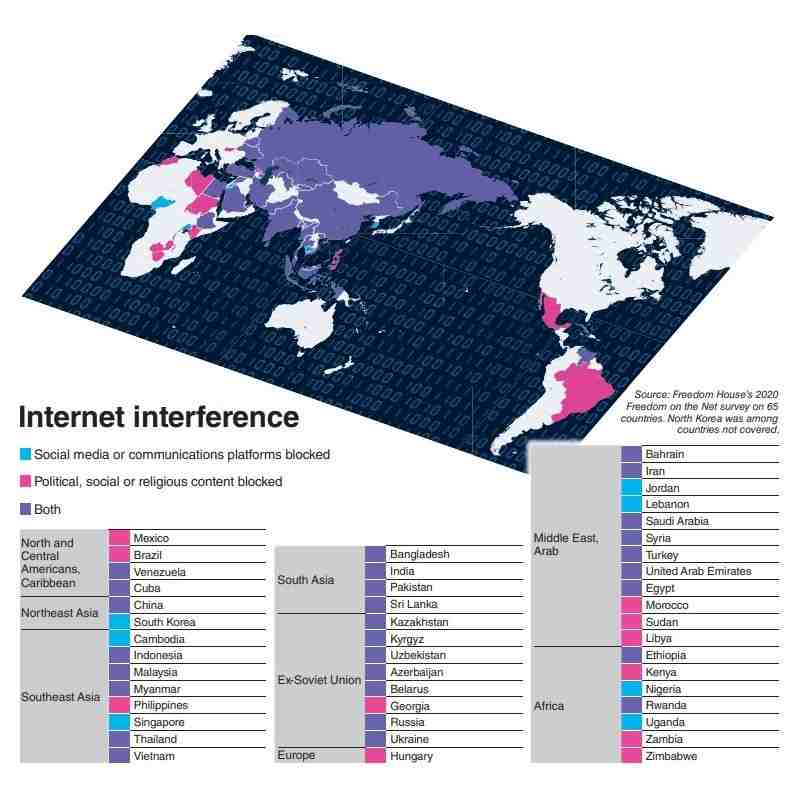
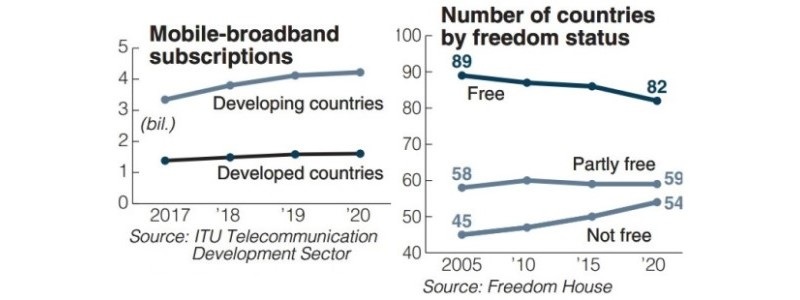
According to the Oxford Internet Institute of the University of Oxford, bots have been used in 57 countries, and human agents have been used in 79 countries. The Freedom House report said that governments of 39 countries have used the internet to try to control public opinion.
Governments have also tried to control public opinion in other countries.
On April 15, the U.S. government announced sanctions on officials of Russian intelligence authorities, alleging that they had spread false information via websites and tried to manipulate public opinion during last year’s U.S. presidential election campaign.
The U.S. government said that one of the websites also had false information about the novel coronavirus.
Russia was alleged to have intervened in the 2016 U.S. presidential election by posting defamatory information about Hillary Clinton, who was the Democratic Party nominee.
Government censorship
Many regimes delete information online or obstruct people’s use of smartphone apps.
According to Reuters, some websites opposing the Cuban government cannot be accessed in that country. In some cases, emails that contained such words as “democracy” and “human rights” have failed to reach their intended recipients.
According to the Freedom House report, 35 countries blocked access to information about politics, social affairs and religion.
In Uganda, when the incumbent president was reelected to his sixth term in January, people were unable to access social media sites. It is believed that the shutout was to block moves of the opposition party candidate. It is also notable that some countries have tried to establish national borders online to eliminate the possibility of influence from other countries.
In 2019, Russia passed a law that allows the government to block access to overseas internet platforms. In Iran, a domestic network has been developed to block foreign websites.
The situation in North Korea is close to that of the pre-internet era. According to escapees from the country, people need to register with the communications ministry to purchase smartphones, and if users want to install apps, they have to take their smartphones to the ministry.
People can send messages and use game apps, but they cannot access internet networks outside the country.
Smartphones in North Korea have the ability to detect whether the origin of information is abroad by analyzing fonts and graphic qualities, and automatically delete such information.
Files saved outside of the country using Microsoft’s Word and Excel software or saved as a PDF, Adobe’s portable document format, cannot be opened in North Korea. Codes from a special organization are needed to open such files.




Most Read
Popular articles in the past 24 hours
-

Japanese Shipping Giants Halt Strait of Hormuz Transit as Iran Co...
-

U.S. Launches Attacks on Iran: Avoid Escalation of Conflict by An...
-

Rental Lab Space in Tokyo Area More Than Doubles Since 2010, Offe...
-

Sawtooth Roof Factory Stands as Monument to Ashikaga Textile Hist...
-

Parents of Japanese Teen Shot in U.S. Strive for Gun Control
-

Disinformation Spreads About Team Mirai, Ballot Readers; Online P...
-

Asahi Breweries to Stage Comeback with New Product in April; Comp...
-

Bank of Japan Deputy Governor Says Rate Hikes Likely to Continue
Popular articles in the past week
-

Nepal Bus Crash Kills 19 People, Injures 25 Including One Japanes...
-

Milano Cortina 2026: Japanese Gold Medalist Figure Skater Miura S...
-
Tokyo Spends Big on Children, Wins Over Parents
-

McDonald's Japan Raises Prices; Big Mac to Cost ¥500, Double Chee...
-

‘Dry Bonsai’ Gives New Life to Withered Trees, Allows Free Artist...
-

Japan’s Miura, Kihara Announce Withdrawal from Figure Skating Wor...
-

Exhibition Featuring Yoshiharu Tsuge’s Manga World Underway in Ch...
-

Yokohama to Test Out Renewable-Powered Offshore Floating Data Cen...
Popular articles in the past month
-

Producer Behind Pop Group XG Arrested for Cocaine Possession
-

Japan PM Takaichi’s Cabinet Resigns en Masse
-

Man Infected with Measles Reportedly Dined at Restaurant in Tokyo...
-

Israeli Ambassador to Japan Speaks about Japan’s Role in the Reco...
-

Videos Plagiarized, Reposted with False Subtitles Claiming ‘Ryuky...
-

Man Infected with Measles May Have Come in Contact with Many Peop...
-

Prudential Life Insurance Plans to Fully Compensate for Damages C...
-

Woman with Measles Visited Hospital in Tokyo Multiple Times Befor...
Top Articles in Society
-
Producer Behind Pop Group XG Arrested for Cocaine Possession
-
Man Infected with Measles Reportedly Dined at Restaurant in Tokyo Station
-
Man Infected with Measles May Have Come in Contact with Many People in Tokyo, Went to Store, Restaurant Around When Symptoms Emerged
-
Woman with Measles Visited Hospital in Tokyo Multiple Times Before Being Diagnosed with Disease
-

Bus Carrying 40 Passengers Catches Fire on Chuo Expressway; All Evacuate Safely
JN ACCESS RANKING
-
Producer Behind Pop Group XG Arrested for Cocaine Possession
-
Japan PM Takaichi’s Cabinet Resigns en Masse
-
Man Infected with Measles Reportedly Dined at Restaurant in Tokyo Station
-
Israeli Ambassador to Japan Speaks about Japan’s Role in the Reconstruction of Gaza
-
Videos Plagiarized, Reposted with False Subtitles Claiming ‘Ryukyu Belongs to China’; Anti-China False Information Also Posted in Japan