
Paper-Based Textbooks Backed by Boards of Education; Concerns Voiced Over Students’ Learning, Burden on Teachers
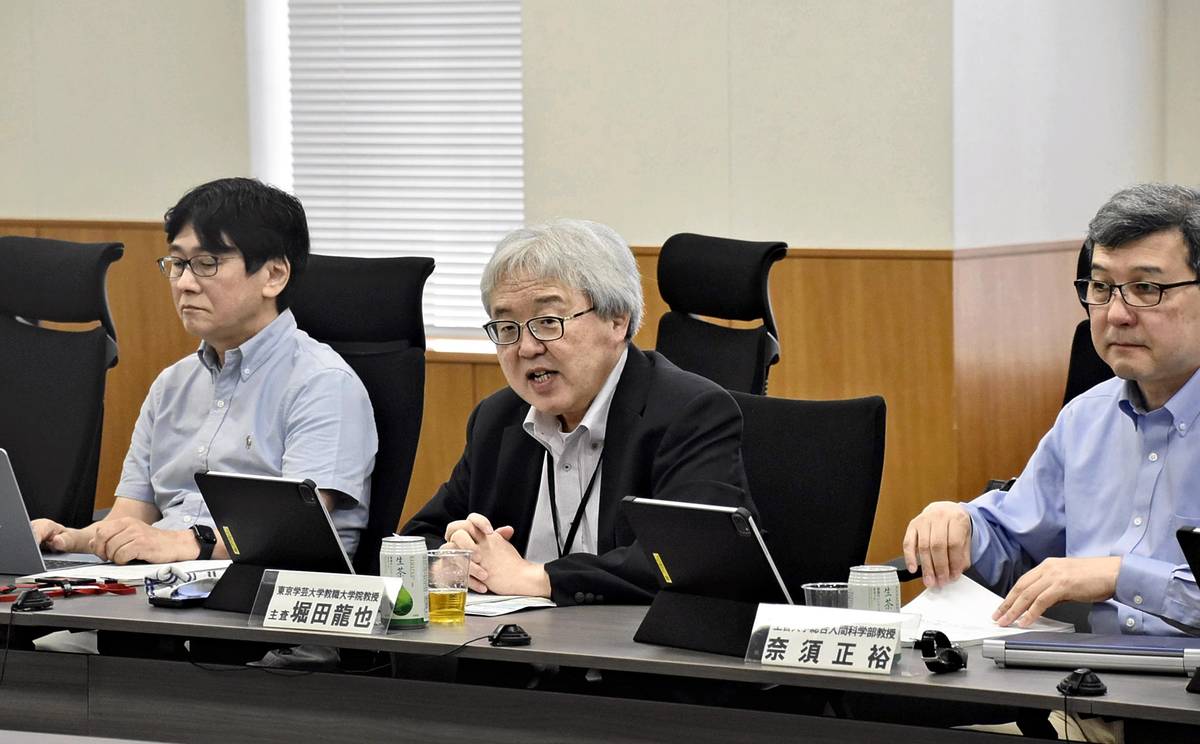
A working group of the Central Council for Education under the Education, Culture, Sports, Science and Technology Ministry approves a summary of their deliberations on the official use of digital textbooks in September.
7:00 JST, November 19, 2025
Boards of education nationwide have revealed deep-rooted concerns about learning outcomes and other issues that could stem from the official use of digital textbooks.
The Yomiuri Shimbun conducted a survey among 109 boards around the country, to which 90 responded.
The Education, Culture, Sports, Science and Technology Ministry aims to amend relevant laws during the ordinary Diet session next year to change the textbook system, but there was strong support for paper-based textbooks among the boards of education surveyed. This highlights a gap in awareness between the government and local educational authorities.
As to what problems could stem from the official use of digital textbooks in classrooms, many respondents pointed to children’s learning and teaching methods.
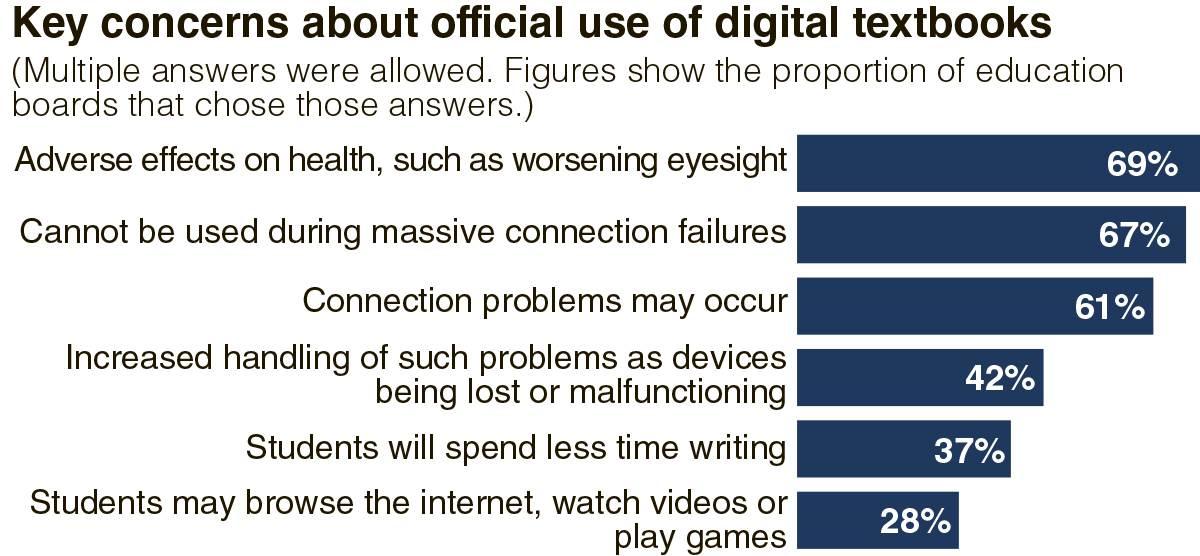
When asked to select multiple answers from a list of 10 potential problems, 37% of the boards of education chose “Students will spend less time writing.”
The board of education in Arakawa Ward, Tokyo, emphasized the importance of writing for children, stating, “The correct stroke order for kanji and hiragana characters cannot be mastered without repeated practice.” It also described the importance of paper textbooks, saying that they “help develop memory and thinking skills and ensure effective learning.”
A board of education in the Chubu region said an increasing number of children struggle with writing long passages when they are assigned to write compositions. The board stressed the importance of handwriting, stating, “Moving one’s hand to write characters helps develop the brain and deepens thinking.”
Research shows that using paper and handwriting foster memory and other skills. In 2021, a team of researchers from the University of Tokyo and other institutions published a paper showing that writing schedules in a paper notebook allows for faster memorization than using electronic devices and increases brain activity when recalling the information.
The most common concern, selected by the highest proportion of nearly 70% of the boards of education, was “the impact on children’s health, such as worsening eyesight and poor posture.” Almost 30% said “children may use devices for unrelated activities, such as browsing the internet, watching videos or playing games.”
According to an education ministry survey, the percentage of elementary and junior high school students with unaided vision below 1.0 increased in fiscal 2024 compared to fiscal 2019, before the full implementation of the government’s Global and Innovative Gateway for All initiative to equip every child with a digital device.
Amid the spread of smartphones, there seems to be growing concern that pushing digitalization in schools could lead to children being immersed in digital devices all day long.
A working group of the Central Council for Education under the education ministry compiled a summary of their deliberations on the official use of digital textbooks. It suggested allowing the use of a hybrid format combining paper and digital materials, but survey respondents showed their support for learning with paper.
The board of education in Okazaki, Aichi Prefecture, said: “Isn’t it paper textbooks, rather than digital, that allow students to truly experience learning?” A board of education in the Tohoku region said, “Writing characters on paper helps organize one’s thoughts and improves comprehension.”
Of all the boards of education that responded, 50% selected a “paper-centered hybrid format with digital materials used in a supplementary manner,” far outnumbering those that chose “digital-centered” at 9%.
Many were also found to be wary of rapid digitalization. “Sudden shifts to a digital-centered environment would confuse those working on the front lines at schools,” said a board of education in one of Tokyo’s 23 wards.
However, some expressed strong hopes for change. “Digital textbooks can be accessed anywhere and will be easy to use for home study and self-directed learning, giving students more learning opportunities,” a board of education in the Kanto region said.
Concern over heavier workload
The survey also showed that boards of education across the country are on guard against the additional burdens that digitalization may put on them.
Elementary, junior and senior high school textbooks need to undergo selection procedures by boards of education and other bodies. A total of 78% said there will be more work involved in this process.
Boards of education are closely examining the content of candidate textbooks. When it comes to digital textbooks, the workload is expected to significantly increase, as officials will also have to examine content including videos, audio, phonetic guides for characters and zoom functions. “There will be more to verify, like the functionality of digital content and teaching materials linked via QR codes,” one respondent wrote.
“The survey results revealed that boards of education are hesitant about digitalization,” said Fujio Ohmori, a professor emeritus at Tohoku University and an expert on education policy. “As seen in the hybrid textbooks envisioned by the education ministry, there are so many things that remain unknown. Board of education members probably think it’s full of mystery.
“The government should consider what directions textbooks should take, so as not to ruin the merits of paper textbooks, which are suitable for learning to read and write,” Ohmori said.






Most Read
Popular articles in the past 24 hours
-

Japanese High School Student Aims to Share Kaiten History Through...
-

PM Takaichi Spells out Plans to Advance Bold Policy Shifts in Spe...
-

Chronic Issues Erode Thailand’s Economy as Political Confusion Pe...
-

Japanese Version of Shohei Ohtani's Picture Book Published
-

Tottori: 95-Year-Old Japanese Descendent from Philippines Visits ...
-

Japan to Monitor Trump Administration's Response to U.S. Supreme ...
-

Milano Cortina 2026: Speed Skater Takagi Finishes 6th in the 1,50...
-
Osaka: 40 Ninjas Display Shuriken Throwing Skills at Japan Champi...
Popular articles in the past week
-

Japan PM Takaichi’s Cabinet Resigns en Masse
-

Man Infected with Measles Reportedly Dined at Restaurant in Tokyo...
-

Sanae Takaichi Elected Prime Minister of Japan; Keeps All Cabinet...
-

Japan's Govt to Submit Road Map for Growth Strategy in March, PM ...
-

Bus Carrying 40 Passengers Catches Fire on Chuo Expressway; All E...
-

Milano Cortina 2026: Figure Skaters Riku Miura, Ryuichi Kihara Pa...
-

Japan, U.S. Name 3 Inaugural Investment Projects; Reached Agreeme...
-

U.S. Firm to Build Training Hub in Fukushima N-plant for Debris R...
Popular articles in the past month
-
Japan PM Takaichi’s Cabinet Resigns en Masse
-

Japan Institute to Use Domestic Commercial Optical Lattice Clock ...
-

Israeli Ambassador to Japan Speaks about Japan’s Role in the Reco...
-
Man Infected with Measles Reportedly Dined at Restaurant in Tokyo...
-

Videos Plagiarized, Reposted with False Subtitles Claiming ‘Ryuky...
-

Man Infected with Measles May Have Come in Contact with Many Peop...
-

Prudential Life Insurance Plans to Fully Compensate for Damages C...
-

Woman with Measles Visited Hospital in Tokyo Multiple Times Befor...
Top Articles in Society
-
Man Infected with Measles Reportedly Dined at Restaurant in Tokyo Station
-
Man Infected with Measles May Have Come in Contact with Many People in Tokyo, Went to Store, Restaurant Around When Symptoms Emerged
-
Woman with Measles Visited Hospital in Tokyo Multiple Times Before Being Diagnosed with Disease
-
Australian Woman Dies After Mishap on Ski Lift in Nagano Prefecture
-
Foreign Snowboarder in Serious Condition After Hanging in Midair from Chairlift in Nagano Prefecture
JN ACCESS RANKING
-
Japan PM Takaichi’s Cabinet Resigns en Masse
-
Japan Institute to Use Domestic Commercial Optical Lattice Clock to Set Japan Standard Time
-
Israeli Ambassador to Japan Speaks about Japan’s Role in the Reconstruction of Gaza
-
Man Infected with Measles Reportedly Dined at Restaurant in Tokyo Station
-
Videos Plagiarized, Reposted with False Subtitles Claiming ‘Ryukyu Belongs to China’; Anti-China False Information Also Posted in Japan