
TICAD 9 Event Explores How Art Can Change Views of Disability; JICA Promotes Disability Mainstreaming Initiatives
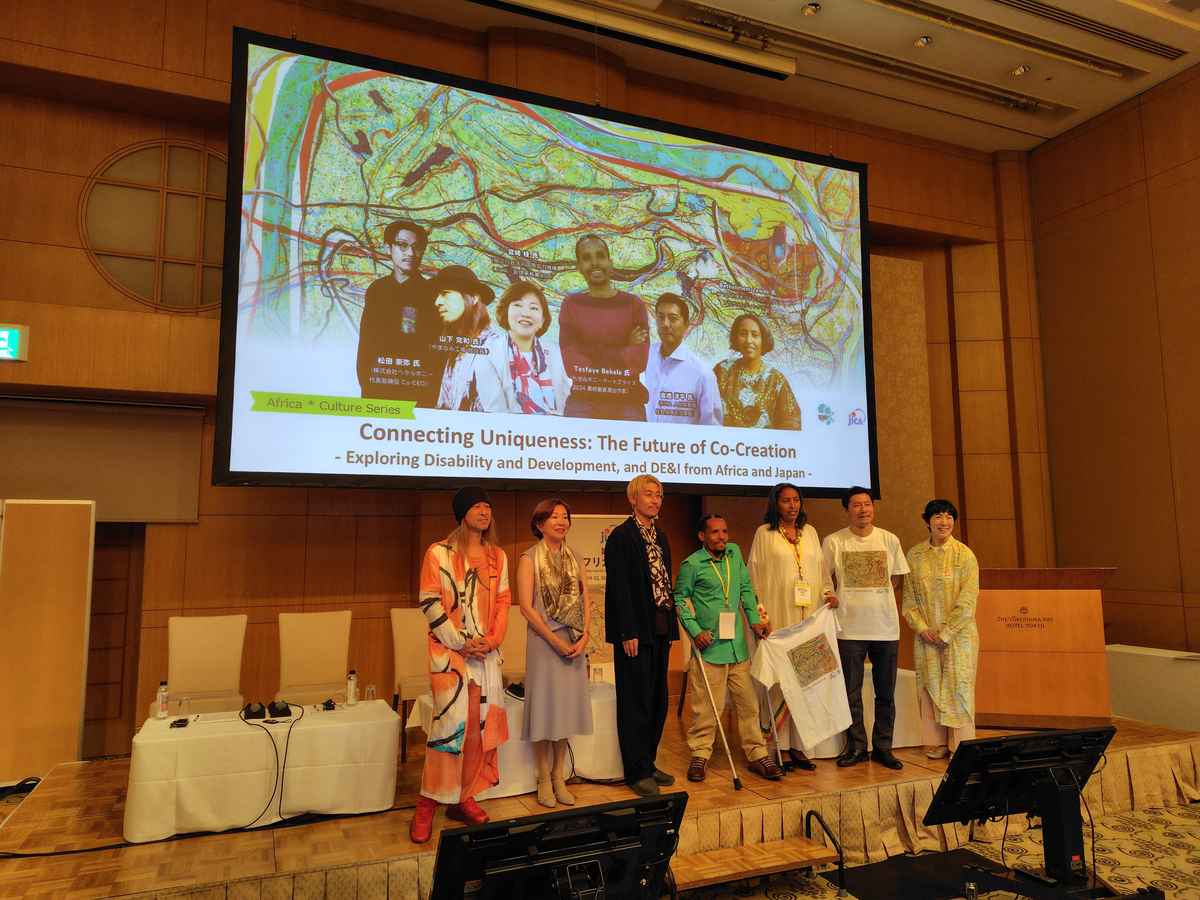
From left: Atelier Yamanami director Masato Yamashita, JICA Executive Senior Vice President Katsura Miyazaki, Heralbony Co. co-CEO Takaya Matsuda, Ethiopian artist Tesfaye Bekele, African Disability Forum program director Bethelehem Zewde and JICA social security team director Yohei Takahashi attend a TICAD 9 event in Yokohama on Tuesday.
17:23 JST, August 20, 2025
YOKOHAMA — An event exploring the challenges faced by people with disabilities in Africa and how art can enable social participation was held as part of the ongoing Ninth Tokyo International Conference on African Development (TICAD 9).
Titled “Connecting Uniqueness: The Future of Co-Creation — Exploring Disability and Development, and DE&I from Africa and Japan,” the event took place at The Yokohama Bay Hotel Tokyu on Tuesday. It was part of the Africa and Culture Series at TICAD 9.
These and other events sponsored by the Japan International Cooperation Agency (JICA) are being held at TICAD 9, which is running through Friday in Yokohama. The aim is to explore cooperation between Japan and African nations across a wide range of fields, including mineral development, refugee issues, agriculture, gender equality and AI.
Twin-track approach
Tuesday’s event was a panel discussion held in collaboration between JICA, the African Disability Forum (ADF) and Heralbony Co., a Morioka-based planning company that handles artworks by artists with disabilities.
Panelist Yohei Takahashi, director of the social security team in JICA’s human development department, spoke of the agency’s “twin-track approach” of conducting both disability-specific initiatives and disability mainstreaming initiatives (DMIs).
DMIs involve integrating the viewpoints and needs of those with disabilities across all development efforts, rather than disability being treated as a separate issue. Takahashi said implementing DMIs has not been easy for JICA in Africa, as it is not yet a mainstream approach.
Referring to data from the World Health Organization, ADF program director Bethelehem Zewde said that 16% of people globally and 240 million in Africa have some form of disability. The challenges these people face are not purely economic, she said, but also include a lack of access to services — such as in education — social attitudes and norms and inaccessibility in the built environment.
She said that personal, economic and social empowerment can come through art and culture for people with disabilities, and “there is a need to show the capacity of people with disabilities.”
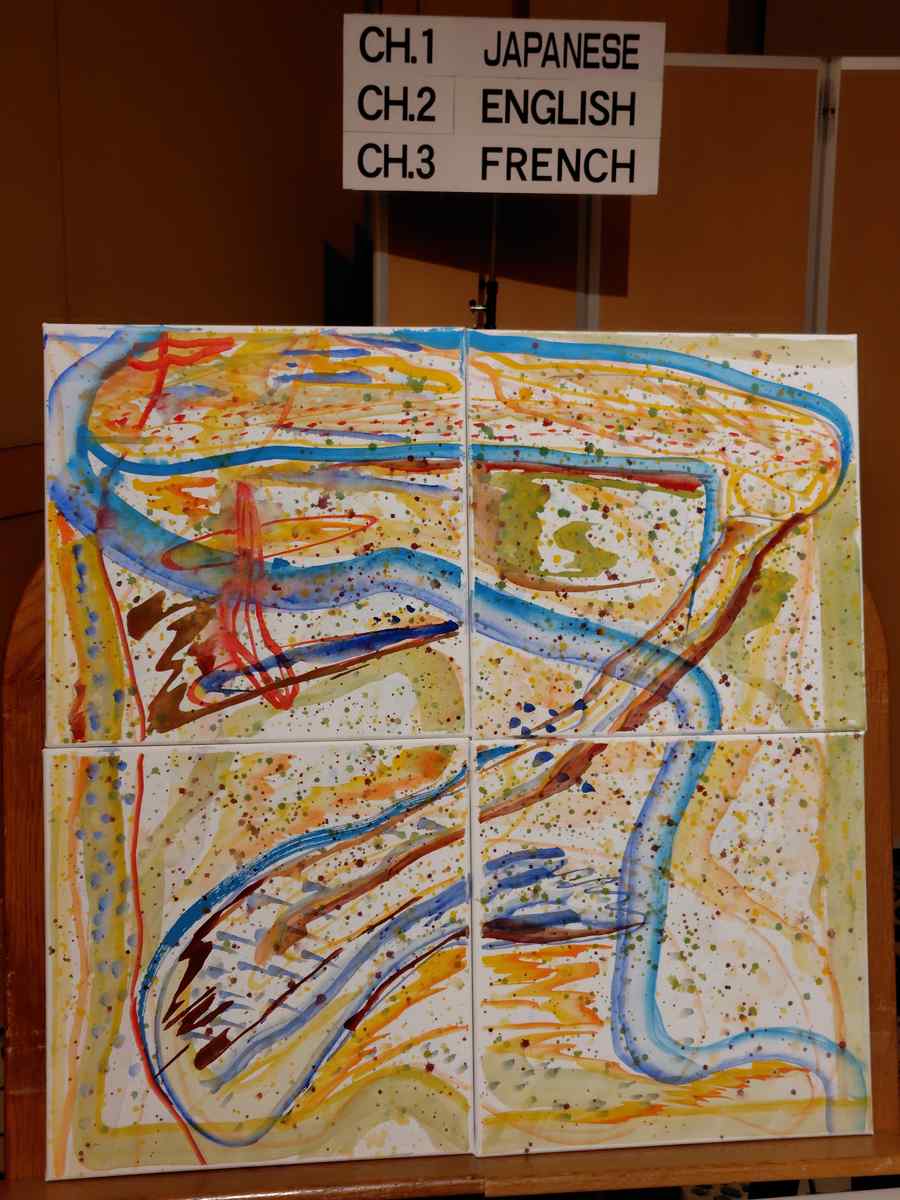
Artwork created on Monday by Tesfaye Bekele at Atelier Yamanami is displayed at TICAD 9 in Yokohama on Tuesday.
‘Art can act as a bridge’
Also on the panel was Tesfaye Bekele, an Ethiopian artist who obtained his master’s degree in fine art from Addis Ababa University in 2016 and is a teacher at the institution’s Alle School of Fine Arts and Design. He created “Balance of Movement,” the key visual for the JICA-sponsored TICAD events.
Tesfaye also created a work specifically for Tuesday’s event while visiting Atelier Yamanami the previous day, and a video was shown of his creative process. Standing on crutches and using a long brush, he used a variety of techniques to apply paints to canvases placed on the floor.
Located in Koka, Shiga Prefecture, Atelier Yamanami is a studio where about 90 artists are engaged in various creative activities. Many of these artists have physical or intellectual disabilities. The studio’s director, Masato Yamashita, was also on the panel.
When asked about how he became interested in art, Tesfaye said, “It transformed my self-expression” and that it encourages collaboration and co-creation. He added that as visual work, people can look at art and evaluate it on its own merits, without first seeing the artist’s disability. By seeing what people with disabilities are capable of, their perception in society may change. “Art can act as a bridge,” Tesfaye said.
Takaya Matsuda, co-CEO of Heralbony, agreed, saying, “People purchase the works because they like them, not because they’ve been created by people with disabilities.”
Both Tesfaye and Bethelehem spoke about how Monday’s visit to Atelier Yamanami had inspired them. For Bethelehem, it showed her what collaboration with the private sector could achieve in Africa. Tesfaye called the studio a “sanctuary” and said he would like to see the model implemented in Ethiopia. The two were set to visit Heralbony on Wednesday.






Most Read
Popular articles in the past 24 hours
-

Japan Figure Skating Legend Yuzuru Hanyu Is Proud Disaster Surviv...
-

Massive Sewer Pipe Found Jutting Out of Highway in Osaka
-

Japan-U.S. Summit Likely to Focus on Middle East; Takaichi to Fac...
-
Hawaii Museum on Tsunami Including Japan's 2011 Disaster at Risk ...
-

15 Years since Great East Japan Earthquake: How Can Affected Area...
-

Japan Holds Memorial Events to Mark 15th Anniversary of 2011 Eart...
-

Japan Train Company to Increase Fares, Including in Tokyo Metropo...
-

Parents in Japan to Get Instagram Notifications When Teens Repeat...
Popular articles in the past week
-

Ibaraki Pref.'s 1st Foreign Bus Driver Hired in Tsukuba
-

Nippon Life Insurance's U.S. Arm Sues OpenAI Over Legal Assistanc...
-
Japan Figure Skating Legend Yuzuru Hanyu Is Proud Disaster Surviv...
-

Govt to Utilize ODA for Ensuring Economic Security; Securing Ener...
-
Massive Sewer Pipe Found Jutting Out of Highway in Osaka
-

Amid Strait of Hormuz Blockade, Shipping Companies Scramble to Ge...
-

Beckoning Cats Get Makeover to Fit Modern Lifestyles with Sleek D...
-
Japan Govt Survey Finds Just 10% of Workers Want Working Hours to...
Popular articles in the past month
-

Producer Behind Pop Group XG Arrested for Cocaine Possession
-

Japan PM Takaichi’s Cabinet Resigns en Masse
-

Man Infected with Measles Reportedly Dined at Restaurant in Tokyo...
-

Videos Plagiarized, Reposted with False Subtitles Claiming ‘Ryuky...
-

iPS Treatments Pass Key Milestone, but Broader Applications Far f...
-

Sanae Takaichi Elected Prime Minister of Japan; Keeps All Cabinet...
-

Nepal Bus Crash Kills 19 People, Injures 25 Including One Japanes...
-

South Korea Tightens Rules on Foreigners Buying Homes in Seoul Me...
Top Articles in Society
-
Producer Behind Pop Group XG Arrested for Cocaine Possession
-
Man Infected with Measles Reportedly Dined at Restaurant in Tokyo Station
-

Bus Carrying 40 Passengers Catches Fire on Chuo Expressway; All Evacuate Safely
-
Ibaraki Pref.’s 1st Foreign Bus Driver Hired in Tsukuba
-

Tokyo Skytree’s Elevator Stops, Trapping 20 People; All Rescued (Update 1)
JN ACCESS RANKING
-
Producer Behind Pop Group XG Arrested for Cocaine Possession
-
Japan PM Takaichi’s Cabinet Resigns en Masse
-
Man Infected with Measles Reportedly Dined at Restaurant in Tokyo Station
-
Videos Plagiarized, Reposted with False Subtitles Claiming ‘Ryukyu Belongs to China’; Anti-China False Information Also Posted in Japan
-
iPS Treatments Pass Key Milestone, but Broader Applications Far from Guaranteed