
2 Nobel Prize Laureates Express Concern over Decline in Number of Science Papers by Japanese Researchers
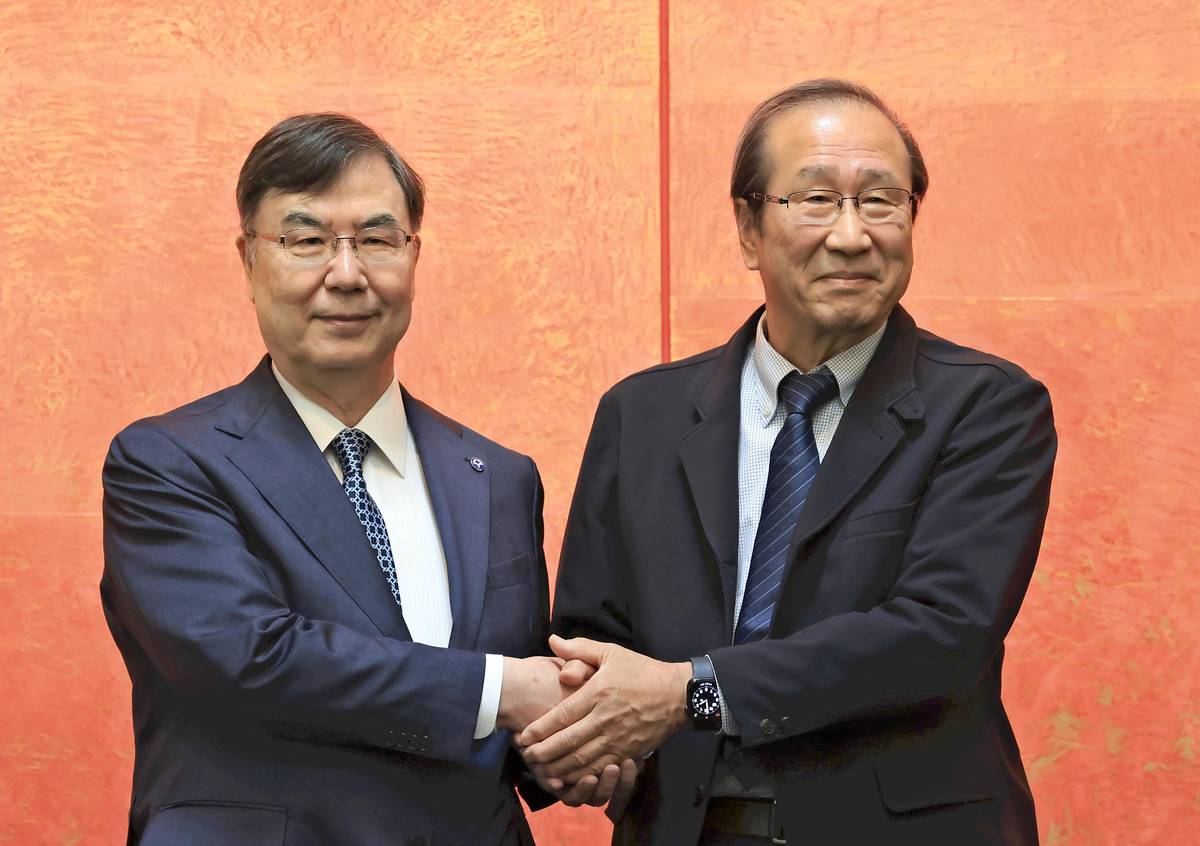
Nobel Prize laureates Shimon Sakaguchi, left, and Susumu Kitagawa shake hands after a talk event at Kyoto University in Kyoto on Monday.
2:00 JST, November 12, 2025
KYOTO — Shimon Sakaguchi and Susumu Kitagawa, the two Japanese scientists awarded the Nobel Prize this year, expressed concern over the decline in the number of science papers by Japanese scientists during a talk event at their alma mater, Kyoto University, on Monday.
Sakaguchi, 74, a specially appointed professor at the University of Osaka, won the Nobel Prize in Physiology or Medicine, and Kitagawa, 74, a distinguished professor at Kyoto University, won the Nobel Prize in Chemistry.
At the event, they also called for more support for scientists and increased research funds.
According to the National Institute of Science and Technology Policy of the Education, Culture, Sports, Science and Technology Ministry, Japan is lagging behind in the country rankings for highly cited papers in recent years.
“The number of researchers in young generations is shrinking,” Kitagawa said. “There’s a need for general support for them.”
Sakaguchi agreed and added that researchers today have less free time they can use for their research than in the past.
“There’re not enough core funding,” he said.
They both entered Kyoto University in 1970. Kitagawa majored in engineering, and Sakaguchi was a medicine major, so they had no contact with each other during their student days. As both of them happen to love reading, they happily discussed at the event what they read when they were students.
“Shortly after entering the university, I just looked for interesting books to read,” Kitagawa said. “I also took on a challenge to study languages such as Russian and French. I owe very much to books that made me able to think about various things. I hope young people will spend time reading.”
Sakaguchi said he, too, read books on various fields such as psychology and psychiatric medicine.
“There were times when I wondered whether I should become a clinician or a researcher. I eventually decided to become a researcher in immunology, which I found interesting after studying it on my own,” he said.


Related Tags
Most Read
Popular articles in the past 24 hours
-
Govt Urges Caution for Lightning Strikes, Tornadoes in Japan’s Ka...
-

Policy Measures on Foreign Nationals: How Should Stricter Regulat...
-

Milan's Historic Trams at Night as the City Gears up for the Wint...
-
Historic Kamakura Farmers’ Market Peddles Showa-Era Charm, Vibran...
-

Criminal Charges against Iwaki Shinkumi: Clarify Alleged Involvem...
-

Billie Eilish Wins Song of the Year at the 2026 Grammy Awards, Sh...
-

Tens of Thousands of Czechs Rally in Support of President Pavel o...
-

France's Capgemini to Sell Subsidiary Working with ICE during Ang...
Popular articles in the past week
-

Japan Institute to Use Domestic Commercial Optical Lattice Clock ...
-
North Korea Possibly Launches Ballistic Missile
-
Foreign Snowboarder in Serious Condition After Hanging in Midair ...
-
Australian Woman Dies After Mishap on Ski Lift in Nagano Prefectu...
-
Chinese Embassy in Japan Reiterates Call for Chinese People to Re...
-
Narita Airport, Startup in Japan Demonstrate Machine to Compress ...
-
Sakie Yokota, Last Surviving Parent of a North Korea Abductee, Ur...
-
Toyota Motor Group Firm to Sell Clean Energy Greenhouses for Stra...
Popular articles in the past month
-
Univ. in Japan, Tokyo-Based Startup to Develop Satellite for Disa...
-
JAL, ANA Cancel Flights During 3-day Holiday Weekend due to Blizz...
-
China Confirmed to Be Operating Drilling Vessel Near Japan-China ...
-

China Eyes Rare Earth Foothold in Malaysia to Maintain Dominance,...
-
M6.2 Earthquake Hits Japan's Tottori, Shimane Prefectures; No Tsu...
-
Japan, Qatar Ministers Agree on Need for Stable Energy Supplies; ...
-
Japan Institute to Use Domestic Commercial Optical Lattice Clock ...
-
Japan, Italy to Boost LNG Cooperation; Aimed at Diversifying Japa...
Top Articles in Science & Nature
-
Univ. in Japan, Tokyo-Based Startup to Develop Satellite for Disaster Prevention Measures, Bears
-
Japan Institute to Use Domestic Commercial Optical Lattice Clock to Set Japan Standard Time
-
Space Mission Demonstrates Importance of International Cooperation, Astronaut Kimiya Yui Says
-
Tsunami Can Travel Vast Distances Before Striking, Warn Japanese Researchers
-
Japan to Face Shortfall of 3.39 Million Workers in AI, Robotics in 2040; Clerical Workers Seen to Be in Surplus
JN ACCESS RANKING
-
Univ. in Japan, Tokyo-Based Startup to Develop Satellite for Disaster Prevention Measures, Bears
-
JAL, ANA Cancel Flights During 3-day Holiday Weekend due to Blizzard
-
China Confirmed to Be Operating Drilling Vessel Near Japan-China Median Line
-
China Eyes Rare Earth Foothold in Malaysia to Maintain Dominance, Counter Japan, U.S.
-
M6.2 Earthquake Hits Japan’s Tottori, Shimane Prefectures; No Tsunami Threat (Update 4)