
Cabinet OK’s Bills Aimed at Expanding Lifespan of Nuclear Reactors Beyond 60 Years
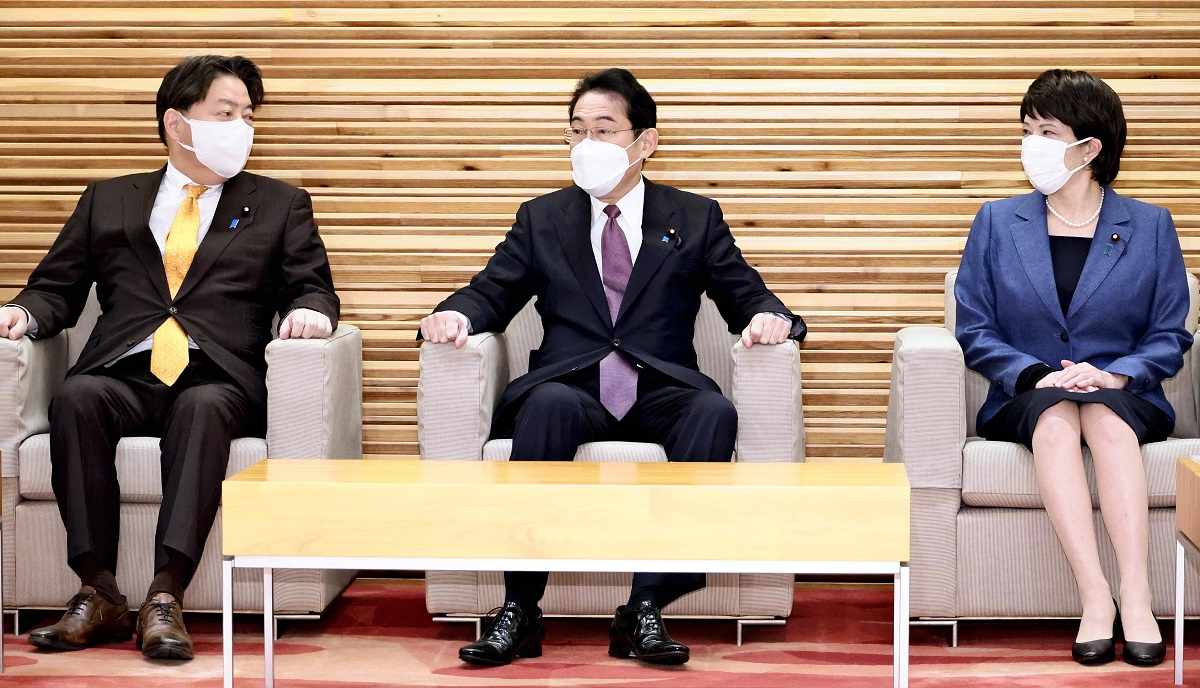
Prime Minister Fumio Kishida, center, attends a Cabinet meeting on Tuesday morning.
16:39 JST, February 28, 2023
The Cabinet agreed on a package of bills Tuesday to allow nuclear reactors to operate beyond their current 60-year limit, marking a major shift in government policy since the 2011 nuclear accident in Fukushima Prefecture.
The government aims to pass the bills in the current Diet session.
The package of bills will revise five laws: the Atomic Energy Basic Law; the Electricity Business Law; a law on the regulation of nuclear reactors; a law regarding the reprocessing of spent nuclear fuel; and a special measures law on renewable energy.
The Cabinet decision was based on the government’s green transformation policy, which focuses on measures for decarbonization.
The bills are aimed at extending the lifespan of reactors, making it possible for reactors more than 60 years old to continue operating by excluding from their total operation terms, offline periods for safety inspections by the Nuclear Regulation Authority and suspension orders by courts, among other circumstances.
Under existing rules, the current lifespan of a reactor is 40 years in principle, but they can be operational for a maximum of 60 years.
The government hopes to strike a balance between safety and electricity supply stability by extending the lifespan of reactors beyond 60 years under the Electricity Business Law.
The government plans to establish a new regulation that will require electricity firms to obtain safety approval from the NRA every 10 years for reactors that have been operational for at least 30 years.
The firms will have to conduct strict safety checks on the reactors based on their age, evaluate damage and review operational systems.
One of the law revisions will make reactor decommissioning the remit of the Nuclear Reprocessing Organization of Japan, which deals with Japan’s nuclear fuel cycle projects. The revision is also aimed at requiring electricity firms and other entities to cover the costs of decommissioning work.
The government also plans to create a new system to secure funds for improving and expanding utility power grids.
The Cabinet had been scheduled to agree on the package of bills on Feb. 21 but the decision was postponed following opposition to the extension by one out of five NRA members at a meeting on Feb. 13.







Most Read
Popular articles in the past 24 hours
-

‘Dry Bonsai’ Gives New Life to Withered Trees, Allows Free Artist...
-

McDonald's Japan Raises Prices; Big Mac to Cost ¥500, Double Chee...
-

Nepal Bus Crash Kills 19 People, Injures 25 Including One Japanes...
-

Japan’s Nikkei Stock Average Rises as AI-Related Stocks Shine; Co...
-

Aggression against Ukraine: Malignant Precedent Must Not Be Set t...
-

Joruri Bunraku Narrative Performed in Honor of Donald Keene by La...
-

Astellas Collaborates with Vir to Develop Its Experimental Prosta...
-

Early-Blooming Kawazu Cherry Blossoms Create Sea of Pink at Park ...
Popular articles in the past week
-

Producer Behind Pop Group XG Arrested for Cocaine Possession
-

Japan PM Takaichi’s Cabinet Resigns en Masse
-

Sanae Takaichi Elected Prime Minister of Japan; Keeps All Cabinet...
-

Japan's Govt to Submit Road Map for Growth Strategy in March, PM ...
-

Bus Carrying 40 Passengers Catches Fire on Chuo Expressway; All E...
-

Japan, U.S. Name 3 Inaugural Investment Projects; Reached Agreeme...
-

Riku-Ryu Pair Wins Gold Medal: Their Strong Bond Leads to Major C...
-

Tokyo Skytree's Elevator Stops, Trapping 20 People; All Rescued (...
Popular articles in the past month
-
Producer Behind Pop Group XG Arrested for Cocaine Possession
-
Japan PM Takaichi’s Cabinet Resigns en Masse
-

Japan Institute to Use Domestic Commercial Optical Lattice Clock ...
-

Man Infected with Measles Reportedly Dined at Restaurant in Tokyo...
-

Israeli Ambassador to Japan Speaks about Japan’s Role in the Reco...
-

Videos Plagiarized, Reposted with False Subtitles Claiming ‘Ryuky...
-

Man Infected with Measles May Have Come in Contact with Many Peop...
-

Prudential Life Insurance Plans to Fully Compensate for Damages C...
Top Articles in Politics
-
Japan PM Takaichi’s Cabinet Resigns en Masse
-
Sanae Takaichi Elected Prime Minister of Japan; Keeps All Cabinet Appointees from Previous Term
-
Japan’s Govt to Submit Road Map for Growth Strategy in March, PM Takaichi to Announce in Upcoming Policy Speech
-

LDP Wins Historic Landslide Victory
-

LDP Wins Landslide Victory, Secures Single-party Majority; Ruling Coalition with JIP Poised to Secure Over 300 seats (UPDATE 1)
JN ACCESS RANKING
-
Producer Behind Pop Group XG Arrested for Cocaine Possession
-
Japan PM Takaichi’s Cabinet Resigns en Masse
-
Japan Institute to Use Domestic Commercial Optical Lattice Clock to Set Japan Standard Time
-
Man Infected with Measles Reportedly Dined at Restaurant in Tokyo Station
-
Israeli Ambassador to Japan Speaks about Japan’s Role in the Reconstruction of Gaza