
Prevent Accidents When Removing Snow from Roofs; Always Use Proper Gear and Follow Safety Precautions
17:37 JST, January 27, 2026
As it gets colder, accidental falls while removing snow from rooftops become more common in snowy regions. It is crucial for people who do this job to take safety measures, such as wearing a safety line and not working alone. Icicles hanging from eaves and snow sliding off roofs can also cause injury.
***
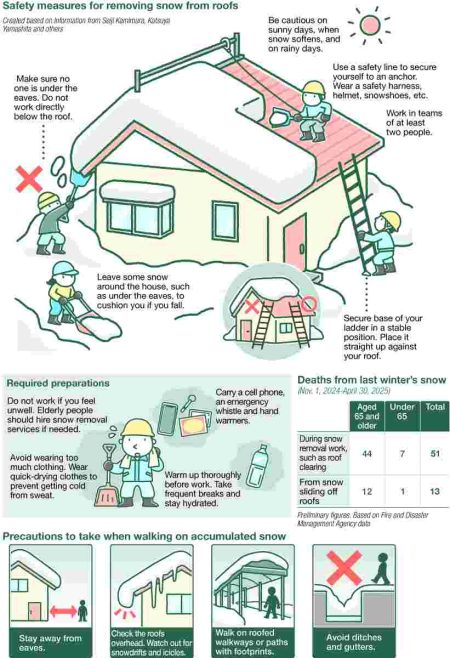
According to the Fire and Disaster Management Agency, 68 people died from snow-related causes last winter. Of these, 51, or three-quarters, died due to accidents associated with snow removal work, such as clearing snow from roofs. Nearly 90% of those who died were aged 65 or older.
Prof. Seiji Kamimura, a snow and ice engineering specialist at Nagaoka University of Technology, stated: “Clearing snow from high roofs is dangerous due to the risk of falling. Before you do it, you should consider whether it’s really necessary.”
Each region has its own standards for the amount of snow that residential buildings must be able to withstand. If snowfall does not reach that level for the area where a home is located, it does not need to be removed.
When unexpectedly heavy snow necessitates clearing one’s roof, Kamimura recommends not doing it on a sunny day — when snow softens easily — or a rainy day — when it becomes slippery. He recommends doing the job at a time when temperatures are low, such as early in the morning, and working in teams of two or more people.
The hard work of moving snow off of a roof will cause you to sweat a lot, so it is best to wear clothes that are easy to put on and take off. To keep the sweat from making you cold, prepare moisture-wicking, quick-drying inner layers and highly waterproof clothing such as a windbreaker. It is also a good idea to wear a helmet and safety harness.
Another essential piece of equipment is an anchor, installed near the center of your roof, to which you can secure a safety line. Some municipalities offer subsidies for installing one of these on your house. Once you are on the roof, connect your safety harness to the anchor using a sturdy rope.
In addition, do not stand directly below the eaves when removing snow from a roof with a long pole or similar tool, because a large amount of snow could suddenly slide off and fall on you.
Stay away from eaves
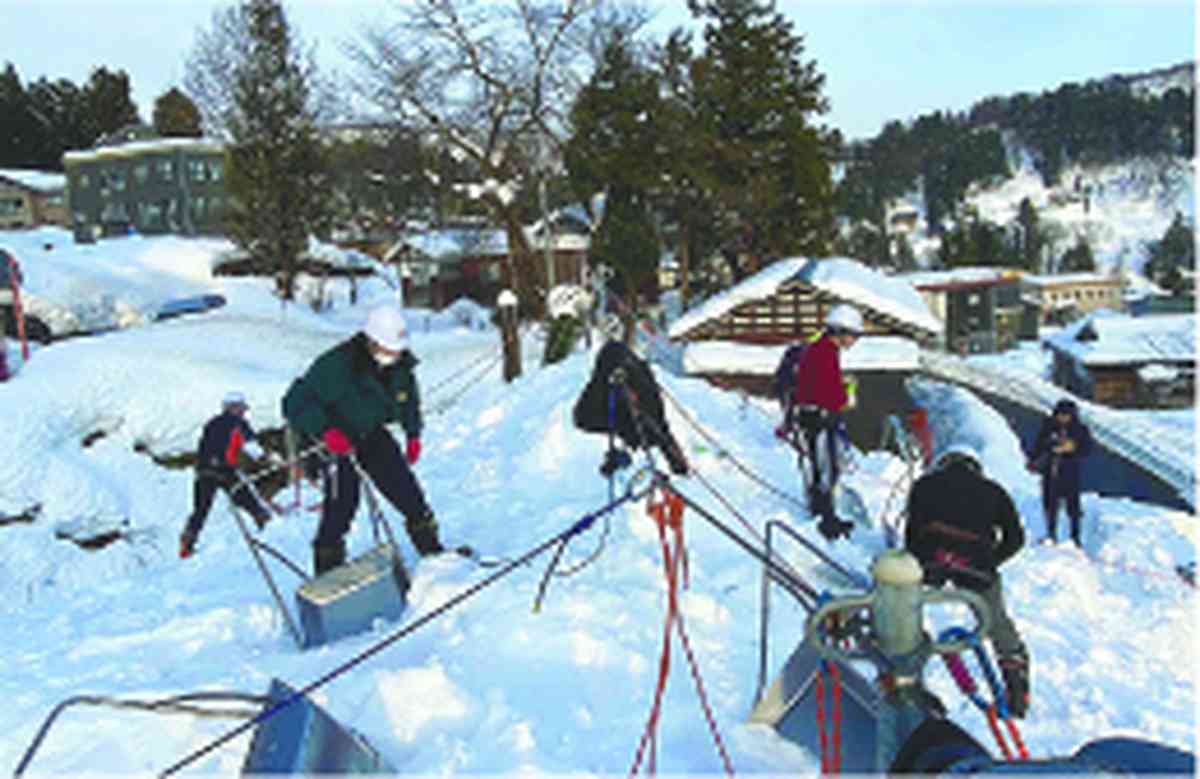
Local residents and volunteers with safety lines secured to an anchor remove snow from the roof of a house in Nagaoka, Niigata Prefecture, in Feb. 2023.
The roof is not the only dangerous spot during snow removal. Another is any place where heavy snow that has been removed from the roof has accumulated under the eaves. Falling into snow deeper than your height can put you in mortal danger.
Katsuya Yamashita, chief researcher at the National Research Institute for Earth Science and Disaster Resilience’s Snow and Ice Research Center, stressed: “You should remember that if you become completely buried in snow, you won’t be able to free yourself.” If you are unable to move and call for help, you may suffocate or succumb to hypothermia.
During snow removal, carry a smartphone or emergency whistle to be able to call for help. Also make sure to tell family members or neighbors what you are going to do before starting.
You should also be careful when walking around your home. Wear anti-slip rain boots and walk in places where you can see footprints. If accumulated snow makes it impossible to see a clear path ahead of you, you should probe your way forward with a stick or some other item.
Also, watch out for chunks of snow falling from roofs. Being struck in the head or body by compacted snow can cause fractures and other serious injuries.
Look up at the roof to make sure that there are no icicles or masses of snow protruding from the eaves. Snow falling from a three-meter-high can hit you even when you are three or four meters away. Yamashita advises: “Do not approach dangerous eaves. Walk at a safe distance from them.”
***
Portable Power Stations Are Important Source for Electricity in Disasters, Making Them Integral to Preparations
17:37 JST, January 27, 2026
In case of a prolonged power outage resulting from an earthquake or other disaster, it becomes impossible to use electric appliances and smartphones, causing great inconvenience to our daily lives.
Takamasa Wada, an adviser on disaster crisis management, urges people to regard a source of electricity as the “third stockpile material,” meaning that having a power source is an important part of disaster preparedness, next to water and food.
Having a portable power station incurs costs. However, it is recommended to keep at least one and, if possible, it is advisable to have two or more that can be charged with electrical outlets for household use with a capacity of over 1,000 watts per hour and that are easy to carry. The power stations allow users to secure electricity for several days until power is restored, although their duration will depend on how they are used.
Portable power stations can be used not only to charge smartphones, but also to power rice cookers, microwaves, cookware, lighting equipment such as desk lamps, electric fans and electric blankets.
Prior to using one, make sure to check how much electricity is used by the electric appliances in your home. It is also advisable to test it and get accustomed to how to use it beforehand.
A foldable solar panel can charge electricity using the power of the sun, increasing the sense of security. According to a major solar panel maker, a portable power station can be efficiently charged by connecting it via a cable to a foldable solar panel that is placed on the ground at an angle of 30 degrees to 45 degrees during daylight hours between 10 a.m. and 2 p.m.
It is also recommended to have multiple portable battery chargers, which can be used while traveling.





Most Read
Popular articles in the past 24 hours
-
Hawaii Museum on Tsunami Including Japan's 2011 Disaster at Risk ...
-

Japan Train Company to Increase Fares, Including in Tokyo Metropo...
-

Tail of ANA Plane Struck Runway During Landing in Houston; No Inj...
-

Japan Govt to Tighten Requirements to Receive Permanent Residency...
-

Samurai Japan Holds First Practice in Miami; Team Will Play again...
-

Iran Targets Busiest International Airport as Top UN Body Demands...
-

Japan to Face Venezuela in World Baseball Classic Quarterfinals
-

Medical Care at Home and Disasters: Ensure Systems to Provide Con...
Popular articles in the past week
-

Japan Figure Skating Legend Yuzuru Hanyu Is Proud Disaster Surviv...
-

Nippon Life Insurance's U.S. Arm Sues OpenAI Over Legal Assistanc...
-

Ibaraki Pref.'s 1st Foreign Bus Driver Hired in Tsukuba
-
Govt to Utilize ODA for Ensuring Economic Security; Securing Ener...
-
Massive Sewer Pipe Found Jutting Out of Highway in Osaka
-

Amid Strait of Hormuz Blockade, Shipping Companies Scramble to Ge...
-

Beckoning Cats Get Makeover to Fit Modern Lifestyles with Sleek D...
-
Japan Govt Survey Finds Just 10% of Workers Want Working Hours to...
Popular articles in the past month
-

Producer Behind Pop Group XG Arrested for Cocaine Possession
-

Japan PM Takaichi’s Cabinet Resigns en Masse
-

Man Infected with Measles Reportedly Dined at Restaurant in Tokyo...
-

Videos Plagiarized, Reposted with False Subtitles Claiming ‘Ryuky...
-

iPS Treatments Pass Key Milestone, but Broader Applications Far f...
-

Sanae Takaichi Elected Prime Minister of Japan; Keeps All Cabinet...
-
Japan Figure Skating Legend Yuzuru Hanyu Is Proud Disaster Surviv...
-

Nepal Bus Crash Kills 19 People, Injures 25 Including One Japanes...
Top Articles in JN Specialities
-

Step Back in Time at Historical Estate Renovated into a Commercial Complex in Tokyo
-

The Japan News / Weekly Edition (2/20-2/26)
-
‘World’s Oldest Bio-Business’ Is Japan’s Seed Koji Retailing, Mold Used to Make Fermented Products like Sake, Miso, Soy Sauce
-
Donald Keene’s Drinking Buddy and Translator Yukio Kakuchi Pays Tribute to Japanologist’s Lifelong Work
-
“The Tale of Genji” Back-Translation Project Led to Touching Encounter with Keene; Poet Sisters Recount Memories of Scholar at Packed Talk Event in Tokyo
JN ACCESS RANKING
-
Producer Behind Pop Group XG Arrested for Cocaine Possession
-
Japan PM Takaichi’s Cabinet Resigns en Masse
-
Man Infected with Measles Reportedly Dined at Restaurant in Tokyo Station
-
Videos Plagiarized, Reposted with False Subtitles Claiming ‘Ryukyu Belongs to China’; Anti-China False Information Also Posted in Japan
-
iPS Treatments Pass Key Milestone, but Broader Applications Far from Guaranteed