
15:50 JST, August 28, 2025
Britain, France and Germany plan to jointly notify the United Nations Security Council on Thursday morning that Iran is in “significant” violation of the 2015 nuclear deal and that they will reinstate international sanctions that were suspended as part of that agreement.
The “snapback” provisions of the deal would automatically go into effect after 30 days, restoring a wide array of measures, including a conventional arms embargo, restrictions on ballistic missile production, asset freezes and visa bans.
The decision, according to several European officials who discussed the volatile situation on the condition of anonymity, comes after years of threats and weeks of unsuccessful negotiations between the three European countries and Tehran. Britain, France and Germany – along with the United States, European Union, Russia and China – were all part of the original 2015 agreement, from which President Donald Trump withdrew during his first term in office.
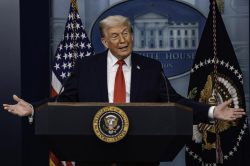
Trump has employed a policy of “maximum pressure” U.S. sanctions against Iran and in June followed Israeli attacks on Iranian nuclear sites and scientists with a massive bombing campaign designed to destroy the three main facilities at the heart of the Islamic Republic’s nuclear program.
The brief summer conflict interrupted what had been halting talks between Washington and Tehran in pursuit of what Trump called a “better deal” to contain a program of uranium enrichment to bomb-grade levels.
Trump claimed to have “obliterated” Iran’s nuclear facilities, although U.S. intelligence and the International Atomic Energy Agency have said that although severe damage was done to the program, it is not yet clear what has become of Iran’s stockpile of highly-enriched uranium and the capacity to produce more.
During their own negotiations, the Europeans set an end-of-August deadline for Iran to make tangible progress in talks with the United States on what remains of its nuclear program, including an accounting of the status of the nearly 900 pounds of highly-enriched uranium the IAEA says it had produced, and the return of IAEA inspectors who were withdrawn during the bombing.
The 2015 agreement stipulated, among other things, that Iran could produce only low-level enriched uranium for civil purposes and restricted the number and sophistication of centrifuges it could have – all of which Tehran has far exceeded. Iran charges that the Europeans have violated the agreement.
The snapback deadline was keyed to the Oct. 18 expiration of the sanctions provision in the 2015 nuclear agreement, known as the Joint Comprehensive Plan of Action, or JCPOA. The intent of the Europeans is to trigger the 30-day countdown before Russia takes over from South Korea as the rotating chairman of the Security Council on Oct. 1.
Following a call Wednesday between Secretary of State Marco Rubio and the three European foreign ministers, the State Department said in a statement that “all reiterated their commitment to ensuring that Iran never develops or obtains a nuclear weapon.”
Russia, an Iranian ally, said this week that if snapback was notified, it would introduce a council resolution extending the provisions of the nuclear deal, although the U.S., Britain and France probably would – as veto-wielding members – prevent its passage.
Iran has threatened to withdraw from the nuclear Non-Proliferation Treaty, which among other things mandates nuclear safeguards and IAEA inspections.
Iranian Foreign Minister Abbas Araghchi said in an interview published Wednesday by the Saudi newspaper Asharq Al-Awsat that Iran was prepared to enter “fair and balanced” negotiations with the U.S. over its nuclear program “provided they will reassure us there will be no military aggression during the talks.”
“If they come to the table for fair negotiations built on mutual interests, that serves both sides,” Araghchi said. “But if they believe they can achieve through negotiations what they failed to achieve through military strikes, then such talks will not happen.”
IAEA Director General Rafael Grossi said Wednesday that he believed it was still possible to resume the U.S.-Iran dialogue. On a visit to Washington, where he met with Rubio, special presidential envoy Steve Witkoff and Energy Secretary Chris Wright, Grossi told reporters, “I sense that they are open to that, of course provided that this is meaningful and … leads to concrete agreements, direct contacts.”
Trump, who has reveled in the success of the U.S. bombings and called himself a “war hero,” has shown no interest in further negotiations. But Grossi said, “President Trump himself has been very open to meet with any other leader in the world, even with those with which, you know, he may have differences.”
During their talks earlier this year, shepherded by Oman, Iran refused meetings beyond more than a handshake with Witkoff, the U.S. negotiator. Direct discussions were held at a lower level.
Grossi said a team of IAEA inspectors has returned to Iran and on Wednesday visited the Bushehr nuclear power reactor. He said negotiations were underway about returning to mandated inspection and verification of nuclear activities remaining at the three sites – Fordow, Isfahan and Natanz – that were the main production and storage areas for highly-enriched uranium and centrifuges before the U.S. bombing.
Much of the discussion, Grossi said, was over whether the bombed facilities were accessible. But that, he said, was a decision for the inspectors to make after on-site visits. “Let us be the judge,” he said.
Asked about reports that Iran may have moved large quantities of highly-enriched uranium to an undisclosed location before the airstrikes, Grossi said, “We do not see or believe that there has been any major movement of material.”





Most Read
Popular articles in the past 24 hours
-

Not Ready for Robots in Homes? The Maker of a Friendly New Humano...
-

Astronomers Unveil Map of Dark Matter’s Distribution
-
New York, New Jersey Sue Trump Administration over Tunnel Funding...
-

90-Year-Old Mother of Abductee Laments Lack of Progress
-
UK Police Open Criminal Investigation into Politician Peter Mande...
-

Son of Norway's Crown Princess Denies Rape Charges as Trial Begin...
-
Trump Accused of Distorting History of Mexican-American War to Ju...
-
Trump Signs Bill to End Partial Government Shutdown, Setting Stag...
Popular articles in the past week
-
Australian Woman Dies After Mishap on Ski Lift in Nagano Prefectu...
-
Foreign Snowboarder in Serious Condition After Hanging in Midair ...
-
Chinese Embassy in Japan Reiterates Call for Chinese People to Re...
-
Narita Airport, Startup in Japan Demonstrate Machine to Compress ...
-

Toyota Motor Group Firm to Sell Clean Energy Greenhouses for Stra...
-

Sakie Yokota, Last Surviving Parent of a North Korea Abductee, Ur...
-

Beer Yeast Helps Save Labor, Water Use in Growing Rice; Govt Hope...
-
Japan Tourism Agency Calls for Strengthening Measures Against Ove...
Popular articles in the past month
-
Univ. in Japan, Tokyo-Based Startup to Develop Satellite for Disa...
-
JAL, ANA Cancel Flights During 3-day Holiday Weekend due to Blizz...
-
China Confirmed to Be Operating Drilling Vessel Near Japan-China ...
-
China Eyes Rare Earth Foothold in Malaysia to Maintain Dominance,...
-

Japan Institute to Use Domestic Commercial Optical Lattice Clock ...
-
M6.2 Earthquake Hits Japan's Tottori, Shimane Prefectures; No Tsu...
-
Japan, Qatar Ministers Agree on Need for Stable Energy Supplies; ...
-
Japan, Italy to Boost LNG Cooperation; Aimed at Diversifying Japa...
Top Articles in News Services
-

Prudential Life Expected to Face Inspection over Fraud
-
Arctic Sees Unprecedented Heat as Climate Impacts Cascade
-

South Korea Prosecutor Seeks Death Penalty for Ex-President Yoon over Martial Law (Update)
-
Trump Names Former Federal Reserve Governor Warsh as the Next Fed Chair, Replacing Powell
-
Suzuki Overtakes Nissan as Japan’s Third‑Largest Automaker in 2025
JN ACCESS RANKING
-
Univ. in Japan, Tokyo-Based Startup to Develop Satellite for Disaster Prevention Measures, Bears
-
JAL, ANA Cancel Flights During 3-day Holiday Weekend due to Blizzard
-
China Confirmed to Be Operating Drilling Vessel Near Japan-China Median Line
-
China Eyes Rare Earth Foothold in Malaysia to Maintain Dominance, Counter Japan, U.S.
-
Japan Institute to Use Domestic Commercial Optical Lattice Clock to Set Japan Standard Time