
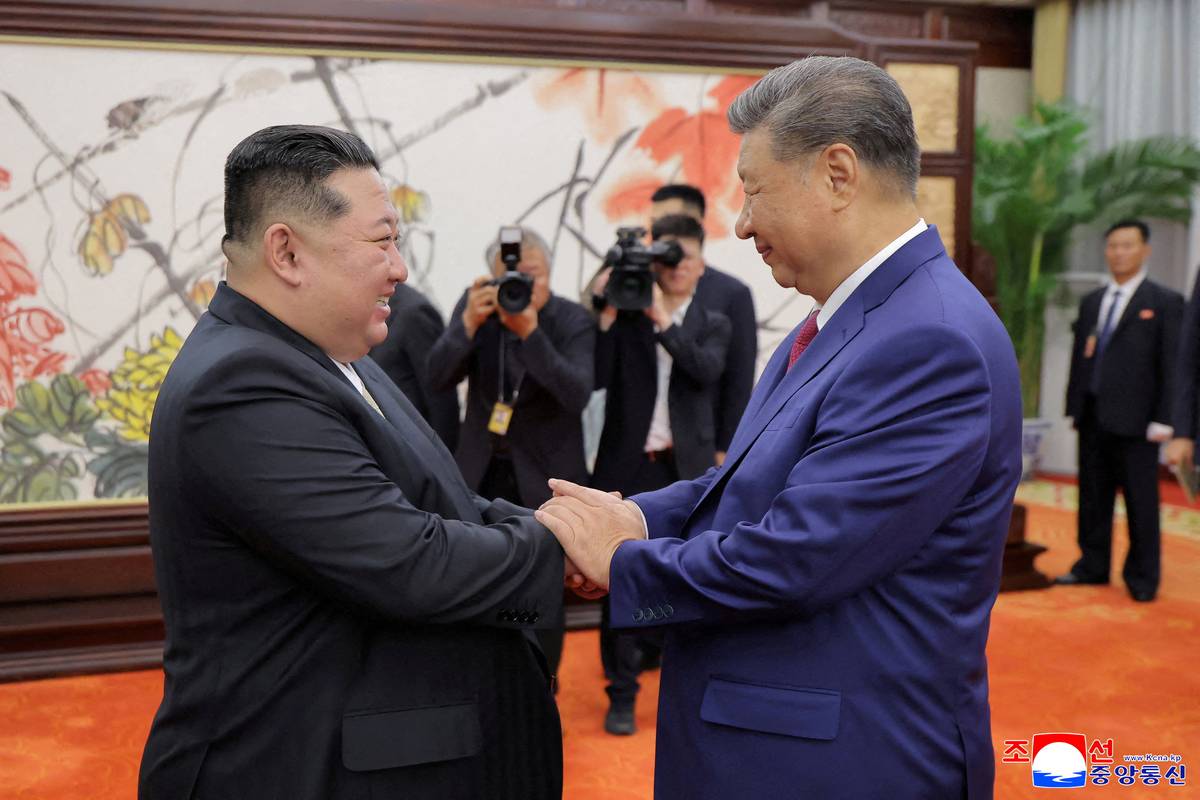
North Korean leader Kim Jong Un and Chinese President Xi Jinping shake hands on the day of their bilateral summit in Beijing, China, September 4, 2025, in this picture released by North Korea’s official Korean Central News Agency.
14:35 JST, March 12, 2026
BEIJING, March 11 (Reuters) – The first passenger train service between China and North Korea after a six-year hiatus is scheduled to set off from Beijing on Thursday, part of a series of moves by China to shore up cross-border infrastructure and rebuild bilateral ties.
Following a 24 hour and 41 minute journey skirting north of the Bohai Sea and a stopover in China’s northeastern border city of Dandong, train K27 from Beijing is scheduled to arrive in Pyongyang at 6:07 p.m. (0907 GMT) on Friday, according to a Tuesday notice from China’s railway authority. China and North Korea are “friendly neighbours” and a cross-border passenger train service facilitates people-to-people exchanges between the two, China’s foreign ministry spokesperson told reporters on Wednesday.
China also supports the strengthening of communication between authorities on both sides to create more convenient conditions for bilateral personnel exchanges, the spokesperson added.
The train service was suspended when the COVID-19 pandemic broke out in 2020.
The Beijing-Pyongyang route will operate four days a week, in both directions, on Monday, Wednesday, Thursday and Saturday, according to a notice by China’s railway authority. The Dandong-Pyongyang route will operate daily in both directions. The tickets, restricted to business visa holders, were sold out for Thursday’s trip, but those for March 18 were still available, a Beijing travel agency said.
State-run news agency Xinhua said on Tuesday that the route aimed to facilitate cross-border travel, economic and trade cooperation and cultural exchanges.
North Korea is largely closed to foreign tourism, with limited exceptions largely for Russian tour groups under restricted arrangements, according to travel agencies organising trips to the country.






Most Read
Popular articles in the past 24 hours
-

Japan Figure Skating Legend Yuzuru Hanyu Is Proud Disaster Surviv...
-

Japan-U.S. Summit Likely to Focus on Middle East; Takaichi to Fac...
-
Hawaii Museum on Tsunami Including Japan's 2011 Disaster at Risk ...
-

15 Years since Great East Japan Earthquake: How Can Affected Area...
-

Japan Train Company to Increase Fares, Including in Tokyo Metropo...
-
Japan Holds Memorial Events to Mark 15th Anniversary of 2011 Eart...
-

Japan’s Mitsui O.S.K. Lines Container Ship Anchored in Persian Gu...
-

Struggling Onosato Pulls out of Spring Tourney
Popular articles in the past week
-

Ibaraki Pref.'s 1st Foreign Bus Driver Hired in Tsukuba
-
Japan Figure Skating Legend Yuzuru Hanyu Is Proud Disaster Surviv...
-

Nippon Life Insurance's U.S. Arm Sues OpenAI Over Legal Assistanc...
-
Govt to Utilize ODA for Ensuring Economic Security; Securing Ener...
-
Massive Sewer Pipe Found Jutting Out of Highway in Osaka
-
Amid Strait of Hormuz Blockade, Shipping Companies Scramble to Ge...
-

Beckoning Cats Get Makeover to Fit Modern Lifestyles with Sleek D...
-
Japan Govt Survey Finds Just 10% of Workers Want Working Hours to...
Popular articles in the past month
-

Producer Behind Pop Group XG Arrested for Cocaine Possession
-

Japan PM Takaichi’s Cabinet Resigns en Masse
-

Man Infected with Measles Reportedly Dined at Restaurant in Tokyo...
-

Videos Plagiarized, Reposted with False Subtitles Claiming ‘Ryuky...
-

iPS Treatments Pass Key Milestone, but Broader Applications Far f...
-

Sanae Takaichi Elected Prime Minister of Japan; Keeps All Cabinet...
-

Nepal Bus Crash Kills 19 People, Injures 25 Including One Japanes...
-

South Korea Tightens Rules on Foreigners Buying Homes in Seoul Me...
Top Articles in News Services
-
Survey Shows False Election Info Perceived as True
-

Japan’s Nikkei Stock Average Falls as US-Iran Tensions Unsettle Investors (UPDATE 1)
-
Japan’s Nikkei Stock Average Rises on Tech Rally and Takaichi’s Spending Hopes (UPDATE 1)
-
Japan to Ban Use of Power Banks on Airplanes
-

North Korea Unveils Image of Kim Jong Un’s Teenage Daughter Firing Rifle
JN ACCESS RANKING
-
Producer Behind Pop Group XG Arrested for Cocaine Possession
-
Japan PM Takaichi’s Cabinet Resigns en Masse
-
Man Infected with Measles Reportedly Dined at Restaurant in Tokyo Station
-
Videos Plagiarized, Reposted with False Subtitles Claiming ‘Ryukyu Belongs to China’; Anti-China False Information Also Posted in Japan
-
iPS Treatments Pass Key Milestone, but Broader Applications Far from Guaranteed