To use this site, please disable the ad blocking feature and reload the page.
This website uses cookies to collect information about your visit for purposes such as showing you personalized ads and content, and analyzing our website traffic. By clicking “Accept all,” you will allow the use of these cookies.
Users accessing this site from EEA countries and UK are unable to view this site without your consent. We apologize for any inconvenience caused.
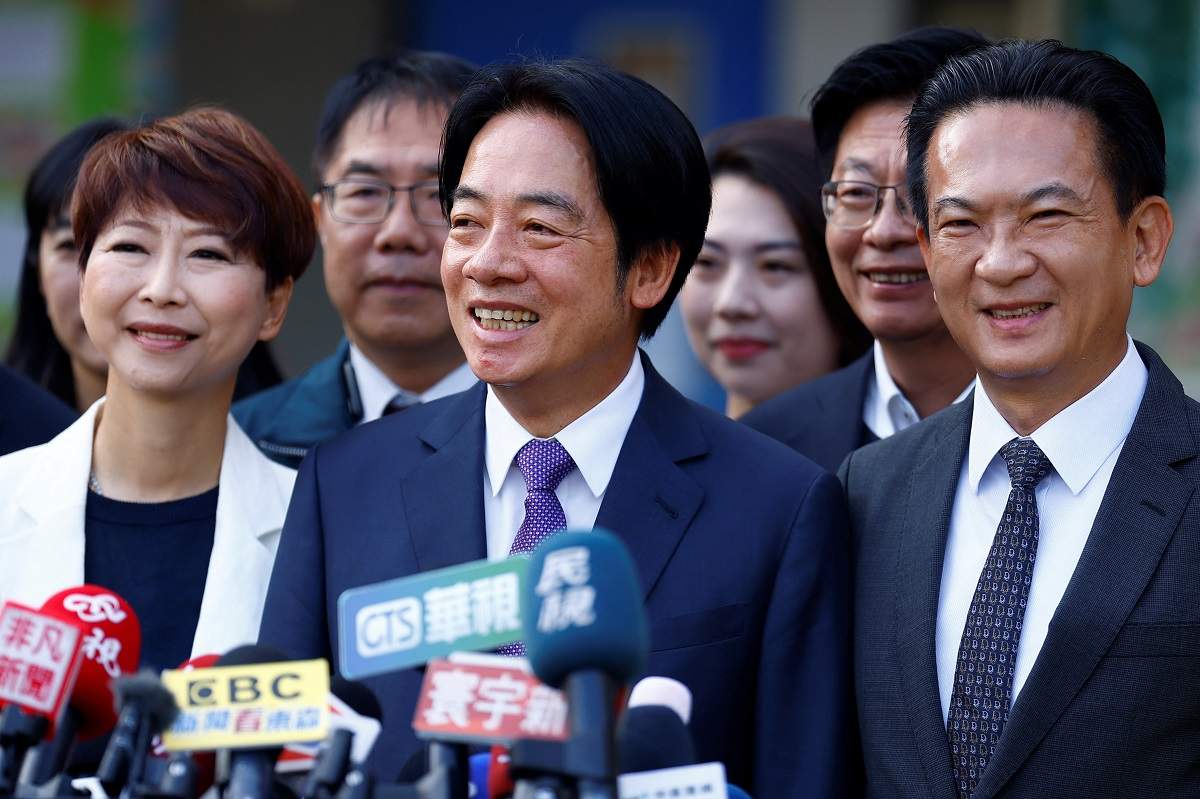
Reuters Lai Ching-te, center, Taiwan’s vice president and the ruling Democratic Progressive Party’s (DPP) presidential candidate, speaks to the press during the presidential and parliamentary elections in Tainan, Taiwan, January 13.
Reuters
21:13 JST, January 13, 2024
TAIPEI, Jan 13 (Reuters) – Lai Ching-te, the presidential candidate for Taiwan’s ruling party, won an election on Saturday that China had framed as a choice between war and peace.
The candidate for Taiwan’s main opposition party the Kuomintang (KMT), Hou Yu-ih, conceded defeat in the election.
Lai’s Democratic Progressive Party, which champions Taiwan’s separate identity and rejects China’s territorial claims, was seeking a third term, unprecedented under Taiwan’s current electoral system.
Lai was facing two opponents for the presidency – the KMT’s Hou and former Taipei Mayor Ko Wen-je of the small Taiwan People’s Party, only founded in 2019.
Speaking to reporters in the southern city of Tainan before voting, Lai encouraged people to cast their ballots.
“Every vote is valued, as this is Taiwan’s hard-earned democracy,” he said in brief remarks.
In the run-up to the election, China repeatedly denounced Lai as a dangerous separatist and rebuffed his repeated calls for talks. Lai says he is committed to preserving peace across the Taiwan Strait and boosting the island’s defenses.
Taiwan’s defense ministry said on Saturday morning it had again spotted Chinese balloons crossing the sensitive strait, one of which flew over Taiwan itself. The ministry has denounced the spate of balloons reported over the strait in the past month as psychological warfare and a threat to aviation safety.
“Nobody wants war,” said Jennifer Lu, 36, a businesswoman, who was playing on a grass pitch with her daughter after casting a ballot on a sunny morning in Taipei’s Songshan district.
Hou wants to restart engagement beginning with people-to-people exchanges and has, like China, accused Lai of supporting Taiwan’s formal independence. Lai says Hou is pro-Beijing, which Hou rejects.
Ko has won a passionate support base, especially among young voters, for focussing on bread and butter issues such as the high cost of housing. He also wants to re-engage China but insists that cannot come at the expense of protecting Taiwan’s democracy and way of life.
The parliamentary elections are equally important, especially if no party wins a majority, potentially hindering the new president’s ability to pass legislation and spending, especially for defense.
“Compared to previous elections, the result this time is very difficult to predict,” said Liao Jeng-wen, 44, a financial sector worker who voted early on Saturday. “Taiwan’s next leader should think of ways to peacefully get along with China… Many Taiwanese think we should maintain the status quo.”
President Tsai Ing-wen is constitutionally barred from standing again after two terms in office.