To use this site, please disable the ad blocking feature and reload the page.
This website uses cookies to collect information about your visit for purposes such as showing you personalized ads and content, and analyzing our website traffic. By clicking “Accept all,” you will allow the use of these cookies.
Users accessing this site from EEA countries and UK are unable to view this site without your consent. We apologize for any inconvenience caused.
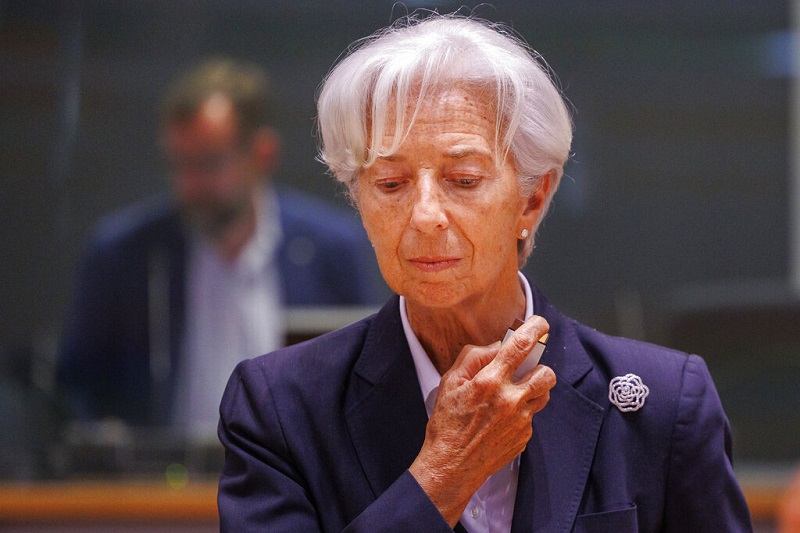
AP Photo/Olivier Matthys European Central Bank President Christine Lagarde enjoys a spray of perfume prior to a meeting of Eurogroup Finance Ministers at the European Council building in Brussels, Monday, May 23, 2022.
AP
14:46 JST, May 24, 2022
FRANKFURT, Germany (AP) — The president of the European Central Bank on Monday gave the clearest sign yet that policymakers will aim to raise interest rates as soon as July to ease surging inflation.
In a blog post on the Frankfurt, Germany-based bank’s website, President Christine Lagarde said she expects asset purchases that buoy the economy would end “very early in the third quarter.”
“This would allow us a rate lift-off at our meeting in July, in line with our forward guidance,” she wrote. “Based on the current outlook, we are likely to be in a position to exit negative interest rates by the end of the third quarter.”
The central bank for the 19 countries that use the euro currency has trailed others around the world in interest rate hikes meant to combat inflation. Consumer prices rose as countries rebounded from the COVID-19 pandemic and then got worse as Russia’s war in Ukraine drove energy and food costs even higher and further squeezed supply chains.
The eurozone saw consumer prices climb to 7.4% last month, compared with a year ago. Energy prices were driving inflation in Europe, which is heavily reliant on Russian oil and natural gas. It’s led to everything from more expensive utility bills and trips to the grocery store to the halt of public works projects in Italy.
The Bank of England has raised is key rate four times since December, with inflation soaring to a four-decade high of 9% last month. The U.S. Federal Reserve hiked its key rate this month to ease inflation running close to a 40-year high of 8.3% and expects more increases in the months ahead.
The Fed has moved more aggressively than the ECB in part because its leaders worry that U.S. inflation has spread more broadly through the economy, while European inflation has still largely been driven by higher energy and food prices stemming from Russia’s invasion of Ukraine. Higher rates can do less to quell inflation driven by those trends.
In Europe, Lagarde said it wasn’t clear if more rate hikes would follow because “supply shocks are raising inflation and slowing growth in the near term,” so the bank would have to closely monitor changing economic conditions.
The European Union’s executive commission slashed its forecasts for economic growth in the 27-nation bloc from 4% this year to 2.7% because of the fallout from the war in Ukraine.
Lagarde also vowed that the ECB would take “whatever steps are needed” to meet the central bank’s medium-term goal of 2% inflation.
The bank has maintained its interest rates at zero or less and kept other market borrowing costs low by purchasing hundreds of billions of euros of assets in financial markets.