
Economic Security Panels Debate Supply Chains, Rare Earths; Participants Emphasize Importance of Cooperation Among Allies
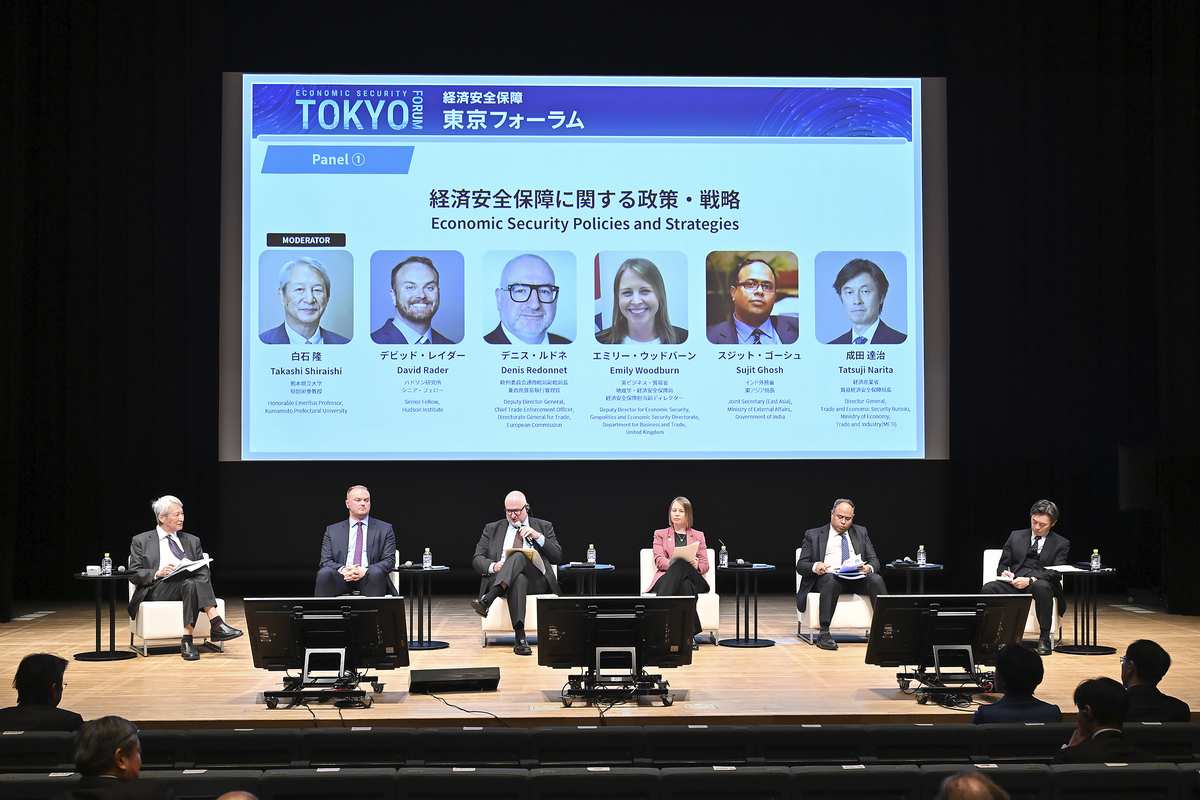
Panelists are seen at the Economic Security Forum Tokyo in Tokyo on Monday.
6:00 JST, December 17, 2025
Participants from Japan, the United States, Europe and elsewhere joined four panel discussions at the Tokyo Economic Security Forum on Monday, exchanging views on economic security matters including supply chains and rare earths procurement.
At the opening session of the forum, Seema Malhotra, the U.K. parliamentary under-secretary of state for the Indo-Pacific in the Foreign, Commonwealth and Development Office, stressed the importance of Japan-U.K. cooperation in economic security. “Our teams have been working together on a practical action plan with real, meaningful steps — the first of its kind for both countries — to bring that economic security partnership to life,” Malhotra said.
Panel discussions were closed to the media.
The first panel featured participants including David Rader, a senior fellow at the Hudson Institute in the United States; Denis Redonnet, deputy director general and chief trade enforcement officer in the Directorate General for Trade in the European Commission; Emily Woodburn, deputy director for economic security in the Geopolitics and Economic Security Directorate in the Department for Business and Trade of Britain; and Sujit Ghosh, joint secretary (East Asia) at the Ministry of External Affairs of India, who introduced initiatives in their respective countries.
According to attendees, Woodburn explained that Japan-U.K. relations are very strong and that cooperation is being promoted through the action plan.
Another panelist said moves are emerging to weaponize current dependencies on rare earths, highlighting the increasing urgency of addressing vulnerabilities. The panelist also noted that Japan is leading economic security initiatives and expressed the view that collaboration with Japanese companies and investors is important.
Furthermore, it was indicated that all nations recognize the weaponization of dependencies on critical minerals and rare earths as a major threat. The need to accelerate proposals for reducing dependencies and diversifying supply sources, while maintaining dialogue with China, was also noted as important.
Public-private partnership initiatives were discussed at the second panel, which featured executives from such organizations as the Finnish National Emergency Supply Agency and companies including NEC Corp.
According to attendees, one panelist cited the concrete identification of 17 key strategic sectors by Prime Minister Sanae Takaichi’s administration. They suggested that when a state clearly defines priority areas, this provides private companies with predictability, thereby enabling them to secure important positions by winning out in competition.
Another panelist said the semiconductor supply structure is concentrated in specific countries and regions, which poses risks, and expressed the view that the chip industry requires indispensable long-term support at the national level.
Additionally, it was argued that like-minded countries need to create an environment in which they can jointly utilize advanced technologies.
The third panel featured executives from the Japan Organization for Metals and Energy Security and private companies exchanging views on the supply chains for critical minerals.
According to attendees, efforts that are underway in Japan to secure critical minerals were introduced, including stockpiling and diversifying procurement networks. It was noted that rare earths are susceptible to market fluctuations, necessitating continuous government support for developing rare earths.
The importance of cooperation with Australia, the second-largest rare earth supplier after China, was also highlighted, along with the growing attention in Europe for businesses engaged in rare earth recycling.
The fourth panel featured experts from think tanks in Japan, the United States, Britain and Australia who discussed the role of think tanks in economic security.
One panelist reportedly said that the current situation could be termed an “economic cold war,” emphasizing the importance of governments establishing think tanks. They also stressed the need for these institutions to go beyond mere research and incorporate functions for human resource development.
Another panelist said governments tend to struggle with accumulating expertise due to the sheer volume of issues they must address, and suggested that establishing a government think tank could improve both the quality and speed of policy formulation.


Related Tags

Most Read
Popular articles in the past 24 hours
-

Japanese Shipping Giants Halt Strait of Hormuz Transit as Iran Co...
-

Improvement of Japanese Language Schools Lags Rise in Foreigners
-

U.S. Launches Attacks on Iran: Avoid Escalation of Conflict by An...
-
Rental Lab Space in Tokyo Area More Than Doubles Since 2010, Offe...
-
Parents of Japanese Teen Shot in U.S. Strive for Gun Control
-
Sawtooth Roof Factory Stands as Monument to Ashikaga Textile Hist...
-
Disinformation Spreads About Team Mirai, Ballot Readers; Online P...
-
Bank of Japan Deputy Governor Says Rate Hikes Likely to Continue
Popular articles in the past week
-

Nepal Bus Crash Kills 19 People, Injures 25 Including One Japanes...
-
Milano Cortina 2026: Japanese Gold Medalist Figure Skater Miura S...
-
Tokyo Spends Big on Children, Wins Over Parents
-

McDonald's Japan Raises Prices; Big Mac to Cost ¥500, Double Chee...
-

‘Dry Bonsai’ Gives New Life to Withered Trees, Allows Free Artist...
-
Japan’s Miura, Kihara Announce Withdrawal from Figure Skating Wor...
-

Exhibition Featuring Yoshiharu Tsuge’s Manga World Underway in Ch...
-

Yokohama to Test Out Renewable-Powered Offshore Floating Data Cen...
Popular articles in the past month
-

Producer Behind Pop Group XG Arrested for Cocaine Possession
-

Japan PM Takaichi’s Cabinet Resigns en Masse
-

Man Infected with Measles Reportedly Dined at Restaurant in Tokyo...
-

Israeli Ambassador to Japan Speaks about Japan’s Role in the Reco...
-

Videos Plagiarized, Reposted with False Subtitles Claiming ‘Ryuky...
-

Man Infected with Measles May Have Come in Contact with Many Peop...
-

Prudential Life Insurance Plans to Fully Compensate for Damages C...
-

Woman with Measles Visited Hospital in Tokyo Multiple Times Befor...
Top Articles in Business
-
Prudential Life Insurance Plans to Fully Compensate for Damages Caused by Fraudulent Actions Without Waiting for Third-Party Committee Review
-

Japan, U.S. Name 3 Inaugural Investment Projects; Reached Agreement After Considerable Difficulty
-

Japan’s Major Real Estate Firms Expanding Overseas Businesses to Secure Future Growth, Focusing on Europe, U.S., Asia
-

SoftBank Launches AI Service for Call Centers That Converts Harsh Customer Voices into Softer Voices
-
Green Tea Exports Hit Record High in 2025 Amid Growing Demand, Likely to Be Driving Force Behind Govt Export Target
JN ACCESS RANKING
-
Producer Behind Pop Group XG Arrested for Cocaine Possession
-
Japan PM Takaichi’s Cabinet Resigns en Masse
-
Man Infected with Measles Reportedly Dined at Restaurant in Tokyo Station
-
Israeli Ambassador to Japan Speaks about Japan’s Role in the Reconstruction of Gaza
-
Videos Plagiarized, Reposted with False Subtitles Claiming ‘Ryukyu Belongs to China’; Anti-China False Information Also Posted in Japan