
Officials, Experts Discuss Economic Security at Global Forum, Seek Public-Private Cooperation to Strengthen Supply Chains
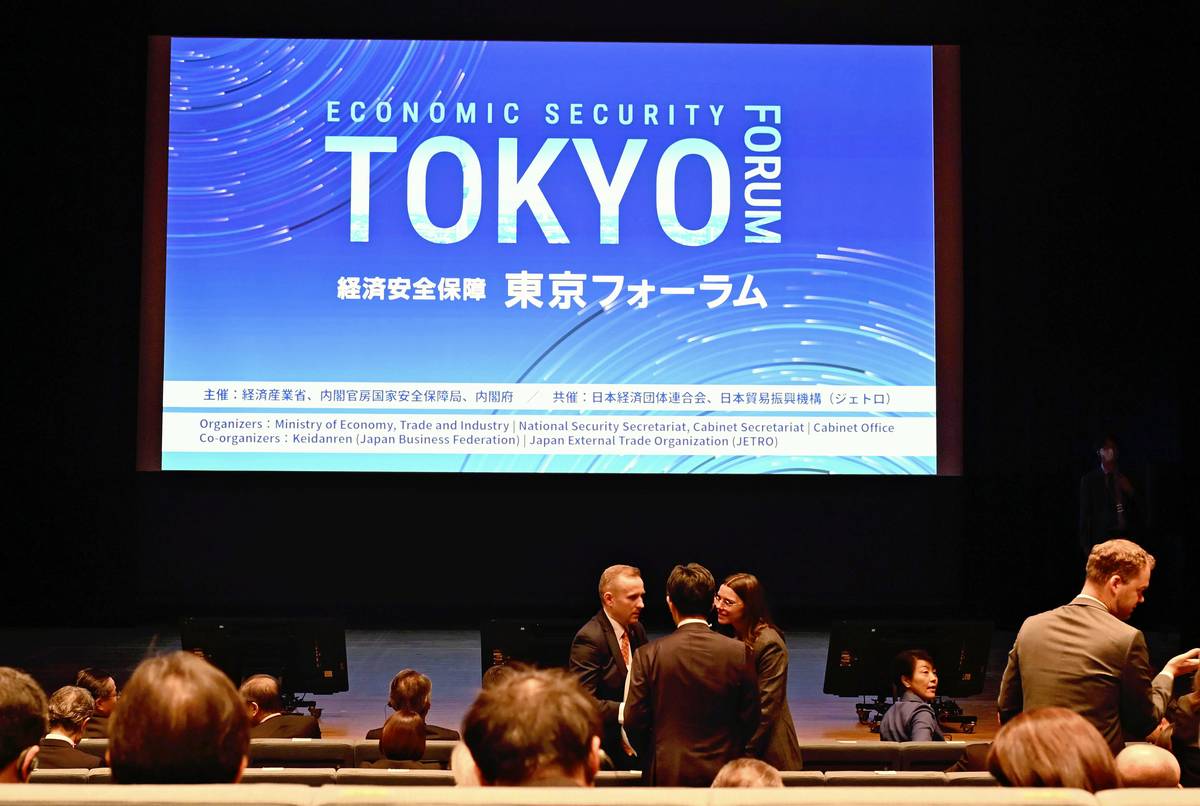
Participants gather at the Tokyo Economic Security Forum at Nikkei Hall in Tokyo on Monday.
20:00 JST, December 15, 2025
Government officials and experts from around the world discussed economic security on Monday at the inaugural Economic Security Tokyo Forum, hosted by the Japanese government in Tokyo.
Four keynote speakers — Japanese and U.K. ministers and a representative of the Japan Business Federation (Keidanren) — discussed economic security from various perspectives at the opening sessions. Four panel discussions followed, with themes such as critical mineral supply chains and national security.
The Forum is the centerpiece of the Economic Security Global Forum Weeks, a series of events being held around the world for the first time to discuss various topics related to economic security.
Stronger partnerships sought
Plans to establish new bodies related to economic security were revealed at the opening session, with calls for stronger partnerships and collaboration.
Economy, Trade and Industry Minister Ryosei Akazawa revealed in a video message that the government plans to establish a public-private council.
“Strengthening supply chains requires unified public-private efforts,” Akazawa said at the forum. “[The public-private council] is a framework to share adequate information between the public and private sectors while ensuring confidentiality.”
Akazawa also stressed the importance of bolstering Japan’s strategic independence and ensuring “strategic indispensability,” in which Japanese products or technologies are an indispensable part of international industrial system, in order to strengthen economic security.
To achieve these strategic goals, he described strengthening supply chains, especially for critical minerals, as “urgent issues to be taken.” This was also true, Akazawa said, of diversifying supply sources and increasing national stockpiling, among other steps.
Economic security minister Kimi Onoda said in a video message that the government envisions creating a think tank on economic security within the Research Institute of Economy, Trade and Industry by fiscal 2026.
“In this most severe and complex security environment since the postwar period, the National Security Secretariat must serve as the command center and conduct analysis and policy proposals with a sense of urgency,” Onoda said.
The envisioned think tank will conduct research and make policy proposals in response to government requests. It will analyze supply chains for critical minerals and other resources, and identify vulnerabilities in such networks, as well as create risk scenarios for infrastructure, share them with both the public and private sectors, and utilize them for tabletop exercises.
Seema Malhotra, the U.K. parliamentary under-secretary of state for the Indo-Pacific emphasized the Japan-UK partnership, for “a free and open Indo-Pacific economic prosperity and security for our peoples and our nations.” Because “the security of the Euro-Atlantic and Indo-Pacific are indivisible,” she argued it is not possible to “confine such challenges to one part of the globe.”
As the “access to resources is being contested like never before and norms that liberal developed countries like the U.K. and Japan have depended on for decades are being challenged, nowhere is this clearer than in growing risks to our shared economic security,” Malhotra warned that “when supply chains are too dependent on a few resources, one disruption can throw entire industries.”
As the “access to resources is being contested like never before and norms that liberal developed countries like the U.K. and Japan have depended on for decades are being challenged, nowhere is this clearer than in growing risks to our shared economic security,” Malhotra warned that “when supply chains are too dependent on a few resources, one disruption can throw entire industries.”
As for the Japan-U.K. partnership, she said the relationship would consist of “tangible cooperation and … projects which can strengthen our most strategic sectors … and resilience to economic shocks,” through more investment and closer cooperation to strengthen our economic security.
Yoshinobu Tsutsui, chairman of Keidanren, appeared last. Tsutsui emphasized the significance of partnership between the private sector and the government, as well as cooperation between like-minded countries.
Because the concept of economic security overlaps economy and security, he said “constant communication and collaboration are necessary.”
Tsutsui commended the economic policies of the government, saying that they “reflect the opinions of business communities in Japan,” as they are “feasible based on the reality of companies’ economic activities but not too restrictive.”


Related Tags
Most Read
Popular articles in the past 24 hours
-

Japanese Shipping Giants Halt Strait of Hormuz Transit as Iran Co...
-

U.S. Launches Attacks on Iran: Avoid Escalation of Conflict by An...
-
Sawtooth Roof Factory Stands as Monument to Ashikaga Textile Hist...
-
Parents of Japanese Teen Shot in U.S. Strive for Gun Control
-
Disinformation Spreads About Team Mirai, Ballot Readers; Online P...
-
Asahi Breweries to Stage Comeback with New Product in April; Comp...
-
Bank of Japan Deputy Governor Says Rate Hikes Likely to Continue
-
Japanese Government Bonds Rally, Yields Tumble as Iran Strikes Sp...
Popular articles in the past week
-

Nepal Bus Crash Kills 19 People, Injures 25 Including One Japanes...
-
Milano Cortina 2026: Japanese Gold Medalist Figure Skater Miura S...
-
Tokyo Spends Big on Children, Wins Over Parents
-

McDonald's Japan Raises Prices; Big Mac to Cost ¥500, Double Chee...
-
Japan’s Miura, Kihara Announce Withdrawal from Figure Skating Wor...
-

Exhibition Featuring Yoshiharu Tsuge’s Manga World Underway in Ch...
-

Yokohama to Test Out Renewable-Powered Offshore Floating Data Cen...
-
BOJ Keeping Eye on Economy and Takaichi's ‘Proactive Fiscal Polic...
Popular articles in the past month
-

Producer Behind Pop Group XG Arrested for Cocaine Possession
-

Japan PM Takaichi’s Cabinet Resigns en Masse
-

Man Infected with Measles Reportedly Dined at Restaurant in Tokyo...
-

Israeli Ambassador to Japan Speaks about Japan’s Role in the Reco...
-

Videos Plagiarized, Reposted with False Subtitles Claiming ‘Ryuky...
-

Man Infected with Measles May Have Come in Contact with Many Peop...
-

Prudential Life Insurance Plans to Fully Compensate for Damages C...
-

Woman with Measles Visited Hospital in Tokyo Multiple Times Befor...
Top Articles in Business
-
Prudential Life Insurance Plans to Fully Compensate for Damages Caused by Fraudulent Actions Without Waiting for Third-Party Committee Review
-

Japan, U.S. Name 3 Inaugural Investment Projects; Reached Agreement After Considerable Difficulty
-

Japan’s Major Real Estate Firms Expanding Overseas Businesses to Secure Future Growth, Focusing on Europe, U.S., Asia
-
SoftBank Launches AI Service for Call Centers That Converts Harsh Customer Voices into Softer Voices
-
Green Tea Exports Hit Record High in 2025 Amid Growing Demand, Likely to Be Driving Force Behind Govt Export Target
JN ACCESS RANKING
-
Producer Behind Pop Group XG Arrested for Cocaine Possession
-
Japan PM Takaichi’s Cabinet Resigns en Masse
-
Man Infected with Measles Reportedly Dined at Restaurant in Tokyo Station
-
Israeli Ambassador to Japan Speaks about Japan’s Role in the Reconstruction of Gaza
-
Videos Plagiarized, Reposted with False Subtitles Claiming ‘Ryukyu Belongs to China’; Anti-China False Information Also Posted in Japan