
Japanese Companies Prepare for Taiwan Contingency; Firms Hold Tabletop Drills, Review Suppliers to Minimize Potential Disruption
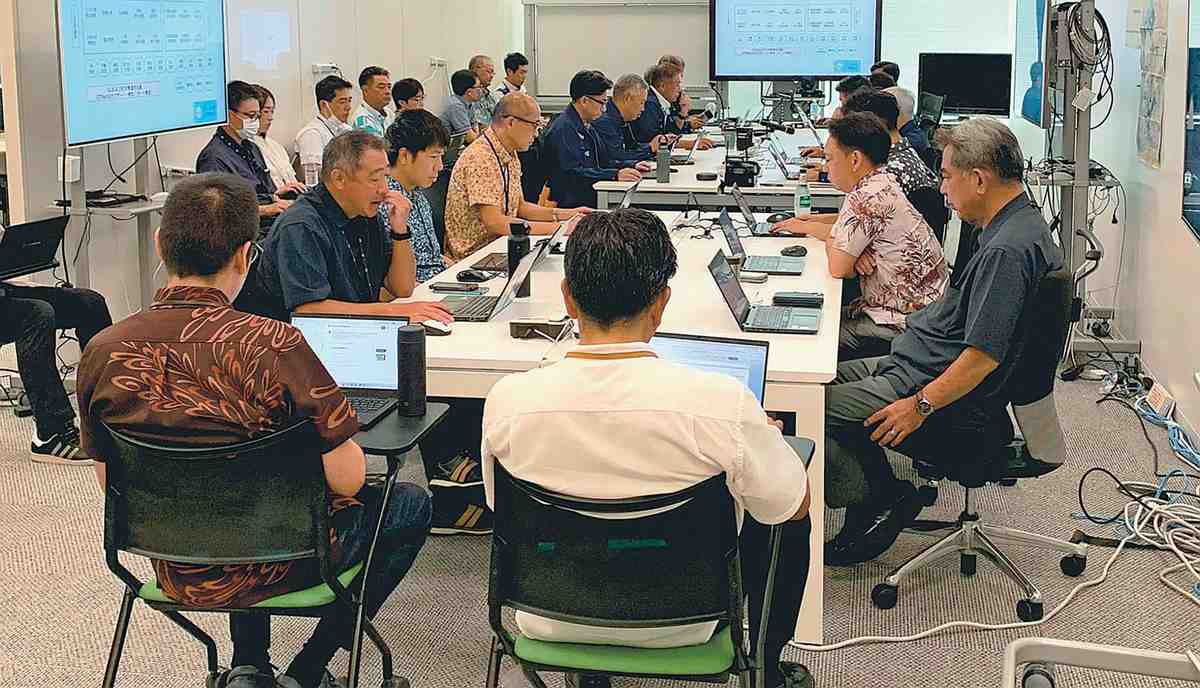
Officials at the Naha headquarters of Okinawa Cellular Telephone Co. conduct a tabletop exercise to prepare for a possible “gray zone” situation in Taiwan in late September.
14:58 JST, December 16, 2025
At a time when there is great worry in Japan about a possible Taiwan contingency, companies that operate telecommunication infrastructure in Okinawa Prefecture’s Sakishima Islands, located east of Taiwan, have begun tabletop drills to prepare to respond to such a situation.
Through these activities, the companies seek to find ways to minimize negative impacts and continue services in the event of a “gray zone situation,” which is a stage preceding a possible military contingency in Taiwan.
A gray zone situation means an unstable situation that is somewhere between peacetime and contingency but in which armed conflict has still not broken out. In a gray zone situation, experts point out that cyberattacks or the intentional spreading of false information could be used to interfere with a country’s telecommunications and infrastructure to delay its initial response to an eventual armed attack.
While many major companies operating in the islands are reluctant to make preparations for such an unprecedented situation, those that have begun to do so seem to be attracting much attention.
Sharing response info
In late September, employees began a tabletop exercise at the Naha headquarters of Okinawa Cellular Telephone Co., a consolidated subsidiary of KDDI Corp. with a greater than 50% share in the prefecture’s market for mobile telecom contracts for smartphones and other such devices.
One senior official of the firm told about 50 others: “Despite a possible contingency, our various departments are yet to be prepared to work together. This practice will help us to speed up our preparations.”
The drill was based on a scenario in which tensions rise in countries near Japan and the Okinawa prefectural government sets up a crisis management headquarters to deal with the situation.
In such a scenario, Okinawa Cellular plans to use its main offices as a headquarters for protecting civilians, under the direction of the company president.
Each department within the company reported how they would deal with a possible gray zone situation.
The company’s sales department reported that they would refrain from sending employees on business trips to the Sakishima Islands for activities such as sales promotions at agent offices.
The technology department said they would begin discussing suspending work on building or maintaining base stations in the islands.
The business department said they would consider lending equipment such as satellite phones to clients in the islands, including medical institutions.
The management department reported that it would begin preparations to evacuate employees to somewhere outside of the prefecture and implement measures to allow employees to work from home.
Okinawa Cellular has been named by the prefectural government as a “designated local public institution” under the Civil Protection Law.
If a contingency occurs, the company is obliged to follow the instructions of the central and local governments to ensure that telecommunications services continue to operate.
After the exercise, Hideki Moriyama, chief of the company’s risk management department, who had played the role of the secretariat of the company’s headquarters, emphasized how meaningful it had been, saying, “It allowed us to communicate with each other about what the company will do” in such a situation.
But he added, “It also clearly pointed up many issues which our company cannot resolve on its own, such as potential problems with logistics and power supply.”
Moriyama went on to say that he felt it would be necessary to repeatedly consult with related companies and administrative authorities.
The company is scheduled to exchange opinions with the prefectural government soon.
Reviewing suppliers, purchasers
The Japan External Trade Organization (JETRO) in March released the results of a survey of about 1,800 Japanese companies which procure parts and materials from overseas about how geopolitical risks could affect their ability to obtain supplies.
The results showed that 76.4% of companies pointed to China as the supplier country for which such impacts had “already occurred” or for which the companies had “concern” they would occur. The second-ranked was Taiwan at 73.5%.
More than 80% of respondents doing business with Chinese companies and more than 70% of those in business with Taiwan companies said they had already taken measures or begun discussing geopolitical risks.
It was noted that many of those measures involved diversifying or changing suppliers and reviewing production sites or sales markets.
Prof. Yoichi Maie of Nagoya University of Foreign Studies, an expert on the Chinese economy who was stationed in China when he worked for JETRO, said, “Companies which have close trading relationships with China and Taiwan tend to feel a greater sense of crisis than those which trade with Western countries, and a growing number of them are taking steps to deal with it, including [the possibility of] a gray zone situation.”
He added, “And in Okinawa Prefecture, which is geographically close to Taiwan, administrative authorities should foster such an atmosphere by proactively encouraging companies to take measures like this.”


Most Read
Popular articles in the past 24 hours
-
Japanese Shipping Giants Halt Strait of Hormuz Transit as Iran Co...
-

U.S. Launches Attacks on Iran: Avoid Escalation of Conflict by An...
-
Sawtooth Roof Factory Stands as Monument to Ashikaga Textile Hist...
-
Parents of Japanese Teen Shot in U.S. Strive for Gun Control
-
Disinformation Spreads About Team Mirai, Ballot Readers; Online P...
-
Asahi Breweries to Stage Comeback with New Product in April; Comp...
-
Bank of Japan Deputy Governor Says Rate Hikes Likely to Continue
-
Japanese Government Bonds Rally, Yields Tumble as Iran Strikes Sp...
Popular articles in the past week
-

Nepal Bus Crash Kills 19 People, Injures 25 Including One Japanes...
-
Milano Cortina 2026: Japanese Gold Medalist Figure Skater Miura S...
-
Tokyo Spends Big on Children, Wins Over Parents
-

McDonald's Japan Raises Prices; Big Mac to Cost ¥500, Double Chee...
-

Japan’s Miura, Kihara Announce Withdrawal from Figure Skating Wor...
-

Exhibition Featuring Yoshiharu Tsuge’s Manga World Underway in Ch...
-
Yokohama to Test Out Renewable-Powered Offshore Floating Data Cen...
-
BOJ Keeping Eye on Economy and Takaichi's ‘Proactive Fiscal Polic...
Popular articles in the past month
-

Producer Behind Pop Group XG Arrested for Cocaine Possession
-

Japan PM Takaichi’s Cabinet Resigns en Masse
-

Man Infected with Measles Reportedly Dined at Restaurant in Tokyo...
-

Israeli Ambassador to Japan Speaks about Japan’s Role in the Reco...
-

Videos Plagiarized, Reposted with False Subtitles Claiming ‘Ryuky...
-

Man Infected with Measles May Have Come in Contact with Many Peop...
-

Prudential Life Insurance Plans to Fully Compensate for Damages C...
-

Woman with Measles Visited Hospital in Tokyo Multiple Times Befor...
Top Articles in Business
-
Prudential Life Insurance Plans to Fully Compensate for Damages Caused by Fraudulent Actions Without Waiting for Third-Party Committee Review
-

Japan, U.S. Name 3 Inaugural Investment Projects; Reached Agreement After Considerable Difficulty
-

Japan’s Major Real Estate Firms Expanding Overseas Businesses to Secure Future Growth, Focusing on Europe, U.S., Asia
-

SoftBank Launches AI Service for Call Centers That Converts Harsh Customer Voices into Softer Voices
-

Green Tea Exports Hit Record High in 2025 Amid Growing Demand, Likely to Be Driving Force Behind Govt Export Target
JN ACCESS RANKING
-
Producer Behind Pop Group XG Arrested for Cocaine Possession
-
Japan PM Takaichi’s Cabinet Resigns en Masse
-
Man Infected with Measles Reportedly Dined at Restaurant in Tokyo Station
-
Israeli Ambassador to Japan Speaks about Japan’s Role in the Reconstruction of Gaza
-
Videos Plagiarized, Reposted with False Subtitles Claiming ‘Ryukyu Belongs to China’; Anti-China False Information Also Posted in Japan