
Govt Implements System to Help Workers Acquire Skills to Adapt to Technological Changes; Companies Concerned About Labor Shortages
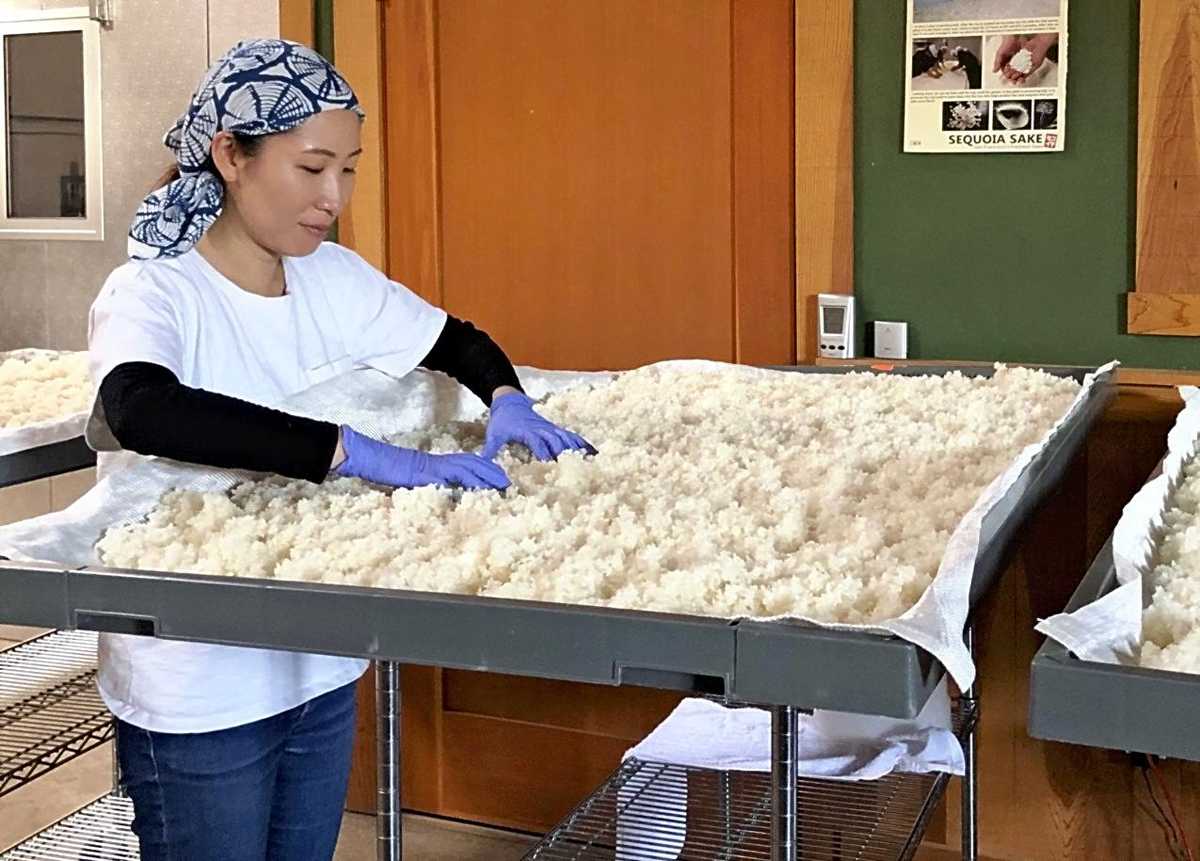
Mai Nihei produces koji filamentous fungus in a sake brewery in San Francisco in November 2019. She worked at a startup producing Japanese sake in the United States to learn about business management.
7:00 JST, December 13, 2025
The Health, Labor and Welfare Ministry launched a system in October to provide financial assistance to workers who take a leave of absence from their companies to acquire new skills.
The system was implemented to encourage more Japanese employees to undergo new training to adapt to technological and other changes in society.
However, as there are companies that are concerned about labor shortages, it remains to be seen whether the system can actually take root.
Reskilling involves people learning and acquiring new skills necessary for a job.
The World Economic Forum (WEF) said in a report this year that demand for people in the tech industry, as well as in agriculture, nursing care, construction and other such fields, will be on the rise over the next five years. However, there will be a surplus of office personnel and secretaries.
The WEF believes that 40% of the skills for existing jobs will be outdated, resulting in the need to promote reskilling programs.
Company policies changing
The new system of providing financial assistance covers employees who take a leave of absence for 30 days or more to acquire new skills.
The ministry provides cash benefits to the employees equivalent to 50%-80% of their salaries during their leave using funds from an employment insurance scheme.
There are companies that have introduced systems to allow employees to take paid or unpaid leave or that will rehire workers if they want to quit their current position to acquire new skills. The government’s measure assumes that workers are taking unpaid leave.
The new system will cover a wide range of reskilling programs, including engineering to develop artificial intelligence, basic technological skills such as utilizing spreadsheet software, learning a foreign language and obtaining a Master of Business Administration degree.
Mai Nihei, 40, an employee of Osaka-based Rohto Pharmaceutical Co., is one such person who decided to acquire new skills. She was in the United States for two years and studied business.
In 2018, after being with the company for 10 years, she learned English at a language school and then studied corporate management at a university in the United States.
“As I had work experience, I had clear goals that I wanted to achieve while studying overseas, and I learned a lot,” Nihei said.
Although she mainly worked in the sales department before studying abroad, after returning, she took charge of a project to help other employees at the company start businesses.
She helped realize other employees’ ideas and assisted in establishing four companies. One such company manufactures and sells sunglasses using recycled eye drop bottles.
Before, Rohto would require employees who wanted to take an extended leave of absence to resign, but they would later be rehired. In June, the company established a system in which employees can take unpaid leave for up to two years.
“We expect that employees who have undergone reskilling will motivate their colleagues, creating a virtuous cycle,” said an official of Rohto’s personnel management department.
Reskilling attracted attention at the WEF’s annual meeting, known as the Davos conference, five years ago because a goal was proposed to teach new job skills to 1 billion people in 10 years.
In Japan in 2022, then Prime Minister Fumio Kishida announced a policy to invest ¥1 trillion in assistance in five years to help people acquire new skills.
The reason for the move toward reskilling is due to rapid digitalization and other factors creating changes in employees’ duties and industrial structures.
At the Davos conference, in response to a question about whether attendees think their skills will prove useful until they retire, 80% said no.
Staffing concerns
Last year, Skill-up Kenkyujo, a business research firm, conducted a survey on company employees, asking how they felt about reskilling, and 163 people responded.
Of the respondents, 84% were positive about the idea of reskilling.
However, a labor ministry survey from last fiscal year, in which 4,261 companies responded, showed that 83% of companies had no plan to introduce a leave-of-absence system to allow employees to acquire new skills.
Regarding the reason, with multiple answers allowed, 46% said that finding replacements would be difficult.
“I have 15 employees,” said a manager of a company manufacturing miscellaneous household goods based in Higashi-Osaka, Osaka Prefecture. “Due to the chronic labor shortage, if even one employee leaves, it really impacts the company’s ability to continue. If an employee goes to another company as a result of learning new skills, the damage would be huge.”



Most Read
Popular articles in the past 24 hours
-

Japanese Shipping Giants Halt Strait of Hormuz Transit as Iran Co...
-

U.S. Launches Attacks on Iran: Avoid Escalation of Conflict by An...
-

Sawtooth Roof Factory Stands as Monument to Ashikaga Textile Hist...
-

Parents of Japanese Teen Shot in U.S. Strive for Gun Control
-

Disinformation Spreads About Team Mirai, Ballot Readers; Online P...
-

Asahi Breweries to Stage Comeback with New Product in April; Comp...
-

Bank of Japan Deputy Governor Says Rate Hikes Likely to Continue
-

Japanese Government Bonds Rally, Yields Tumble as Iran Strikes Sp...
Popular articles in the past week
-

Nepal Bus Crash Kills 19 People, Injures 25 Including One Japanes...
-

Milano Cortina 2026: Japanese Gold Medalist Figure Skater Miura S...
-

Tokyo Spends Big on Children, Wins Over Parents
-

McDonald's Japan Raises Prices; Big Mac to Cost ¥500, Double Chee...
-

Japan’s Miura, Kihara Announce Withdrawal from Figure Skating Wor...
-

Exhibition Featuring Yoshiharu Tsuge’s Manga World Underway in Ch...
-

Yokohama to Test Out Renewable-Powered Offshore Floating Data Cen...
-

BOJ Keeping Eye on Economy and Takaichi's ‘Proactive Fiscal Polic...
Popular articles in the past month
-

Producer Behind Pop Group XG Arrested for Cocaine Possession
-

Japan PM Takaichi’s Cabinet Resigns en Masse
-

Man Infected with Measles Reportedly Dined at Restaurant in Tokyo...
-

Israeli Ambassador to Japan Speaks about Japan’s Role in the Reco...
-

Videos Plagiarized, Reposted with False Subtitles Claiming ‘Ryuky...
-

Man Infected with Measles May Have Come in Contact with Many Peop...
-

Prudential Life Insurance Plans to Fully Compensate for Damages C...
-

Woman with Measles Visited Hospital in Tokyo Multiple Times Befor...
Top Articles in Business
-
Prudential Life Insurance Plans to Fully Compensate for Damages Caused by Fraudulent Actions Without Waiting for Third-Party Committee Review
-

Japan, U.S. Name 3 Inaugural Investment Projects; Reached Agreement After Considerable Difficulty
-

Japan’s Major Real Estate Firms Expanding Overseas Businesses to Secure Future Growth, Focusing on Europe, U.S., Asia
-

SoftBank Launches AI Service for Call Centers That Converts Harsh Customer Voices into Softer Voices
-

Green Tea Exports Hit Record High in 2025 Amid Growing Demand, Likely to Be Driving Force Behind Govt Export Target
JN ACCESS RANKING
-
Producer Behind Pop Group XG Arrested for Cocaine Possession
-
Japan PM Takaichi’s Cabinet Resigns en Masse
-
Man Infected with Measles Reportedly Dined at Restaurant in Tokyo Station
-
Israeli Ambassador to Japan Speaks about Japan’s Role in the Reconstruction of Gaza
-
Videos Plagiarized, Reposted with False Subtitles Claiming ‘Ryukyu Belongs to China’; Anti-China False Information Also Posted in Japan