
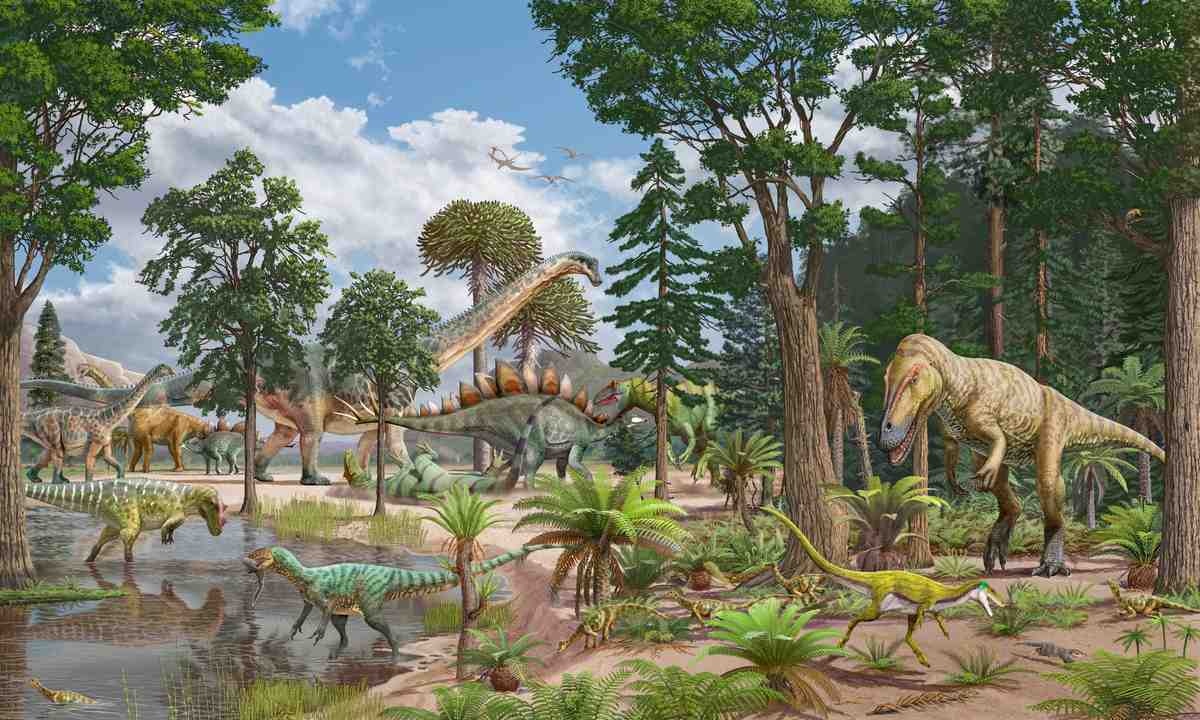
A reconstruction of a Late Jurassic Dry Mesa Dinosaur Quarry ecosystem from around 150 million years ago shows a diverse array of bipedal theropod dinosaurs, including Torvosaurus (far right in the brown), the longest in the ecosystem, alongside two Allosaurus in the center (green) hunting a Stegosaurus (green with red plates on its back), while Ceratosaurus and Marshosaurus prowl for food in a shallow stream and a Stokesosaurus pursues a small mammal, in the U.S. state of Colorado, in this illustration on Jan. 28.
13:01 JST, February 22, 2026
WASHINGTON (Reuters) — It may have been suicidal for a predator to go after a healthy adult Brachiosaurus, a behemoth weighing perhaps 60 tons that was a member of the long-necked group of dinosaurs called sauropods that included the largest land animals ever on Earth.
But, as research shows, Brachiosaurus and other sauropod babies appear to have been regular dinner fare for meat-eating dinosaurs 150 million years ago. Using multiple lines of evidence, scientists reconstructed the food web for a Jurassic Period ecosystem represented by the numerous fossils unearthed at the Dry Mesa Dinosaur Quarry in southwestern Colorado, mapping out who ate what and who ate whom.
The ecosystem was teeming with life, with at least six types of sauropods, known for their long necks, small heads, four pillar-like legs and lengthy tails, and five types of meat-eating dinosaurs. There also were various other plant-eating dinosaurs as well as flying reptiles called pterosaurs, smaller reptiles, early mammals, crocs, fish and insects.
The researchers concluded that baby and young juvenile sauropods were the most common food source for the meat-eating dinosaurs at the top of the food chain.
“These sauropods would have been high in abundance compared to larger adult sauropods and were relatively defenseless and slow-moving, hence easy to catch and a perfect snack,” said paleontologist Cassius Morrison, a postdoctoral researcher at University College London and lead author of the study published in the New Mexico Museum of Natural History and Science Bulletin.
While Brachiosaurus was the ecosystem’s most massive sauropod, the longest was probably Diplodocus, at roughly 30 meters or more. Other sauropods, all big, sharing this ecosystem were Supersaurus, Apatosaurus, Camarasaurus and Haplocanthosaurus. But their hatchlings emerged from eggs just 30 centimeters wide and needed many years to grow, and evidence suggests they were left to fend for themselves by their parents.
“Adult sauropods relied on their enormous size, long tails and herd behavior for protection,” said ecologist and study coauthor Steven Allain, a lecturer in animal science at Anglia Ruskin University Writtle in England.
“Unfortunately, this took time, meaning that the smaller individuals hadn’t reached that ‘too big to mess with’ stage yet. They lacked armor, spikes or heavy plates, making them far easier to subdue than dinosaurs like Stegosaurus, whose thagomizer — tail spikes — could seriously injure or kill a predator,” Allain said.
This ecosystem’s meat-eating dinosaurs were formidable. The largest were Torvosaurus, at around 9 meters long, and Allosaurus, around 8 meters long. There also were Ceratosaurus at around 7 meters, Marshosaurus at about 4.5 meters and Stokesosaurus at approximately 3.5 meters.
“Hunting a healthy adult Brachiosaurus — or any large sauropod — would have been an extremely daunting, high-risk task for even the largest theropod in the Dry Mesa ecosystem,” Allain said, “with sheer size acting as their primary defense.”
“One well-placed tail swing or a simple sideways step could seriously injure or kill a predator. Even if Allosaurus hunted in groups — which is still debated — bringing down a fully grown, healthy sauropod would have required coordination, stamina and a lot of luck. Because of that risk, predators likely focused on safer options such as juveniles, sick or injured adults, individuals stuck in mud or carcasses from drought or floods,” Allain said.
The researchers considered several types of evidence in reconstructing the complex Dry Mesa food web. Among other things, they looked at chemical evidence in tooth enamel that indicated the types of food an animal ate, scratches left on tooth enamel that indicated the types of food eaten, biomechanical models and fossilized stomach remains.
“This deposit was made by a drought, so it’s one of the only places where you get everything, from small lizard-like animals to the largest dinosaurs,” Morrison said.
The environment was dominated by open woodlands of plants such as conifers, cycads, ferns and horsetails growing along rivers and shallow ponds that periodically dried out.
“The reconstructed food web this data has generated contains over 12,000 unique food chains, indicating a richly interconnected system rather than a simple hierarchy of predators and prey. Sauropods emerged from this analysis as central components of this network,” Allain said.









Most Read
Popular articles in the past 24 hours
-
Japanese High School Student Aims to Share Kaiten History Through...
-
Business Hotels Expanding into Regional Areas in Japan, Aiming to...
-

Milano Cortina 2026: Japan Sees Leap in Olympic Performance Throu...
-
PM Takaichi Spells out Plans to Advance Bold Policy Shifts in Spe...
-
Chronic Issues Erode Thailand’s Economy as Political Confusion Pe...
-

Milano Cortina 2026: Japan's Satoshi Furuno Places 4th in Men's S...
-

Milano Cortina 2026: Speed Skater Takagi Finishes 6th in the 1,50...
-
Osaka: 40 Ninjas Display Shuriken Throwing Skills at Japan Champi...
Popular articles in the past week
-

Japan PM Takaichi’s Cabinet Resigns en Masse
-

Man Infected with Measles Reportedly Dined at Restaurant in Tokyo...
-

Sanae Takaichi Elected Prime Minister of Japan; Keeps All Cabinet...
-

Japan's Govt to Submit Road Map for Growth Strategy in March, PM ...
-

Bus Carrying 40 Passengers Catches Fire on Chuo Expressway; All E...
-

Milano Cortina 2026: Figure Skaters Riku Miura, Ryuichi Kihara Pa...
-

Japan, U.S. Name 3 Inaugural Investment Projects; Reached Agreeme...
-
U.S. Firm to Build Training Hub in Fukushima N-plant for Debris R...
Popular articles in the past month
-
Japan PM Takaichi’s Cabinet Resigns en Masse
-

Japan Institute to Use Domestic Commercial Optical Lattice Clock ...
-

Israeli Ambassador to Japan Speaks about Japan’s Role in the Reco...
-
Man Infected with Measles Reportedly Dined at Restaurant in Tokyo...
-

Videos Plagiarized, Reposted with False Subtitles Claiming ‘Ryuky...
-

Man Infected with Measles May Have Come in Contact with Many Peop...
-

Prudential Life Insurance Plans to Fully Compensate for Damages C...
-

Woman with Measles Visited Hospital in Tokyo Multiple Times Befor...
Top Articles in News Services
-
Survey Shows False Election Info Perceived as True
-

Prudential Life Expected to Face Inspection over Fraud
-
Hong Kong Ex-Publisher Jimmy Lai’s Sentence Raises International Outcry as China Defends It
-

Japan’s Nikkei Stock Average Touches 58,000 as Yen, Jgbs Rally on Election Fallout (UPDATE 1)
-

Trump Names Former Federal Reserve Governor Warsh as the Next Fed Chair, Replacing Powell
JN ACCESS RANKING
-
Japan PM Takaichi’s Cabinet Resigns en Masse
-
Japan Institute to Use Domestic Commercial Optical Lattice Clock to Set Japan Standard Time
-
Israeli Ambassador to Japan Speaks about Japan’s Role in the Reconstruction of Gaza
-
Man Infected with Measles Reportedly Dined at Restaurant in Tokyo Station
-
Videos Plagiarized, Reposted with False Subtitles Claiming ‘Ryukyu Belongs to China’; Anti-China False Information Also Posted in Japan