
Wajima Lacquerware Production in Japan Continues 2 Years After Massive Noto Peninsula Earthquake
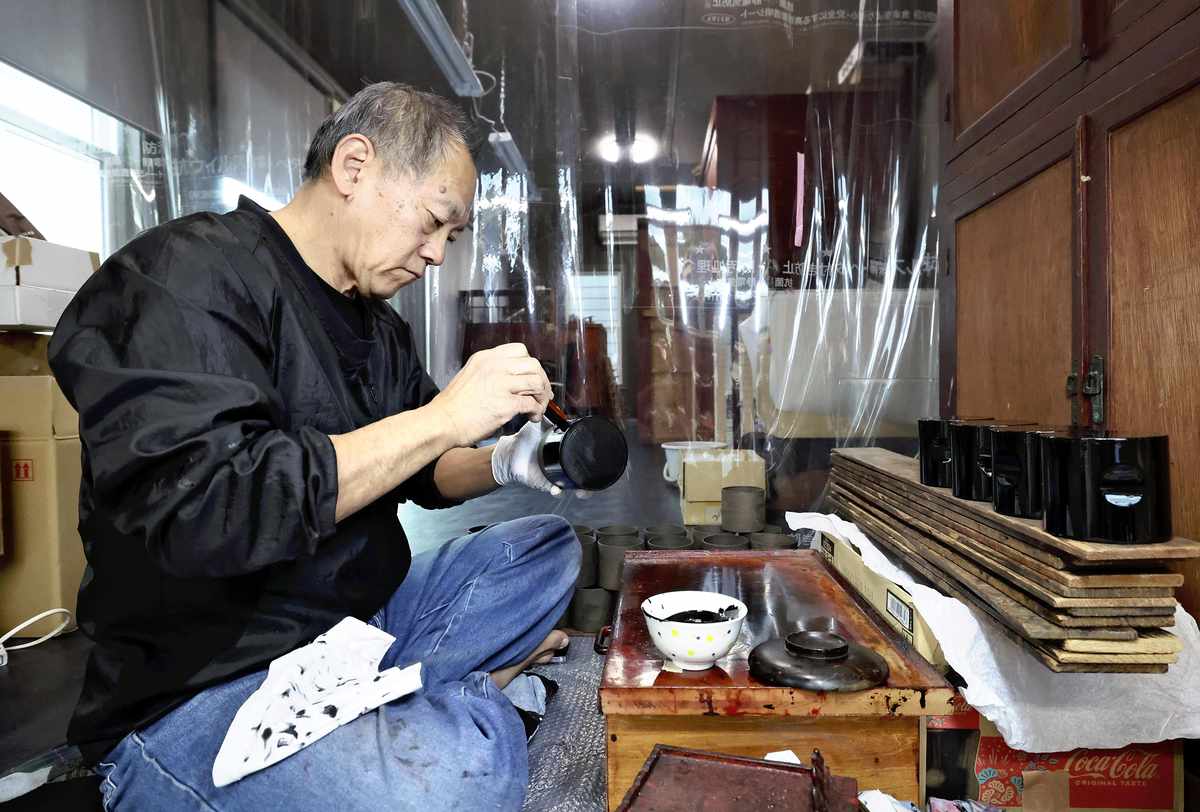
Mitsuo Uwamaki works in a trailer house used as a temporary workshop in Wajima, Ishikawa Prefecture.
2:00 JST, January 1, 2026
WAJIMA, Ishikawa — A lacquerware shop destroyed by the 2024 Noto Peninsula Earthquake has continued producing Wajima lacquerware in trailer houses set up on the site of its former company building.
Thursday marks two years since the massive earthquake struck Wajima, Ishikawa Prefecture.
Before the earthquake, many lacquerware businesses were located on Asaichi-dori shopping street in central Wajima. However, the buildings were destroyed in a fire, and the area is still a vacant lot.
“I thought speed was important in order to rebuild our business,” said Takahiro Taya, representative of lacquerware company Taya Shikkiten Co.
Taya set up 10 trailer houses in his company’s parking lot and on the site of a damaged company building on the outskirts of Wajima. The area, named Wajimanuri Village, opened last summer as a new base for sales and production of the local craft.
Wajimanuri Village aims to become an area where tourists can stay overnight as well as see how Wajimanuri, or Wajima lacquerware, is made.
Inside one of the temporary buildings, lacquerware craftsman Mitsuo Uwamaki, 61, was skillfully applying black lacquer to a piece he was working on. Before working at Wajimanuri Village, he sometimes had to work at home, which was inconvenient for him. He said when applying the finish, it is especially important to be careful about not letting any dirt or dust get in.
Vinyl sheets can be used to partition the about 30-square-meter trailer house, making it easier to carry out multiple tasks simultaneously.
At its peak in fiscal 1991, there were 2,928 Wajima lacquerware artisans. The number subsequently fell to below 2,000, and after the earthquake, it fell to around 700 in fiscal 2024. More people have been leaving the industry or moving out of the city.
The production value of Wajima lacquerware, which was about ¥2.4 billion in fiscal 2022, fell to about ¥1.4 billion in fiscal 2024.
“We’re receiving orders from people all over the country who want to support Wajima, but we’re unable to meet the demand,” said Kensei Sumi, secretary general of the Wajima Lacquerware Industry and Commerce Cooperative Association.
While Taya is determined to rebuild his store and workshop in central Wajima in the future, but he has no idea when it will happen, as plans for reconstructing of the city are still being discussed. But Taya is looking forward to when he can finally reopen his shop.
“I don’t know if Wajimanuri Village is the right answer, but right now, I’ll do what I can to pass on Wajima lacquerware to the next generation,” Taya said.





Most Read
Popular articles in the past 24 hours
-

Japanese Shipping Giants Halt Strait of Hormuz Transit as Iran Co...
-

U.S. Launches Attacks on Iran: Avoid Escalation of Conflict by An...
-

Improvement of Japanese Language Schools Lags Rise in Foreigners
-
Rental Lab Space in Tokyo Area More Than Doubles Since 2010, Offe...
-
Sawtooth Roof Factory Stands as Monument to Ashikaga Textile Hist...
-
Parents of Japanese Teen Shot in U.S. Strive for Gun Control
-
Disinformation Spreads About Team Mirai, Ballot Readers; Online P...
-
Bank of Japan Deputy Governor Says Rate Hikes Likely to Continue
Popular articles in the past week
-

Nepal Bus Crash Kills 19 People, Injures 25 Including One Japanes...
-
Milano Cortina 2026: Japanese Gold Medalist Figure Skater Miura S...
-
Tokyo Spends Big on Children, Wins Over Parents
-

McDonald's Japan Raises Prices; Big Mac to Cost ¥500, Double Chee...
-
‘Dry Bonsai’ Gives New Life to Withered Trees, Allows Free Artist...
-
Japan’s Miura, Kihara Announce Withdrawal from Figure Skating Wor...
-

Exhibition Featuring Yoshiharu Tsuge’s Manga World Underway in Ch...
-

Yokohama to Test Out Renewable-Powered Offshore Floating Data Cen...
Popular articles in the past month
-

Producer Behind Pop Group XG Arrested for Cocaine Possession
-

Japan PM Takaichi’s Cabinet Resigns en Masse
-

Man Infected with Measles Reportedly Dined at Restaurant in Tokyo...
-

Israeli Ambassador to Japan Speaks about Japan’s Role in the Reco...
-

Videos Plagiarized, Reposted with False Subtitles Claiming ‘Ryuky...
-

Man Infected with Measles May Have Come in Contact with Many Peop...
-

Prudential Life Insurance Plans to Fully Compensate for Damages C...
-

Woman with Measles Visited Hospital in Tokyo Multiple Times Befor...
Top Articles in Society
-
Producer Behind Pop Group XG Arrested for Cocaine Possession
-
Man Infected with Measles Reportedly Dined at Restaurant in Tokyo Station
-
Man Infected with Measles May Have Come in Contact with Many People in Tokyo, Went to Store, Restaurant Around When Symptoms Emerged
-
Woman with Measles Visited Hospital in Tokyo Multiple Times Before Being Diagnosed with Disease
-

Bus Carrying 40 Passengers Catches Fire on Chuo Expressway; All Evacuate Safely
JN ACCESS RANKING
-
Producer Behind Pop Group XG Arrested for Cocaine Possession
-
Japan PM Takaichi’s Cabinet Resigns en Masse
-
Man Infected with Measles Reportedly Dined at Restaurant in Tokyo Station
-
Israeli Ambassador to Japan Speaks about Japan’s Role in the Reconstruction of Gaza
-
Videos Plagiarized, Reposted with False Subtitles Claiming ‘Ryukyu Belongs to China’; Anti-China False Information Also Posted in Japan