
Special Consideration Needed for Children to in Evacuation Shelters, Including Designated Spaces for Learning, Playing
17:05 JST, November 18, 2025
In the wake of a disaster, children and adults spend long periods of time together in evacuation shelters, where they have to share the same space.
Special considerations need to be made for children, who often cannot effectively put their own feelings into words, such as setting aside space for them to play together.
Regaining a sense of normalcy
The importance of setting aside space for children gained attention mainly in the aftermath of the 2011 Great East Japan Earthquake.
The Children and Families Agency has published guidelines for preparing such spaces.
“It is important to see things from the children’s perspective to give them back a sense of normalcy,” said Munetake Yamada, a program manager at Save the Children Japan, a Tokyo-based NGO that assists with managing spaces for children in evacuation shelters.
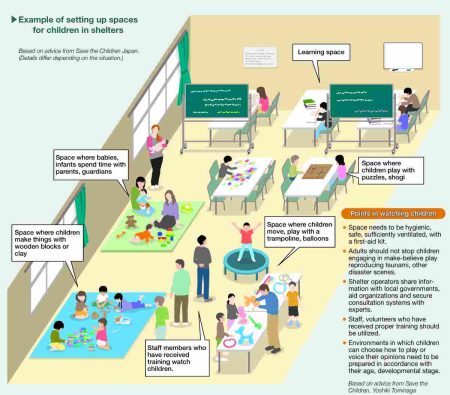
In a school used as a shelter, for instance, securing space for children in empty classrooms is recommended so that they can have separate spaces from those for eating and sleeping.
You may also like to read
Extended Stays Become Focus for Tsunami Towers to Ensure Communities Have Adequate Accommodations in Earthquake-Prone JapanSeparate areas for different activities could set up in the classroom. For example, there are dedicated areas with chairs and desks for learning, with shogi boards and puzzles for spending time quietly and with ample space to play and move around.
Measures to prevent infectious diseases from spreading are also required, such as ensuring sufficient ventilation.
Items suitable for each age group should be prepared. For example, picture books and wooden blocks are suitable for babies and infants, while board games and playing cards are good for elementary school students and older children.
When they regain a sense of normalcy through such activities, the children gradually begin voicing their feelings.
Yamada said that during aid work in the aftermath of the Great East Japan Earthquake, one child told him, “My grandfather died in the tsunami.”
Staff watching children need to be properly trained to respond appropriately to such words and relay them to experts in childcare.
“It is necessary to be prepared during normal times to set up spaces for children [when a disaster strikes],” Yamada said.
Make-believe play
Living in shelters, where there are many restrictions, is very stressful for children.
“Even if they look fine, children can have sorrow or fear in their hearts, so they should be treated carefully,” said Yoshiki Tominaga, professor emeritus of Hyogo University of Teacher Education.
In some cases, children engage in make-believe play just after a disaster, reproducing scenes they witnessed.
After the 1995 Great Hanshin Earthquake, some children piled up desks and then pushed them over to reproduce the quake. After the Great East Japan Earthquake, some children wrapped themselves up in mats and rolled around on the floor to reproduce the tsunami.
These actions were triggered when the memories of their traumatic experiences activated later, after their safety had been secured and they were able to eat and sleep enough.
Adults need to prohibit this kind of behavior if it is dangerous, to ensure that no children are injured. However, if such behavior is condemned by saying such things as “Stop that silly behavior,” the children may shut themselves off from others.
It is better to calm them down by giving them a drink of water and then keep an eye on them.
There have also been cases in which children in shelters spend long periods of time playing games or watching videos online. Such behavior can be effective at making children concentrate on fun things and temporarily forget their experiences of the disaster. However, if it continues for too long, adverse effects start to appear, such as a lack of sleep. Adults, therefore, need to control such behavior.
Parents and guardians are also under severe stress in shelters and tend to react excessively to their children’s words and actions.
“Parents and guardians need to be aware that they are disaster victims too and not hesitate to reach out to staff at the shelter,” Tominaga said. “I want them to speak up [in times of need].”




Most Read
Most read in the last 24 hours
-
Promote Support, Respect to Help Prevent Harassment of Athletes
-

Japanese Govt to Set Up Panel on Widening Access to Sports Broadc...
-

New Budget Framework for Investments: Work to Achieve Both Growth...
-

Toyota Unveils New Development Hub in Woven City Repurposed from ...
-
Elegant Weeping Cherry Blossoms on Display at Water Purification ...
-

Fukui: Dinosaur Faculty Building Unveiled in Japanese University'...
-
Man Admits to Abandoning Wife's Body in Zoo Incinerator in Hokkai...
-

Japan Govt Panel Says Blocking of Illegal Online Casinos Effectiv...
Most read in the last 7 days
-
Earthquake Hits Japan's Tohoku Region; 3-meter Tsunami Warning Is...
-

China, South Korea Object to Japanese PM Takaichi's Ritual Offeri...
-

Trump Extends the Ceasefire with Iran but Keeps the Blockade
-

India's Arms Indigenization Quest for Self-Reliance / New Delhi S...
-
Japan to Ban Use of Portable Chargers on Airplanes from April 24,...
-

¥1,000 Coins to Be Issued to Mark Anniversary of Beginning of Jap...
-

Most Serious Cyberattacks against the UK Now from Russia, Iran an...
-

Trump Opposes United–American Merger, Signals Support for Spirit
Most read in the last 30 days
-
Earthquake Hits Japan's Tohoku Region; 3-meter Tsunami Warning Is...
-
Police Find Child's Shoe During Search for Missing Boy in Nantan,...
-
Body Found in Nantan, Kyoto Prefecture, During Search for 11-Year...
-
Cherry Blossoms, Rapeseed Flowers Perform Colorful ‘Duet’ in Niig...
-
China, South Korea Object to Japanese PM Takaichi's Ritual Offeri...
-
Trump Extends the Ceasefire with Iran but Keeps the Blockade
-

Olympic Gold Medal-Winning Figure Skaters Riku-Ryu Announce Retir...
-

Japanese Prime Minister Takaichi Speaks to Pakistani Prime Minist...
Top Articles in JN Specialities
-
How to Prepare for Power Outages Caused by Natural Disasters
-
Tokyo Wards Train Volunteer Tour Guides for Locals Passionate About Their Area’s Charms
-

Tateyama Soup Curry in Chiba Challenges Its Sapporo Roots, Cafe Owner Looks to Local Area for Best Ingredients
-
Japan May Build ‘Rescue City’ in Noto Region to Train Disaster Experts
-

Personal History Helps You Look Back, Move Forward; Editor Gives Advice to Those Writing Their Story
JN ACCESS RANKING
-
Earthquake Hits Japan’s Tohoku Region; 3-meter Tsunami Warning Issued (Update 1)
-
Police Find Child’s Shoe During Search for Missing Boy in Nantan, Kyoto Prefecture
-
Body Found in Nantan, Kyoto Prefecture, During Search for 11-Year-Old Boy in Area (Update 1)
-
Cherry Blossoms, Rapeseed Flowers Perform Colorful ‘Duet’ in Niigata
-
China, South Korea Object to Japanese PM Takaichi’s Ritual Offering to Yasukuni Shrine
Most read in the last 24 hours
-
Promote Support, Respect to Help Prevent Harassment of Athletes
-
Japanese Govt to Set Up Panel on Widening Access to Sports Broadc...
-
New Budget Framework for Investments: Work to Achieve Both Growth...
-
Toyota Unveils New Development Hub in Woven City Repurposed from ...
-
Elegant Weeping Cherry Blossoms on Display at Water Purification ...
Most read in the last 7 days
-
Earthquake Hits Japan's Tohoku Region; 3-meter Tsunami Warning Is...
-
China, South Korea Object to Japanese PM Takaichi's Ritual Offeri...
-
Trump Extends the Ceasefire with Iran but Keeps the Blockade
-
India's Arms Indigenization Quest for Self-Reliance / New Delhi S...
-
Japan to Ban Use of Portable Chargers on Airplanes from April 24,...
Most read in the last 30 days
-
Earthquake Hits Japan's Tohoku Region; 3-meter Tsunami Warning Is...
-
Police Find Child's Shoe During Search for Missing Boy in Nantan,...
-
Body Found in Nantan, Kyoto Prefecture, During Search for 11-Year...
-
Cherry Blossoms, Rapeseed Flowers Perform Colorful ‘Duet’ in Niig...
-
China, South Korea Object to Japanese PM Takaichi's Ritual Offeri...