
18:56 JST, September 22, 2025
Many people are unable to sleep well in shelters after a strong earthquake or other large-scale disaster, as they are not accustomed to the environment and feel intense stress.
Not getting enough sleep can increase the risk of catching infectious diseases.
Knowing how to improve one’s sleep environment by doing light physical exercises or other activities before bedding down is very helpful.
***
As sleepiness dictates
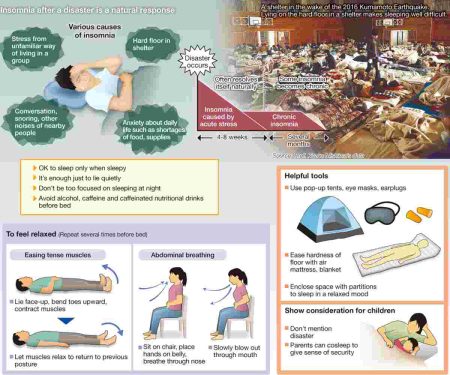
When a disaster occurs, many people suffer from insomnia, especially in disaster shelters where privacy is hard to find.
Intense stress after a disaster also tends to cause insomnia. In the wake of the 2024 Noto Peninsula Earthquake, a greater than usual number of people complained of insomnia.
However, according to Prof. Kazuo Mishima of Akita University, who is also vice director of the Akita University Hospital, “There’s no need to worry too much because insomnia after a disaster is a natural reaction.”
Mishima, an expert in sleep medicine, said that mental preparedness is necessary to sleep well. Rather than thinking you have to sleep at night, just sleep when you feel sleepy. It can be easier, to dose off in the daytime when people feel more secure.
One approach is to set up a rest area in a shelter where people who cannot sleep are allowed to spend time at night.
If this kind of separate zone distinct from daily living spaces is available, it can also be used for people who feel sleepy during the day to have a nap.
Preparing a good sleep environment is also important.
If pop-up tents that can be easily erected are available, these can provide a private space and reduce the feeling of being looked at, for example.
It is best to prepare thick air mattresses and blankets.
Another good idea is to use eye masks and earplugs. It is also recommended to listen to quiet background music through earphones while going to sleep.
Ease tension
In the event of a disaster, people tend to be constantly tense and feel stiff all over.
Prof. Kumi Hirokawa of Kansai University’s Faculty of Social Safety Sciences, who is an expert in mental health studies, recommended such steps as “relaxing the body and mind by doing light exercises.”
Muscle relaxation can be easily done before bedding down. Firstly, tense up the muscles and then go limp to relax them.
This method is also useful for people taking shelter at their own houses.
One technique is bending the ankles. Lying face-up, bend the toes upward and tense the muscles. After holding for about five seconds, relax.
Abdominal breathing is also recommended. Lightly shut your eyes, place your hands on your belly and breathe in through the nose, feeling your belly expand. Then slowly breathe out, taking twice the time it took to breathe in.
Drinking alcoholic beverages before bed should be avoided because doing so worsens the quality of sleep.
For children who cannot fall asleep, parents should avoid mentioning the disaster and be careful not to let them see shocking images on smartphones and other devices.
It is also effective to sleep beside children to give them a sense of security.
Attention should be paid if insomnia continues for a long time; four weeks or longer is a rough standard. Hirokawa said that as a prolonged condition, it could raise the risk of high blood pressure or infectious diseases.
“If you feel anxiety or fatigue, don’t hesitate to consult doctors or other experts,” Hirokawa advised.




Most Read
Popular articles in the past 24 hours
-
Japanese High School Student Aims to Share Kaiten History Through...
-
PM Takaichi Spells out Plans to Advance Bold Policy Shifts in Spe...
-
Chronic Issues Erode Thailand’s Economy as Political Confusion Pe...
-
Tottori: 95-Year-Old Japanese Descendent from Philippines Visits ...
-

Japan to Monitor Trump Administration's Response to U.S. Supreme ...
-
Milano Cortina 2026: Speed Skater Takagi Finishes 6th in the 1,50...
-
Osaka: 40 Ninjas Display Shuriken Throwing Skills at Japan Champi...
-
Miyazaki: Japanese Woman Walks in Footsteps of Samurai Ancestor W...
Popular articles in the past week
-

Japan PM Takaichi’s Cabinet Resigns en Masse
-

Man Infected with Measles Reportedly Dined at Restaurant in Tokyo...
-

Sanae Takaichi Elected Prime Minister of Japan; Keeps All Cabinet...
-

Japan's Govt to Submit Road Map for Growth Strategy in March, PM ...
-

Bus Carrying 40 Passengers Catches Fire on Chuo Expressway; All E...
-

Milano Cortina 2026: Figure Skaters Riku Miura, Ryuichi Kihara Pa...
-

Japan, U.S. Name 3 Inaugural Investment Projects; Reached Agreeme...
-

U.S. Firm to Build Training Hub in Fukushima N-plant for Debris R...
Popular articles in the past month
-
Japan PM Takaichi’s Cabinet Resigns en Masse
-

Japan Institute to Use Domestic Commercial Optical Lattice Clock ...
-

Israeli Ambassador to Japan Speaks about Japan’s Role in the Reco...
-
Man Infected with Measles Reportedly Dined at Restaurant in Tokyo...
-

Videos Plagiarized, Reposted with False Subtitles Claiming ‘Ryuky...
-

Man Infected with Measles May Have Come in Contact with Many Peop...
-

Prudential Life Insurance Plans to Fully Compensate for Damages C...
-

Woman with Measles Visited Hospital in Tokyo Multiple Times Befor...
Top Articles in JN Specialities
-
Tokyo University of the Arts Now Offering Free Guided Tour of New Storage Building, Completed in 2024
-
Exhibition Shows Keene’s Interactions with Showa-Era Writers in Tokyo, Features Newspaper Columns, Related Materials
-

Step Back in Time at Historical Estate Renovated into a Commercial Complex in Tokyo
-

The Japan News / Weekly Edition (1/30-2/5)
-
Prevent Accidents When Removing Snow from Roofs; Always Use Proper Gear and Follow Safety Precautions
JN ACCESS RANKING
-
Japan PM Takaichi’s Cabinet Resigns en Masse
-
Japan Institute to Use Domestic Commercial Optical Lattice Clock to Set Japan Standard Time
-
Israeli Ambassador to Japan Speaks about Japan’s Role in the Reconstruction of Gaza
-
Man Infected with Measles Reportedly Dined at Restaurant in Tokyo Station
-
Videos Plagiarized, Reposted with False Subtitles Claiming ‘Ryukyu Belongs to China’; Anti-China False Information Also Posted in Japan