
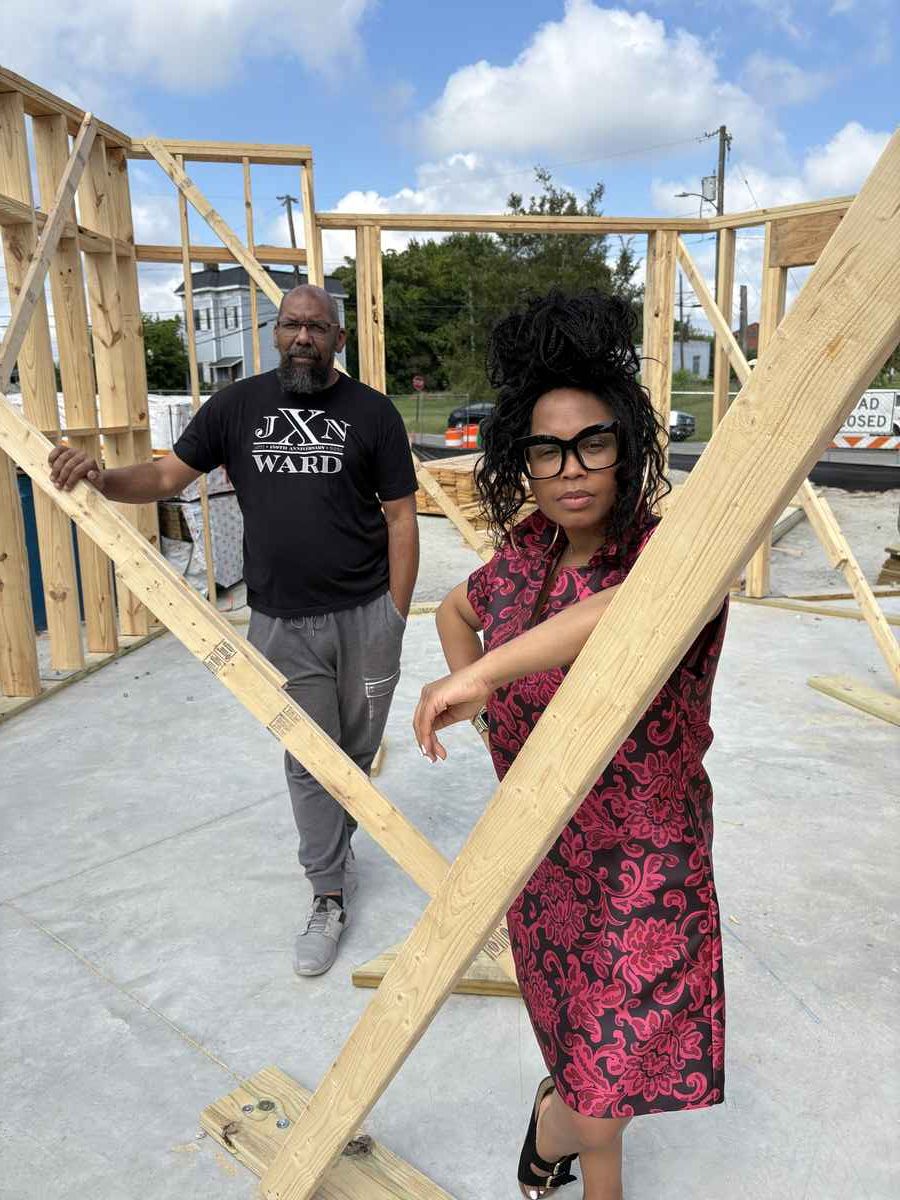
Burt Pinnock, left, is a Richmond architect who designed plans for the Skipwith-Roper Cottage, a new memorial to a pioneering free Black resident at the time of the city’s founding. Sesha Joi Moon, right, conceived the memorial along with her sister, Enjoli Moon, as part of their nonprofit organization, the JXN Project.
12:37 JST, September 8, 2025
RICHMOND – Abraham Peyton Skipwith died in 1799 and left his wife the kind of estate that befits a city founding father: horse and buggy, gun, six Windsor chairs, silver teaspoons, a home, a plot of land, a respected name.
But unlike his contemporaries in the new Virginia capital – such as future Supreme Court Justice John Marshall and uber-lawyer George Wythe – Skipwith was Black and formerly enslaved.
The little-known story of his success in the early days of the republic is finally getting attention through an exhibit at the Library of Virginia and an unusual monument under construction nearby. Together, they aim to recalibrate the understanding of how Skipwith and other Black Americans helped build the nation we have today and how the social foundation they created was shattered during the 20th century.
History “was just a lot more complicated than I think we give it credit for,” said Sesha Joi Moon, who with her sister, Enjoli, started the JXN Project nonprofit organization that conceived of the Skipwith memorial.
The project is part of a new wave of memorials in Richmond and elsewhere that aim to broaden the country’s understanding of America as its 250th birthday looms next year. Efforts by the Trump administration to restore Confederate monuments and scrub the Smithsonian Institution of exhibits that highlight slavery have given urgency to the push to tell a more complete story of the past, said Rivka Maizlish, who tracks Confederate memorials nationally for the Southern Poverty Law Center.
The emphasis on not just noting but celebrating the Confederacy should give way to “a positive history of struggles for justice and the people whose efforts have been largely erased,” Maizlish said.
In Augusta, Georgia, college students recently crusaded for and won historical markers honoring long-ago Black and Jewish leaders. In Kentucky and Indiana, the Kentuckiana Underground Railroad Project is working to create an art installation memorializing efforts to help enslaved people get to freedom across the Ohio River. The Museum of Contemporary Art in Los Angeles is assembling parts of dismantled Confederate memorials from across the country – including in Richmond and Charlottesville – for an exhibit this fall examining the racist mythology of the Lost Cause.
Richmond, the former capital of the Confederacy, was ground zero for the Lost Cause, with hometown sculptor Edward Valentine cranking out some of its enduring iconography and statues lining the city’s most prestigious thoroughfares. Today, the monuments are mostly gone and the Valentine, the city history museum that bears his name, has recently overhauled its depiction of his studio.
Using samples of Valentine’s work, the museum looks at the enduring power of images to reinforce divisions in society – in other words, the Valentine is using media to elevate some people and cast others as outsiders.
“This is a reminder of a pattern,” Valentine director William J. Martin said. “How are we repeating some of these patterns? How do we respond to immigration? How do we respond to race? How do we remember our history?”
A few blocks away, the city is making plans to commemorate a major African burying ground that was desecrated by development. And work has begun on the Shockoe Project, an ambitious multiyear effort to commemorate a Richmond slave market that was once the second-busiest in the nation, after New Orleans. Plans include an institute to study the long-term effects of the South’s slave-based economy as well as a national museum to the trade in human chattel.
The Shockoe Project’s facilities are being designed by local architect Burt Pinnock, who also designed the JXN Project’s memorial to Skipwith.
“This renaissance of working to tell untold and undertold stories and narratives is incredibly powerful, and I’m grateful to be involved with it,” Pinnock said.
Working with researchers at the Library of Virginia, Shesha Joi Moon and her sister identified Skipwith as probably the earliest Black landowner in Richmond, which became the state capital in 1780. Skipwith had petitioned for his freedom in 1785 during a period when the flush of the American Revolution led the General Assembly to open avenues for manumission. He finally bought his way out of slavery in 1789, leaving an extensive paper trail in state archives that showed his connections to some of the most prominent names in Virginia, including associates of Marshall and Thomas Jefferson.
Skipwith bought lots in Richmond to build his home in 1793. The neighborhood that grew up around him became a diverse mix of enslaved Black workers, hired out by their rural owners for urban jobs, living side-by-side with free Blacks, Jews and recent immigrants from Europe.
His granddaughter Maria inherited the house and married a free Black man named Peter Roper. One of their sons enlisted in the Union Army near the end of the Civil War. With emancipation, the bustling neighborhood that became known as Jackson Ward took off as an economic engine of the city, and another of Maria’s sons was elected to the Common Council that governed Richmond.
Jackson Ward flourished with banks, newspapers, theaters and restaurants, known both as Black Wall Street and as one of the Harlems of the South.
But the state discarded its Reconstruction constitution in 1902 for one written with the express purpose of disenfranchising Black voters. The Ku Klux Klan became active in Richmond and Confederate monuments spread across the city through the 1920s, as depicted through a multimedia display at the Valentine.
Jackson Ward was gerrymandered to reduce its political influence on the city council and then, in the 1950s, partly demolished to make way for the highway that is now Interstate 95, said Barbara Batson of the Library of Virginia. Batson curated a new “House to Highway” exhibit at the library that tells the Jackson Ward story through the lens of the Skipwith-Roper Cottage, which a White family saved from the wrecking ball in the 1950s and moved to a former plantation in Goochland County.
The Moon sisters gave up on plans to bring the house back to Richmond after determining that most of its historic components had been altered. So the JXN Project, which raised more than $2 million, is creating a memorial to Skipwith and his community on a plot of land in a part of Jackson Ward that was cut off by the highway and all but abandoned, with most structures now gone or dilapidated.
“We wanted to create a nucleus for this community that’s been so decimated,” Pinnock said. His design calls for a re-creation of the gambrel-roofed home that Skipwith built attached to a facility that will serve as a space for public programs, research and educational outreach. The outdoor area will feature a garden that Pinnock hopes will evoke the way residents of Jackson Ward used their environment to grow food and support one another.
Moon and her sister hope to raise another $3.5 million for the full build out of the facility. They plan to open next April in conjunction with celebrations of the founding of Jackson Ward and of America’s semiquincentennial.
It is, after all, a quintessentially American story. Skipwith was in the room in Williamsburg as patriots spoke of revolution; his presence was documented by the family that enslaved him. He built his own life on values of freedom and liberty. He left wealth for his descendants.
“He thought that he had done it all right,” Moon said. “In his will it says, to my heirs, and forever.”
But the community his descendants built was all but snuffed out during Jim Crow. As the Trump administration seeks to restore public tributes to the Confederacy, the JXN Project aims to celebrate a heritage thatendures.
“I feel like regardless of … the political climate or cultural climate, we are ensuring that this man can finally rest in peaceful power,” Moon said. “We are making sure that he now is known and honored forever, and so it’s our juxtaposition to everything else that’s happening.”









Most Read
Popular articles in the past 24 hours
-

Not Ready for Robots in Homes? The Maker of a Friendly New Humano...
-

Astronomers Unveil Map of Dark Matter’s Distribution
-

New York, New Jersey Sue Trump Administration over Tunnel Funding...
-

90-Year-Old Mother of Abductee Laments Lack of Progress
-

UK Police Open Criminal Investigation into Politician Peter Mande...
-

Son of Norway's Crown Princess Denies Rape Charges as Trial Begin...
-

Trump Accused of Distorting History of Mexican-American War to Ju...
-

Trump Signs Bill to End Partial Government Shutdown, Setting Stag...
Popular articles in the past week
-

Australian Woman Dies After Mishap on Ski Lift in Nagano Prefectu...
-
Foreign Snowboarder in Serious Condition After Hanging in Midair ...
-

Chinese Embassy in Japan Reiterates Call for Chinese People to Re...
-
Narita Airport, Startup in Japan Demonstrate Machine to Compress ...
-

Toyota Motor Group Firm to Sell Clean Energy Greenhouses for Stra...
-
Sakie Yokota, Last Surviving Parent of a North Korea Abductee, Ur...
-

Beer Yeast Helps Save Labor, Water Use in Growing Rice; Govt Hope...
-

Japan Tourism Agency Calls for Strengthening Measures Against Ove...
Popular articles in the past month
-

Univ. in Japan, Tokyo-Based Startup to Develop Satellite for Disa...
-
JAL, ANA Cancel Flights During 3-day Holiday Weekend due to Blizz...
-

China Confirmed to Be Operating Drilling Vessel Near Japan-China ...
-

China Eyes Rare Earth Foothold in Malaysia to Maintain Dominance,...
-

Japan Institute to Use Domestic Commercial Optical Lattice Clock ...
-
M6.2 Earthquake Hits Japan's Tottori, Shimane Prefectures; No Tsu...
-

Japan, Qatar Ministers Agree on Need for Stable Energy Supplies; ...
-

Japan, Italy to Boost LNG Cooperation; Aimed at Diversifying Japa...
Top Articles in News Services
-

Prudential Life Expected to Face Inspection over Fraud
-

Arctic Sees Unprecedented Heat as Climate Impacts Cascade
-

South Korea Prosecutor Seeks Death Penalty for Ex-President Yoon over Martial Law (Update)
-

Trump Names Former Federal Reserve Governor Warsh as the Next Fed Chair, Replacing Powell
-

Suzuki Overtakes Nissan as Japan’s Third‑Largest Automaker in 2025
JN ACCESS RANKING
-
Univ. in Japan, Tokyo-Based Startup to Develop Satellite for Disaster Prevention Measures, Bears
-
JAL, ANA Cancel Flights During 3-day Holiday Weekend due to Blizzard
-
China Confirmed to Be Operating Drilling Vessel Near Japan-China Median Line
-
China Eyes Rare Earth Foothold in Malaysia to Maintain Dominance, Counter Japan, U.S.
-
Japan Institute to Use Domestic Commercial Optical Lattice Clock to Set Japan Standard Time