
11:58 JST, September 6, 2025
A federal judge’s ruling Wednesday was a resounding win for Harvard – a sweeping finding that the Trump administration had violated the Constitution in freezing federal research funding to the school. It was immediately cheered by faculty, alumni and student groups, with many urging Harvard to keep fighting.
But despite the victory, Harvard faces daunting hurdles in its standoff against an administration determined to force change on higher education, and the final outcome for the nation’s oldest university is far from clear.
The challenges are unprecedented: They include a promised appeal in court, worry that the government will slow-walk restoring frozen research funds, threats to future grants, complicated settlement negotiations – and the prospect of another 3½ years of a hostile White House with a bevy of arrows in its quiver and a proven willingness to aim them at its opponents.
The Trump administration, which has already opened numerous investigations at Harvard, has threatened to revoke its nonprofit status and to bar international students and scholars from campus.
On Thursday it signaled new plans to eventually “streamline” the process of denying funding for schools found to have violated civil rights law.
“Yesterday’s court ruling is a victory for Harvard,” said Allison Wu, a Harvard Business School graduate who leads a group of alumni, the 1636 Forum, that has pressed the university to change. “But even beyond an appeal, the government still has many means of pressure.”
She mentioned terminating grants, denying visas, seizing patents – and turning threats into action.
The White House made clear the fight is by no means over.
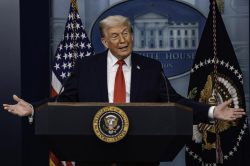
“Harvard does not have a constitutional right to taxpayer dollars,” spokeswoman Liz Huston said, “and remains ineligible for grants in the future.”
Trump’s next move
On Wednesday, U.S. District Judge Allison D. Burroughs ruled that freezing more than $2 billion in research grants and other federal actions violated Harvard’s right to freedom of speech and federal laws. She vacated the freeze and barred the Trump administration from using similar reasoning to block grants to Harvard in the future. In a strongly worded ruling, she said the government “used antisemitism as a smoke screen for a targeted, ideologically-motivated assault on this country’s premier universities,” jeopardizing decades of research.
The White House said it will appeal the ruling, and many expect the case to advance to the Supreme Court.
Experts said the Trump administration’s first move could be to ask that Wednesday’s order be paused pending the outcome of an appeal, which would allow the government to delay resuming any payments to Harvard. That request would be considered by both Burroughs and the U.S. Court of Appeals for the 1st Circuit, said David Super, a law professor at Georgetown University.
If Burroughs’s order is not stayed, then the government is likely to take the same request to the Supreme Court for immediate relief via what is known as the “emergency docket.”
Wednesday’s ruling was “nearly a complete victory” for Harvard, said Michael Gerhardt, a law professor at the University of North Carolina. As a result, the Trump administration’s goal will be to get its arguments before the Supreme Court – where it expects a favorable hearing – “as soon as possible,” Gerhardt said.
In her order, Burroughs was scrupulous about addressing “every single issue” raised by the government and nearly every issue raised by Harvard and its allies, Super said, which will reduce the possibility of any confusion on appeal.
“The most important thing about the ruling is how careful it is,” Super said. “There is just no room for misunderstanding the issues after what Judge Burroughs wrote.”
Noah Feldman, a law professor at Harvard, said parts of Burroughs’s ruling appeared tailored to address guidance provided by Justice Amy Coney Barrett, who proved a key swing vote in an August ruling in a somewhat similar case. Wednesday’s order is a “masterful piece of technical legal craftsmanship,” Feldman said.
A full appeal of Burroughs’s ruling would probably take months. Super predicted that there could be an appellate court decision in the case by Thanksgiving, which would allow for a Supreme Court hearing in the spring.
Grants may not be restored soon
This wouldn’t be the first case about federal funding cuts to make it to the Supreme Court this year.
In June, another federal court judge in Boston ordered the Trump administration to restore cuts made by the National Institutes of Health to hundreds of grants to colleges nationwide related to topics such as race and gender identity. It took more than a month for most of the grants to be reinstated, said a person familiar with the matter, speaking on the condition of anonymity because the case is ongoing.
The Supreme Court subsequently stayed the lower court’s order in part, clearing the way for the Trump administration to proceed with the cuts. However, NIH does not appear to have clawed back the restored grants, the person said.
Even if higher courts affirm that Harvard’s funding must be restored, there are ways for the administration to drag its feet.
The grant funding does not automatically resume. Rather, someone in the government needs to reauthorize payments and reactivate grants, said Scott Delaney, a research scientist at Harvard’s T.H. Chan School of Public Health.
“There are no shortage of strategies that toe the legal line that the Trump administration might employ,” he said.
He added that every day that passes is another day without funding for researchers. “Time is not on Harvard’s side.”
Nancy Krieger is a social epidemiologist at Harvard’s school of public health who had two research grants thrown into turmoil by the Trump administration, one related to health impacts of discrimination. She’s optimistic they will be restored but also cautious given the legal turbulence. She says she has already reached out to the university’s grant administrators. “I’m eager to find out the news, when there is news,” Krieger said. “Who knows what the timelines will be.”
Negotiating a settlement
White House officials – and President Donald Trump himself – have been saying for months that they are likely to reach a deal with Harvard soon. Some experts said Thursday that the court victory could improve the school’s chances for a favorable settlement.
Jay Greene, a senior research fellow at the conservative Heritage Foundation, said Wednesday’s ruling may have improved Harvard’s negotiating position somewhat. Still, any settlement would be a victory for the administration, he said.
Greene noted that the judge concluded Harvard did not appropriately handle antisemitism on campus and said the university will, one way or another, pay for that.
Agreeing to any of the terms the administration is pressing for would be complicated for Harvard, which faces pressure from inside the university and from the broader field of higher education to hang tough.
A faculty union, which had also sued the Trump administration in a case heard concurrently, cheered the win. So did alumni and student groups formed to urge Harvard to keep fighting.
Some experts said Wednesday’s decision made a settlement less likely.
“It’s very hard for Harvard to settle at this point,” said Georgetown’s Super. If the university gave the appearance of capitulating after winning in court on First Amendment grounds, “I just don’t think Harvard could survive that.”
Harvard’s president, Alan M. Garber, said in a message to the campus community Wednesday that the ruling validates the school’s arguments in defense of academic freedom, scientific research and core principles of higher education.
But he also said that the university “will continue to assess the implications of the opinion, monitor further legal developments, and be mindful of the changing landscape in which we seek to fulfill our mission.”
Other possible attacks
For months, the Trump administration unleashed federal efforts to compel Harvard to do more to combat antisemitism and make other changes on campus, using a wide variety of tactics and threats. It has shown no sign it is willing to stop that campaign.
On Thursday the Education Department signaled that it intends to streamline the process of punishing universities found to have violated civil rights laws barring discrimination on the basis of sex, race and national origin.
These plans, which were only briefly summarized, were included in the administration’s spring regulatory agenda, a list of actions expected in coming months.
It was not clear exactly how the administration will seek to expedite the process. The government is required to follow numerous steps before cutting off federal funding, many of which the administration has ignored in withholding funding from several universities. The administration said it aimed to publish its new rules in June 2026.
A department spokeswoman did not reply to a request for comment.
Greene of the Heritage Foundation said the administration can also launch new efforts to pull Harvard’s funding using well-established civil rights laws and procedures. That would stand in contrast to the abrupt cancellation of grants that is being challenged in the case being litigated.
Feldman, the Harvard law professor, said the university – which will be 400 years old in 2036 – should approach its confrontation with the government with an eye toward the very long term.
Scientific research needs to thrive at the university, he said, but “if we could get there without knuckling under to the Trump administration, that would be the optimal result.”
– – –
Carolyn Y. Johnson contributed to this report.






Most Read
Popular articles in the past 24 hours
-
Not Ready for Robots in Homes? The Maker of a Friendly New Humano...
-

Astronomers Unveil Map of Dark Matter’s Distribution
-

New York, New Jersey Sue Trump Administration over Tunnel Funding...
-

90-Year-Old Mother of Abductee Laments Lack of Progress
-

UK Police Open Criminal Investigation into Politician Peter Mande...
-

Son of Norway's Crown Princess Denies Rape Charges as Trial Begin...
-
Trump Accused of Distorting History of Mexican-American War to Ju...
-
Trump Signs Bill to End Partial Government Shutdown, Setting Stag...
Popular articles in the past week
-

Australian Woman Dies After Mishap on Ski Lift in Nagano Prefectu...
-

Foreign Snowboarder in Serious Condition After Hanging in Midair ...
-

Chinese Embassy in Japan Reiterates Call for Chinese People to Re...
-

Narita Airport, Startup in Japan Demonstrate Machine to Compress ...
-

Toyota Motor Group Firm to Sell Clean Energy Greenhouses for Stra...
-

Sakie Yokota, Last Surviving Parent of a North Korea Abductee, Ur...
-

Beer Yeast Helps Save Labor, Water Use in Growing Rice; Govt Hope...
-

Japan Tourism Agency Calls for Strengthening Measures Against Ove...
Popular articles in the past month
-

Univ. in Japan, Tokyo-Based Startup to Develop Satellite for Disa...
-

JAL, ANA Cancel Flights During 3-day Holiday Weekend due to Blizz...
-
China Confirmed to Be Operating Drilling Vessel Near Japan-China ...
-

China Eyes Rare Earth Foothold in Malaysia to Maintain Dominance,...
-

Japan Institute to Use Domestic Commercial Optical Lattice Clock ...
-
M6.2 Earthquake Hits Japan's Tottori, Shimane Prefectures; No Tsu...
-

Japan, Qatar Ministers Agree on Need for Stable Energy Supplies; ...
-

Japan, Italy to Boost LNG Cooperation; Aimed at Diversifying Japa...
Top Articles in News Services
-

Prudential Life Expected to Face Inspection over Fraud
-

Arctic Sees Unprecedented Heat as Climate Impacts Cascade
-

South Korea Prosecutor Seeks Death Penalty for Ex-President Yoon over Martial Law (Update)
-
Trump Names Former Federal Reserve Governor Warsh as the Next Fed Chair, Replacing Powell
-

Suzuki Overtakes Nissan as Japan’s Third‑Largest Automaker in 2025
JN ACCESS RANKING
-
Univ. in Japan, Tokyo-Based Startup to Develop Satellite for Disaster Prevention Measures, Bears
-
JAL, ANA Cancel Flights During 3-day Holiday Weekend due to Blizzard
-
China Confirmed to Be Operating Drilling Vessel Near Japan-China Median Line
-
China Eyes Rare Earth Foothold in Malaysia to Maintain Dominance, Counter Japan, U.S.
-
Japan Institute to Use Domestic Commercial Optical Lattice Clock to Set Japan Standard Time