
‘Dark Patterns’ Exploit Online Consumers’ Vulnerabilities; Psychological Manipulation Can Spur Unwanted Purchases
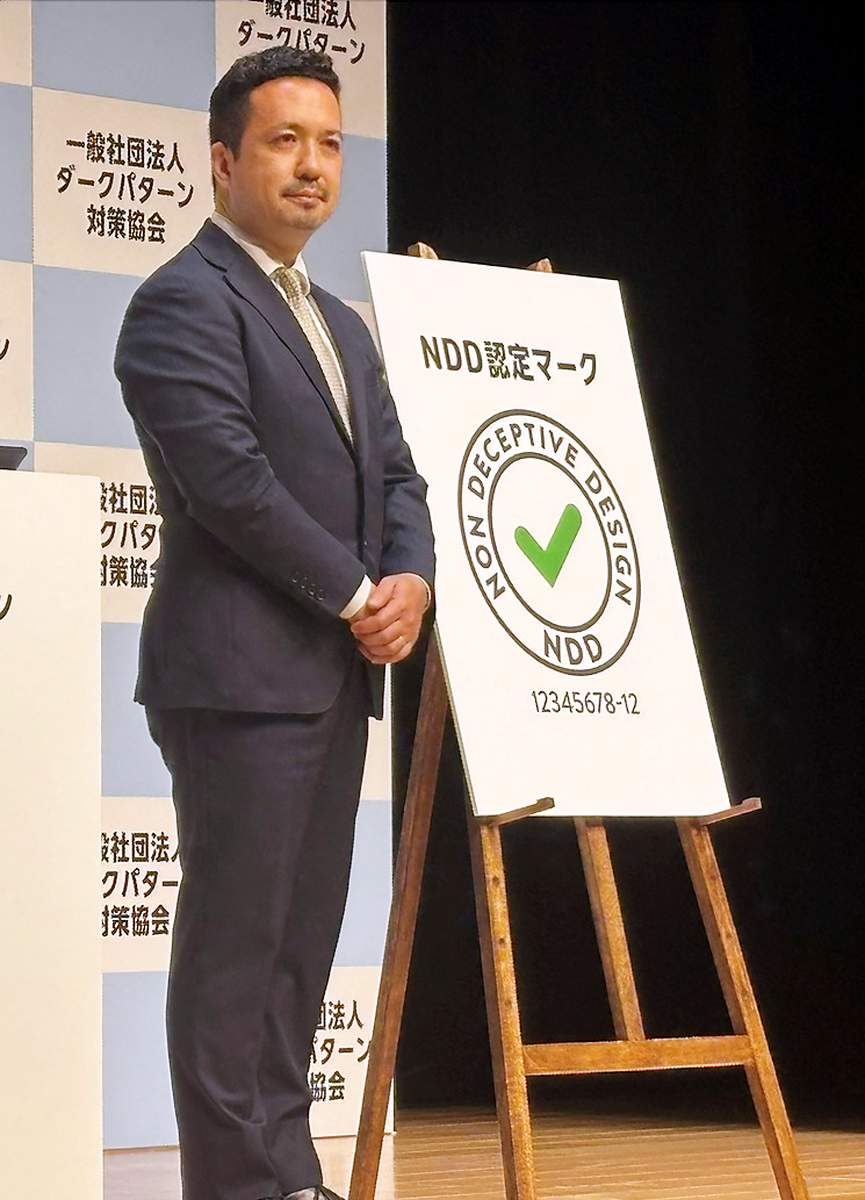
Antonios Karaiskos introduces a “NonDeceptive Design” accreditation mark at a press conference in Tokyo on July 15.
8:00 JST, August 2, 2025
Concerns are growing over “dark patterns” that manipulate consumers into making unintended choices on their computers and smartphones, prodding them to make purchases or sign contracts.
Examples of dark patterns include displaying countdown timers to pressure consumers into making decisions within a limited time frame or using vague and misleading phrases such as “low in stock” to stimulate purchasing desire. While some practices are legally regulated, many fall into a gray area. To avoid being deceived by tricky marketing tactics in the digital space, it is important for us to recognize that we may not always make decisions based on rational judgment.
The term “dark patterns” was coined in 2010. Harry Brignull, a British expert in web design and related fields, defined a dark pattern as “a user interface that has been carefully crafted to trick users into doing things, such as buying insurance with their purchase or signing up for recurring bills.” He urged consumers to be cautious.
Since then, researchers and government agencies have analyzed various types of dark patterns and the biases they exploit to influence behavior.
The Organization for Economic Cooperation and Development has categorized dark patterns into seven types. These include “obstruction,” which complicates the cancellation process as a way to prolong contracts, and “forced action,” which tricks or forces consumers into sharing more information than they wish. Another example is “interface interference,” in which the options desired by the seller are prominent or preselected by default.
Dark patterns are effective because they exploit biases or weaknesses in human psychology. Here are some examples.
First, there is the bias known as social proof. This bias causes people to follow the opinions that are popular around them. In today’s information-saturated society, it is difficult to carefully evaluate each piece of information and make judgments on one’s own, so it is reasonable to refer to the opinions of others. It amounts to saying, “Everyone else says it’s good.”
When it comes to shopping, we don’t want to spend time and effort researching products every time. That is why we care about reputation. However, if that reputation is intentionally fabricated, the situation is different. Examples include claiming to be the best in quality without sufficient supporting research or posting reviews that may be false.
There is also a bias that makes us perceive hard-to-obtain items as valuable. This is known as the scarcity effect. For example, popular items can become even more attention-grabbing and more difficult to obtain because they are scarce. The combination of “popularity” as social proof and “scarcity” creates long lines to buy. When we see the same item available in abundance later on, we might realize that not only the quality of the product but also the power of the “scarcity” appeal influenced our decision to buy.
The psychological mechanisms behind the effectiveness of dark patterns, such as the phrase “low in stock,” likely stem from these mental processes. Similarly, the term “limited time only” appeals to the idea of a rare product available only now, triggering an emotional response.
Such dark patterns are sometimes regulated by consumer protection laws, but there remain gray areas in which it is unclear whether they are legal or illegal.
The Association for Countermeasures Against Dark Patterns, established in September 2024 by concerned companies and experts, plans to certify honest websites that do not use dark patterns with the designation “Non-Deceptive Design” after evaluating the websites. The association will award them an accreditation mark to ensure that consumers can shop safely on secure sites. Antonios Karaiskos, a director of the association and a professor at Ryukoku University, announced the accreditation mark at a press conference in Tokyo on July 15.
Dark patterns encourage consumption by leveraging evolving digital technology to exploit human biases. In the future, artificial intelligence may analyze individual consumers’ bias tendencies — such as whether they are prone to feeling rushed by time constraints like countdown timers — and create dark patterns targeting each person’s vulnerabilities.
Considering this as a drawback of AI development, it becomes apparent that dark patterns share similarities with the serious issue of online misinformation. Uncertain rumors and misinformation have existed in society for a long time, but AI that can mass-produce sophisticated misinformation is exacerbating the situation. When it comes to shopping, there have always been exaggerated and misleading sales pitches, but the expansion of digital transactions is raising new concerns.
While the digital space offers the convenience of being able to shop almost anytime, it is important to be conscious of the new risks that arise in this environment, which lacks the simplicity of the traditional shopping experience of handling products and conversing with human beings on the store staff.
Political Pulse appears every Saturday.

Makoto Mitsui
Makoto Mitsui is a Senior Research Fellow at Yomiuri Research Institute.







Most Read
Popular articles in the past 24 hours
-

Japanese High School Student Aims to Share Kaiten History Through...
-

PM Takaichi Spells out Plans to Advance Bold Policy Shifts in Spe...
-
Chronic Issues Erode Thailand’s Economy as Political Confusion Pe...
-

Tottori: 95-Year-Old Japanese Descendent from Philippines Visits ...
-

Japan to Monitor Trump Administration's Response to U.S. Supreme ...
-

Milano Cortina 2026: Speed Skater Takagi Finishes 6th in the 1,50...
-

Osaka: 40 Ninjas Display Shuriken Throwing Skills at Japan Champi...
-

Miyazaki: Japanese Woman Walks in Footsteps of Samurai Ancestor W...
Popular articles in the past week
-

Japan PM Takaichi’s Cabinet Resigns en Masse
-

Man Infected with Measles Reportedly Dined at Restaurant in Tokyo...
-

Sanae Takaichi Elected Prime Minister of Japan; Keeps All Cabinet...
-

Japan's Govt to Submit Road Map for Growth Strategy in March, PM ...
-

Bus Carrying 40 Passengers Catches Fire on Chuo Expressway; All E...
-

Milano Cortina 2026: Figure Skaters Riku Miura, Ryuichi Kihara Pa...
-

Japan, U.S. Name 3 Inaugural Investment Projects; Reached Agreeme...
-

U.S. Firm to Build Training Hub in Fukushima N-plant for Debris R...
Popular articles in the past month
-
Japan PM Takaichi’s Cabinet Resigns en Masse
-

Japan Institute to Use Domestic Commercial Optical Lattice Clock ...
-

Israeli Ambassador to Japan Speaks about Japan’s Role in the Reco...
-
Man Infected with Measles Reportedly Dined at Restaurant in Tokyo...
-

Videos Plagiarized, Reposted with False Subtitles Claiming ‘Ryuky...
-

Man Infected with Measles May Have Come in Contact with Many Peop...
-

Prudential Life Insurance Plans to Fully Compensate for Damages C...
-

Woman with Measles Visited Hospital in Tokyo Multiple Times Befor...
Top Articles in Editorial & Columns
-

Riku-Ryu Pair Wins Gold Medal: Their Strong Bond Leads to Major Comeback Victory
-

40 Million Foreign Visitors to Japan: Urgent Measures Should Be Implemented to Tackle Overtourism
-

China Provoked Takaichi into Risky Move of Dissolving House of Representatives, But It’s a Gamble She Just Might Win
-
University of Tokyo Professor Arrested: Serious Lack of Ethical Sense, Failure of Institutional Governance
-
Policy Measures on Foreign Nationals: How Should Stricter Regulations and Coexistence Be Balanced?
JN ACCESS RANKING
-
Japan PM Takaichi’s Cabinet Resigns en Masse
-
Japan Institute to Use Domestic Commercial Optical Lattice Clock to Set Japan Standard Time
-
Israeli Ambassador to Japan Speaks about Japan’s Role in the Reconstruction of Gaza
-
Man Infected with Measles Reportedly Dined at Restaurant in Tokyo Station
-
Videos Plagiarized, Reposted with False Subtitles Claiming ‘Ryukyu Belongs to China’; Anti-China False Information Also Posted in Japan