
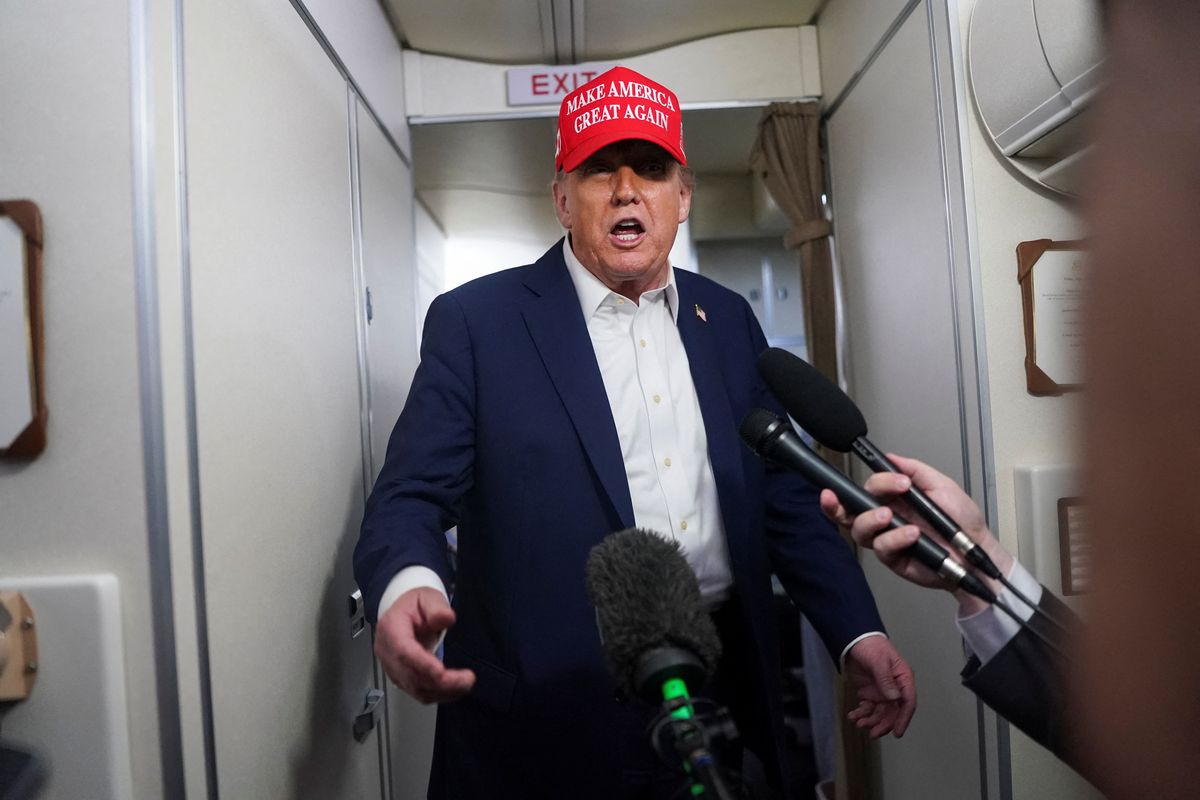
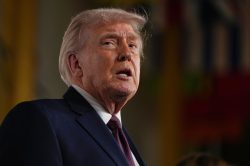
U.S. President Donald Trump speaks to members of the media on board Air Force One on the way to New Jersey, U.S., July 4, 2025.
14:22 JST, July 5, 2025
July 4 (Reuters) – U.S. President Donald Trump said he had signed letters to 12 countries outlining the various tariff levels they would face on goods they export to the United States, with the “take it or leave it” offers to be sent out on Monday.
Trump, speaking to reporters aboard Air Force One as he traveled to New Jersey, declined to name the countries involved, saying that would be made public on Monday.
Trump had earlier on Thursday told reporters that he expected a first batch of letters to go out on Friday, a national holiday in the United States, though the date has now shifted.
In a global trade war that has upended financial markets and set off a scramble among policymakers to guard their economies, Trump in April announced a 10% base tariff rate and additional amounts for most countries, some ranging as high as 50%.
However, all but the 10% base rate were subsequently suspended for 90 days to allow more time for negotiations to secure deals.
That period ends on July 9, although Trump early on Friday said the tariffs could be even higher – ranging up to 70% – with most set to go into effect August 1.
“I signed some letters and they’ll go out on Monday, probably twelve,” Trump said, when asked about his plans on the tariff front. “Different amounts of money, different amounts of tariffs.”
Trump and his top aides initially said they would launch negotiations with scores of countries on tariff rates, but the U.S. president has soured on that process after repeated setbacks with major trading partners, including Japan and the European Union.
He touched on that briefly late on Friday, telling reporters: “The letters are better … much easier to send a letter.”
He did not address his prediction that some broader trade agreements could be reached before the July 9 deadline.
The shift in the White House’s strategy reflects the challenges of completing trade agreements on everything from tariffs to non-tariff barriers such as bans on agricultural imports, and especially on an accelerated timeline.
Most past trade agreements have taken years of negotiations to complete.
The only trade agreements reached to date are with Britain, which reached a deal in May to keep a 10% rate and won preferential treatment for some sectors including autos and aircraft engines, and with Vietnam, cutting tariffs on many Vietnamese goods to 20% from his previously threatened 46%. Many U.S. products would be allowed to enter Vietnam duty free.
A deal expected with India has failed to materialize, and EU diplomats on Friday said they have failed to achieve a breakthrough in trade negotiations with the Trump administration, and may now seek to extend the status quo to avoid tariff hikes.





Most Read
Popular articles in the past 24 hours
-

My Spendthrift Mother Constantly Asks Me for Money
-

Japanese Students Use Traditional Pickle to Create Novel Wagashi ...
-

‘Dry Bonsai’ Gives New Life to Withered Trees, Allows Free Artist...
-

A Packed Bus Plunges off a Nepal Highway, Killing 19 and Injuring...
-

Astellas Collaborates with Vir to Develop Its Experimental Prosta...
-

Nepal Bus Crash Kills 19 People, Injures 25 Including One Japanes...
-

Early-Blooming Kawazu Cherry Blossoms Create Sea of Pink at Park ...
-

Japan’s Nikkei Stock Average Rises as Trading Resumes after Holid...
Popular articles in the past week
-

Producer Behind Pop Group XG Arrested for Cocaine Possession
-

Japan PM Takaichi’s Cabinet Resigns en Masse
-

Man Infected with Measles Reportedly Dined at Restaurant in Tokyo...
-

Sanae Takaichi Elected Prime Minister of Japan; Keeps All Cabinet...
-

Japan's Govt to Submit Road Map for Growth Strategy in March, PM ...
-

Bus Carrying 40 Passengers Catches Fire on Chuo Expressway; All E...
-
U.S. Firm to Build Training Hub in Fukushima N-plant for Debris R...
-

Japan, U.S. Name 3 Inaugural Investment Projects; Reached Agreeme...
Popular articles in the past month
-
Producer Behind Pop Group XG Arrested for Cocaine Possession
-
Japan PM Takaichi’s Cabinet Resigns en Masse
-

Japan Institute to Use Domestic Commercial Optical Lattice Clock ...
-
Man Infected with Measles Reportedly Dined at Restaurant in Tokyo...
-

Israeli Ambassador to Japan Speaks about Japan’s Role in the Reco...
-

Videos Plagiarized, Reposted with False Subtitles Claiming ‘Ryuky...
-

Man Infected with Measles May Have Come in Contact with Many Peop...
-

Prudential Life Insurance Plans to Fully Compensate for Damages C...
Top Articles in News Services
-
Survey Shows False Election Info Perceived as True
-
Hong Kong Ex-Publisher Jimmy Lai’s Sentence Raises International Outcry as China Defends It
-
Japan’s Nikkei Stock Average Touches 58,000 as Yen, Jgbs Rally on Election Fallout (UPDATE 1)
-
Japan’s Nikkei Stock Average Falls as US-Iran Tensions Unsettle Investors (UPDATE 1)
-
Trump Names Former Federal Reserve Governor Warsh as the Next Fed Chair, Replacing Powell
JN ACCESS RANKING
-
Producer Behind Pop Group XG Arrested for Cocaine Possession
-
Japan PM Takaichi’s Cabinet Resigns en Masse
-
Japan Institute to Use Domestic Commercial Optical Lattice Clock to Set Japan Standard Time
-
Man Infected with Measles Reportedly Dined at Restaurant in Tokyo Station
-
Israeli Ambassador to Japan Speaks about Japan’s Role in the Reconstruction of Gaza