
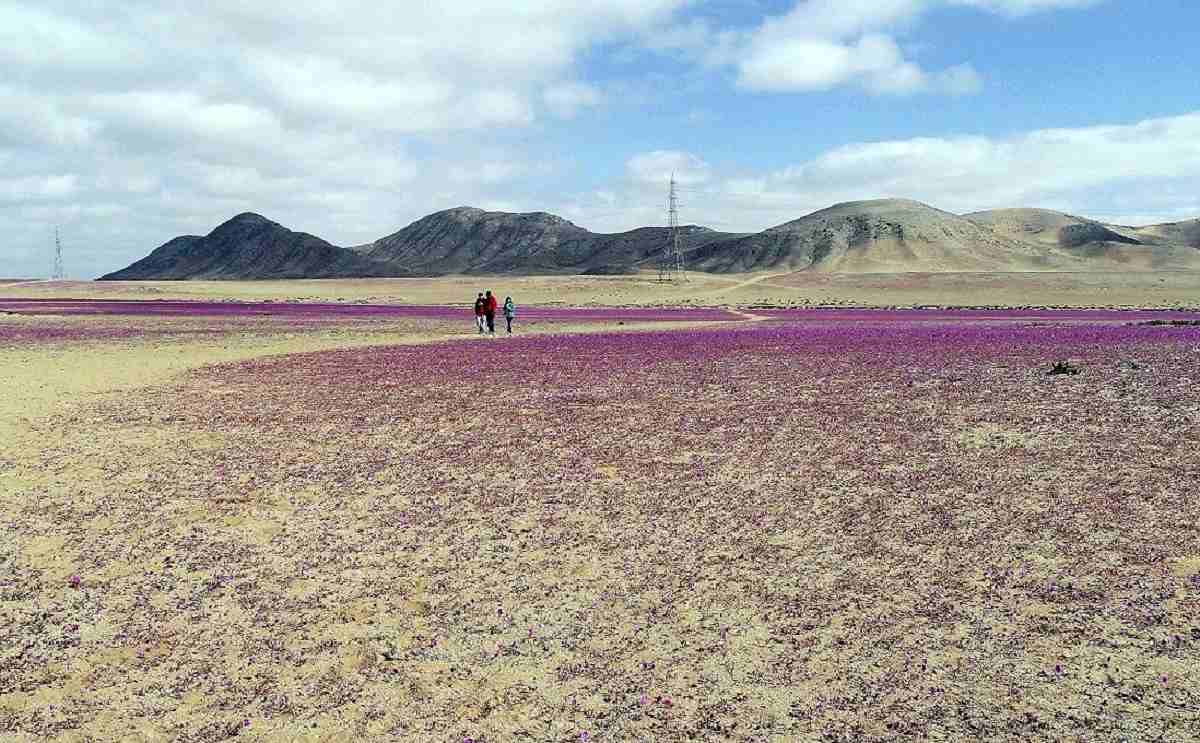
The Atacama Desert covered by flowers is seen in Copiapo, Chile, on July 10.
16:45 JST, July 27, 2024
COPIAPO, Chile (AFP-Jiji) — Large swaths of the Atacama desert, the driest on the planet, have been covered with purple and white flowers after unusual rainfall patterns in northern Chile.
Normally, such a desert bloom occurs every few years in the southern springtime — if and when conditions are just right — blanketing thousands of square kilometers.
But the flowers are making an appearance now in winter, something that hasn’t happened since 2015, experts say.
Cesar Pizarro, head of biodiversity conservation at the National Forestry Corporation, told AFP that 11-12 millimeters of rainfall in April “plus low cloud cover that has been very intense in the area and that wets these surfaces every night, helped activate these plants.”
While the famed spring flowering desert spreads over 15,000 square kilometers, this winter efflorescence is covering only a few hundred square kilometers.
When the bloom is at its peak, more than 200 plant species blossom. Recent weather conditions appear to have mainly suited the “pata de guanaco,” a purple flower that barely requires water and prefers sandy sites.





Most Read
Popular articles in the past 24 hours
-

Japanese Version of Shohei Ohtani's Picture Book Published
-

Milano Cortina 2026: Japan’s Speed Skater Takagi Sinks to 6...
-

Osaka: 40 Ninjas Display Shuriken Throwing Skills at Japan Champi...
-
Tottori: 95-Year-Old Japanese Descendent from Philippines Visits ...
-
Hiroshima: Land Scape, Special Architecture to Offer Unique Beaut...
-
Miyazaki: Japanese Woman Walks in Footsteps of Samurai Ancestor W...
-

Japan PM Sanae Takaichi Declares ‘Responsible Diplomacy’ in Her P...
-

Japan to Host 3rd Pacific Islands Defense Meeting from Sunday thr...
Popular articles in the past week
-

Japan PM Takaichi’s Cabinet Resigns en Masse
-

Man Infected with Measles Reportedly Dined at Restaurant in Tokyo...
-

Sanae Takaichi Elected Prime Minister of Japan; Keeps All Cabinet...
-

Japan's Govt to Submit Road Map for Growth Strategy in March, PM ...
-

Bus Carrying 40 Passengers Catches Fire on Chuo Expressway; All E...
-

Milano Cortina 2026: Figure Skaters Riku Miura, Ryuichi Kihara Pa...
-

Japan, U.S. Name 3 Inaugural Investment Projects; Reached Agreeme...
-

U.S. Firm to Build Training Hub in Fukushima N-plant for Debris R...
Popular articles in the past month
-
Japan PM Takaichi’s Cabinet Resigns en Masse
-

Japan Institute to Use Domestic Commercial Optical Lattice Clock ...
-

Israeli Ambassador to Japan Speaks about Japan’s Role in the Reco...
-
Man Infected with Measles Reportedly Dined at Restaurant in Tokyo...
-

Videos Plagiarized, Reposted with False Subtitles Claiming ‘Ryuky...
-

Man Infected with Measles May Have Come in Contact with Many Peop...
-

Prudential Life Insurance Plans to Fully Compensate for Damages C...
-

Woman with Measles Visited Hospital in Tokyo Multiple Times Befor...
Top Articles in Science & Nature
-
Japan Institute to Use Domestic Commercial Optical Lattice Clock to Set Japan Standard Time
-
Japan to Face Shortfall of 3.39 Million Workers in AI, Robotics in 2040; Clerical Workers Seen to Be in Surplus
-

Record 700 Startups to Gather at SusHi Tech Tokyo in April; Event Will Center on Themes Like Artificial Intelligence and Robotics
-

iPS Treatments Pass Key Milestone, but Broader Applications Far from Guaranteed
-
iPS Cell Products for Parkinson’s, Heart Disease OK’d for Commercialization by Japan Health Ministry Panel
JN ACCESS RANKING
-
Japan PM Takaichi’s Cabinet Resigns en Masse
-
Japan Institute to Use Domestic Commercial Optical Lattice Clock to Set Japan Standard Time
-
Israeli Ambassador to Japan Speaks about Japan’s Role in the Reconstruction of Gaza
-
Man Infected with Measles Reportedly Dined at Restaurant in Tokyo Station
-
Videos Plagiarized, Reposted with False Subtitles Claiming ‘Ryukyu Belongs to China’; Anti-China False Information Also Posted in Japan