
KAGRA to Join International Gravitational Wave Project; Underground Facility Recently Improved Instruments
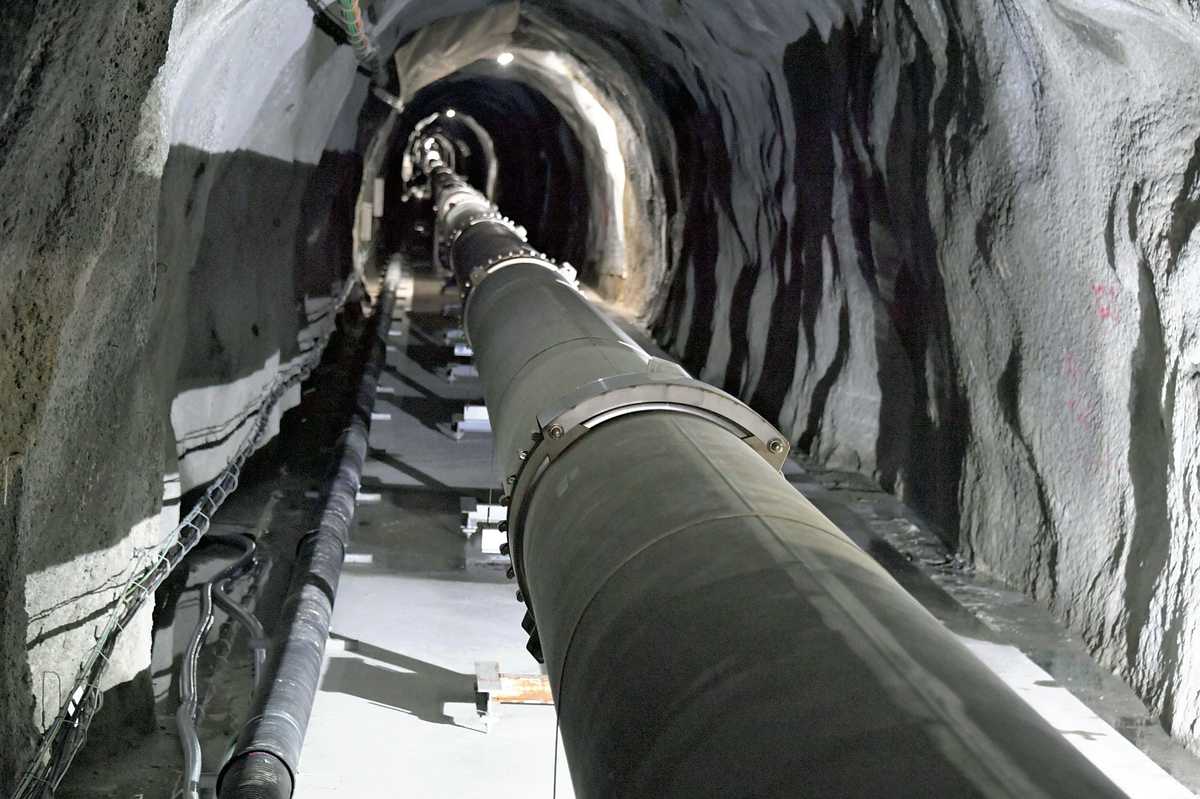
One of KAGRA’s pipe arms is seen deep underground in Hida, Gifu Prefecture.
13:00 JST, February 23, 2025
The Kamioka Gravitational wave detector, Large-scale Cryogenic Gravitational Telescope (KAGRA) is scheduled to join an international scientific observation project for the first time since its establishment, starting in June at the earliest.
KAGRA, located in Hida, Gifu Prefecture, is operated by entities including the University of Tokyo’s Institute for Cosmic Ray Research. The facility will participate in the project together with counterparts in the United States and European countries.
KAGRA has yet to succeed in detecting gravitational waves since it began operation in 2020. This time, researchers have taken measures to improve KAGRA’s observational sensitivity with the aim of detecting gravitational waves for the first time inside Japan.
Gravitational waves are produced by such incidents as mergers of extremely massive astronomical objects, including black holes.
Researchers in the United States succeeded in detecting gravitational waves for the first time in the world in 2015, and researchers in Europe did so in 2017. The U.S. researchers later received the Nobel Prize in Physics.
Detecting gravitational waves with more than one detector can raise the accuracy of observations. It is expected that scientific understanding of the nature of black holes and other mysteries of the universe will be advanced.
Located 200 meters underground, KAGRA comprises two pipe arms, each measuring 3 kilometers long, combined in an L-shaped structure.
KAGRA aims to detect a phenomenon in which laser beams making round trips inside the pipe arms undergo minute distortions due to the effects of passing gravitational waves.
KAGRA began trying to detect the waves in 2020, making its first attempt with the United States in 2023. But KAGRA could not detect any at the time because its observation devices were insufficiently sensitive.
Researchers at KAGRA aimed to begin observations again in spring 2024, but the plan was postponed because the observation devices were affected by the Noto Peninsula Earthquake on Jan. 1 of that year.
The researchers improvements and decided to join the international project with U.S. and European counterparts beginning as early as June of this year.
The researchers increased KAGRA’s observational sensitivity about seven-fold compared with that before the improvements, through such measures as improving anti-vibration equipment. They aim for the facility have a performance level at which it can observe points in the universe 32.6 million light years from Earth.
Prof. Hideyuki Tagoshi of the institute, an expert on gravitational wave physics, said, “By observing in Japan, the United States and Europe simultaneously, it will be easier to identify the locations of origins of gravitational waves.”







Most Read
Popular articles in the past 24 hours
-

Japan Defense Agency to Develop AI Intelligence Analysis System f...
-

Government to Establish ‘Command Center’ for Developing Nuclear P...
-

Moai Statue Shows Lasting Bond Between Miyagi Pref. Town, Easter ...
-

Milano Cortina 2026: Japan’s Oguri Wins Para Snowboard Silver at ...
-
Japan's Defense Ministry: North Korea Appears to Have Fired Balli...
-

Aichi Fisheries Cooperatives Use Smart Tech to Farm Triploid Oyst...
-

Teachers Support Students’ Inquiry Learning behind the Scenes
-

Japan's Lower House Passes Budget Proposal; Could Be Delayed in U...
Popular articles in the past week
-

Japan Figure Skating Legend Yuzuru Hanyu Is Proud Disaster Surviv...
-
Govt to Utilize ODA for Ensuring Economic Security; Securing Ener...
-
15 Measles Patients Confirmed in Tokyo in Past 6 Days; 1 May Have...
-

Massive Sewer Pipe Found Jutting Out of Highway in Osaka
-

Japan Govt to Tighten Requirements to Receive Permanent Residency...
-

JR Tokai Breaks Ground on Yamanashi Maglev Station; Will Be Part ...
-

Beckoning Cats Get Makeover to Fit Modern Lifestyles with Sleek D...
-
Power Outage Forces About 980 Passengers in Yokohama to Walk to T...
Popular articles in the past month
-

Producer Behind Pop Group XG Arrested for Cocaine Possession
-

Japan PM Takaichi’s Cabinet Resigns en Masse
-

Man Infected with Measles Reportedly Dined at Restaurant in Tokyo...
-

Videos Plagiarized, Reposted with False Subtitles Claiming ‘Ryuky...
-
Japan Figure Skating Legend Yuzuru Hanyu Is Proud Disaster Surviv...
-

iPS Treatments Pass Key Milestone, but Broader Applications Far f...
-

Sanae Takaichi Elected Prime Minister of Japan; Keeps All Cabinet...
-

Nepal Bus Crash Kills 19 People, Injures 25 Including One Japanes...
Top Articles in Science & Nature
-
iPS Treatments Pass Key Milestone, but Broader Applications Far from Guaranteed
-

Record 700 Startups to Gather at SusHi Tech Tokyo in April; Event Will Center on Themes Like Artificial Intelligence and Robotics
-
iPS Cell Products for Parkinson’s, Heart Disease OK’d for Commercialization by Japan Health Ministry Panel
-

Parents in Japan to Get Instagram Notifications When Teens Repeatedly Search for Suicide Content
-

Japan to Ban Use of Power Banks on Airplanes
JN ACCESS RANKING
-
Producer Behind Pop Group XG Arrested for Cocaine Possession
-
Japan PM Takaichi’s Cabinet Resigns en Masse
-
Man Infected with Measles Reportedly Dined at Restaurant in Tokyo Station
-
Videos Plagiarized, Reposted with False Subtitles Claiming ‘Ryukyu Belongs to China’; Anti-China False Information Also Posted in Japan
-
Japan Figure Skating Legend Yuzuru Hanyu Is Proud Disaster Survivor and Gold Medalist, Vows to Continue Support Efforts