
Trump’s Response to Supreme Court Tariff Ruling Opens New Era of Uncertainty
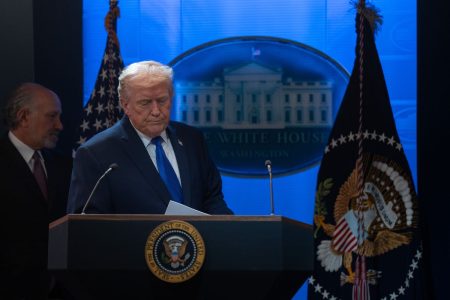
President Donald Trump speaks to reporters during a news conference at the White House on Friday.
11:29 JST, February 22, 2026
The blockbuster Supreme Court ruling that invalidated President Donald Trump’s emergency tariffs ends one chapter of economic uncertainty and begins another.
Even as the nation’s high court determined Friday that the president had exceeded his authority by slapping tariffs on goods from just about every country in the world, Trump made clear at a White House news conference that he was determined to do so again, though this time within the bounds of the law.
Assembling that presidential “Plan B” will take months, meaning the tariff-fueled confusion that has weighed on the economy will linger as the November congressional elections draw nearer.
Trump took the first step Friday by ordering a new 10 percent tariff on all imports under Section 122 of a 1974 trade law, effective 12:01 a.m. Tuesday. Saturday morning, he raised that levy to 15 percent, announcing the move in a Truth Social post.
The high court action ends more than a year of this sort of presidential freelancing, which saw tariffs imposed on the grounds of economics, national security and personal whim. Thanks to the Supreme Court, Trump no longer can introduce, modify or remove tariffs for any reason simply by tapping out a social media post on his smartphone.
But if that unpredictable quick-draw era has ended, plenty of new questions remain in its wake. Will the government refund the $134 billion-plus that it collected in illegitimate import taxes? If so, how and when? What new tariffs will be announced to supplement the 10 percent global tax that Trump rushed out Friday?
“The ruling represents a de-escalation in U.S. trade policy. However, it does not constitute a full reset. Uncertainty persists around the durability of the relief, the potential reimposition of tariffs under alternative statutory authorities, and the treatment of tariffs already collected,” said Gregory Daco, chief economist of EY-Parthenon.
Eliminating the tariffs that Trump imposed last year under the International Economic Emergency Powers Act (IEEPA) will punch a hole in the nation’s fiscal accounts, challenge economic forecasters and perhaps present new opportunities for some savvy Wall Streeters to make bank.
Whether or not the government will now give back the money it wrongly collected from American importers remains to be seen.
The Justice Department said in court filings last year that the government would provide refunds if the tariffs were struck down. But following the Supreme Court ruling, which provided no guidance on the issue, Trump warned that importers and the government “will end up being in court for the next five years” haggling over it.
That’s hardly the only legal question. On Saturday, Neal Katyal, the attorney who helped win the Supreme Court challenge, questioned the validity of Trump’s new 15 percent global rate, saying any “sweeping tariffs” should first be approved by Congress.
The prospect of lengthy legal battles or procedural backlogs at customs brokers may cause some importers to sell their refund rights to hedge funds in return for immediate cash, said Salvatore Stile II, a customs broker in New York. The hedge funds could buy the refund claims at a discount and profit once the government ultimately paid, mirroring a trade some investors engaged in during the months before the court decision.
“A lot of clients are like ‘When are we getting the money?’ And I have to say that you’re not getting the money right away. It’s a long process,” Stile said.
Demands for repayment will reverberate through the economy. The importer of record, the company that actually pays the tariffs, is legally eligible to request a refund. But its customers and its customers’ customers, which may have suffered higher prices as a result of the tariffs, are likely to demand money back from the importer.
Those disputes will be hammered out on a case-by-case basis as companies balance their immediate financial interests with the value of their long-term commercial relationships.
“It’s the ripple effect. The people who paid the tariffs to the U.S. government are hoping that they can get a refund. Then, everyone who paid those people price increases are looking for their share,” said Ted Murphy, a trade lawyer with Sidley Austin. “The commercial issues here are pretty significant.”
Trump’s new strategy consists of a one-two punch of replacement tariffs. First, the 15 percent global import tax, which legally is valid for just 150 days. Second, a flurry of new national security tariffs on individual industries and country-specific levies designed to combat alleged unfair trading practices.
The administrative requirements associated with enacting those additional measures will likely take months. But once in place, the new tariff lineup will produce the same amount of revenue this year as Trump’s original plan, according to Treasury Secretary Scott Bessent.
It’s unlikely, however, that the administration will replace the entire tariff lineup as quickly as it hopes, Daco said. So the end of the emergency tariffs, which drained more than $100 billion from the economy last year, could act as a mild economic stimulant.
The chance that the tariff shuffle might spur the economy, even if only briefly, “could make the Fed[eral Reserve] concerned about the upside risks to inflation further ahead,” economist Stephen Brown of Capital Economics wrote in a research note.
Inflation rose to an annual rate of 3 percent in December, according to the Fed’s preferred gauge, the core personal consumption expenditures index, the government said Friday.
The IEEPA tariffs were responsible for about 0.3 percentage points of the index, according to Brown. Since Trump already has moved to replace the illegal tariffs, companies are unlikely to cut their prices.
Redesigning the nation’s tariff schedule for the third time in little more than a year will produce commercial winners and losers. Brazilian goods, for example, faced 50 percent IEEPA tariffs. Under the new Section 122 arrangement, the import tax will drop to 15 percent. Likewise, the 20 percent rate on Vietnamese products will be cut.
These changes are not enough to cause companies to endure the costly and time-consuming process of moving production from one country to another. But they will effectively put imported goods on sale, at least for the next several months, potentially widening the U.S. trade deficit that the president wants to close. Companies that rely on foreign suppliers may accelerate their imports, as they did in early 2025, seeking to front-run higher tariffs.
“That is a very real possibility,” Murphy said.
As companies assess the impact of this new temporary arrangement, decision-making may slow. “This would also mean a material increase in trade policy uncertainty, creating a new headwind to capex,” JPMorgan Chase economist Michael Feroli wrote in a note to clients, referring to business spending on capital equipment.
Any investment chill would come at a fraught moment for both Trump and the U.S. economy. The president will lead Republicans into congressional elections in less than nine months and the early polls do not look good. Less than two hours before news of his high court setback, the Commerce Department announced that the economy had grown at an annual rate of just 1.4 percent in the final three months of 2025.
Trump’s tariffs are also a source of revenue for the federal government, which is running crisis-level budget deficits of nearly 6 percent of gross domestic product. In January, the Treasury Department collected about $28 billion from all import taxes – not just the IEEPA tariffs – or roughly 5 percent of that month’s government revenue.
Even though Trump plans to maintain tariffs using different legal authorities, some analysts doubt the administration’s strategy of relying on import taxes to fund the government.
“The durability of these policies is very questionable. These are very unpopular; the public doesn’t like them,” said Ed Gresser, who led the Office of the U.S. Trade Representative’s economic research unit during Trump’s first term and is now an analyst with the Progressive Policy Institute.
Indeed, voters oppose the president’s tariffs by a margin of nearly 2-1, 64 percent to 34 percent, according to a new Washington Post-ABC News-Ipsos poll released on Friday.
On Wall Street, traders – who long ago had priced in a Supreme Court defeat for the president – took the tariff decision in stride. Stocks rose by less than 1 percent while the yield on the 10-year Treasury security was virtually unchanged.
The muted reaction, however, belied the significance of the high court action. A Supreme Court dominated by conservatives openly supportive of executive power, including three justices appointed by Trump, flatly rejected his claim that he could “impose tariffs on imports from any country, of any product, at any rate, for any amount of time,” in the words of Chief Justice John G. Roberts Jr.
Sheared of that imagined authority, the president retreated to the more defensible terrain of tariff-making powers that Congress has explicitly delegated to the chief executive. At his extraordinary news conference on Friday, at turns wounded and defiant, Trump sought to put a brave face on his defeat.
But in announcing plans to construct a new tariff regime using other legal mechanisms, he conceded that his new course was “probably the direction I should have gone the first time.”


Related Tags




Most Read
Popular articles in the past 24 hours
-
Japanese High School Student Aims to Share Kaiten History Through...
-
PM Takaichi Spells out Plans to Advance Bold Policy Shifts in Spe...
-
Chronic Issues Erode Thailand’s Economy as Political Confusion Pe...
-

Tottori: 95-Year-Old Japanese Descendent from Philippines Visits ...
-
Japan to Monitor Trump Administration's Response to U.S. Supreme ...
-

Milano Cortina 2026: Speed Skater Takagi Finishes 6th in the 1,50...
-

Osaka: 40 Ninjas Display Shuriken Throwing Skills at Japan Champi...
-

Miyazaki: Japanese Woman Walks in Footsteps of Samurai Ancestor W...
Popular articles in the past week
-

Japan PM Takaichi’s Cabinet Resigns en Masse
-

Man Infected with Measles Reportedly Dined at Restaurant in Tokyo...
-

Sanae Takaichi Elected Prime Minister of Japan; Keeps All Cabinet...
-
Japan's Govt to Submit Road Map for Growth Strategy in March, PM ...
-

Bus Carrying 40 Passengers Catches Fire on Chuo Expressway; All E...
-

Milano Cortina 2026: Figure Skaters Riku Miura, Ryuichi Kihara Pa...
-
Japan, U.S. Name 3 Inaugural Investment Projects; Reached Agreeme...
-
U.S. Firm to Build Training Hub in Fukushima N-plant for Debris R...
Popular articles in the past month
-
Japan PM Takaichi’s Cabinet Resigns en Masse
-

Japan Institute to Use Domestic Commercial Optical Lattice Clock ...
-

Israeli Ambassador to Japan Speaks about Japan’s Role in the Reco...
-
Man Infected with Measles Reportedly Dined at Restaurant in Tokyo...
-

Videos Plagiarized, Reposted with False Subtitles Claiming ‘Ryuky...
-

Man Infected with Measles May Have Come in Contact with Many Peop...
-

Prudential Life Insurance Plans to Fully Compensate for Damages C...
-

Woman with Measles Visited Hospital in Tokyo Multiple Times Befor...
Top Articles in News Services
-
Survey Shows False Election Info Perceived as True
-

Prudential Life Expected to Face Inspection over Fraud
-
Hong Kong Ex-Publisher Jimmy Lai’s Sentence Raises International Outcry as China Defends It
-
Japan’s Nikkei Stock Average Touches 58,000 as Yen, Jgbs Rally on Election Fallout (UPDATE 1)
-
Trump Names Former Federal Reserve Governor Warsh as the Next Fed Chair, Replacing Powell
JN ACCESS RANKING
-
Japan PM Takaichi’s Cabinet Resigns en Masse
-
Japan Institute to Use Domestic Commercial Optical Lattice Clock to Set Japan Standard Time
-
Israeli Ambassador to Japan Speaks about Japan’s Role in the Reconstruction of Gaza
-
Man Infected with Measles Reportedly Dined at Restaurant in Tokyo Station
-
Videos Plagiarized, Reposted with False Subtitles Claiming ‘Ryukyu Belongs to China’; Anti-China False Information Also Posted in Japan