
China Eager to Become Robotics Powerhouse with Humanoid Robots; 169 Companies Showcase Products at World Robot Conference in Beijing
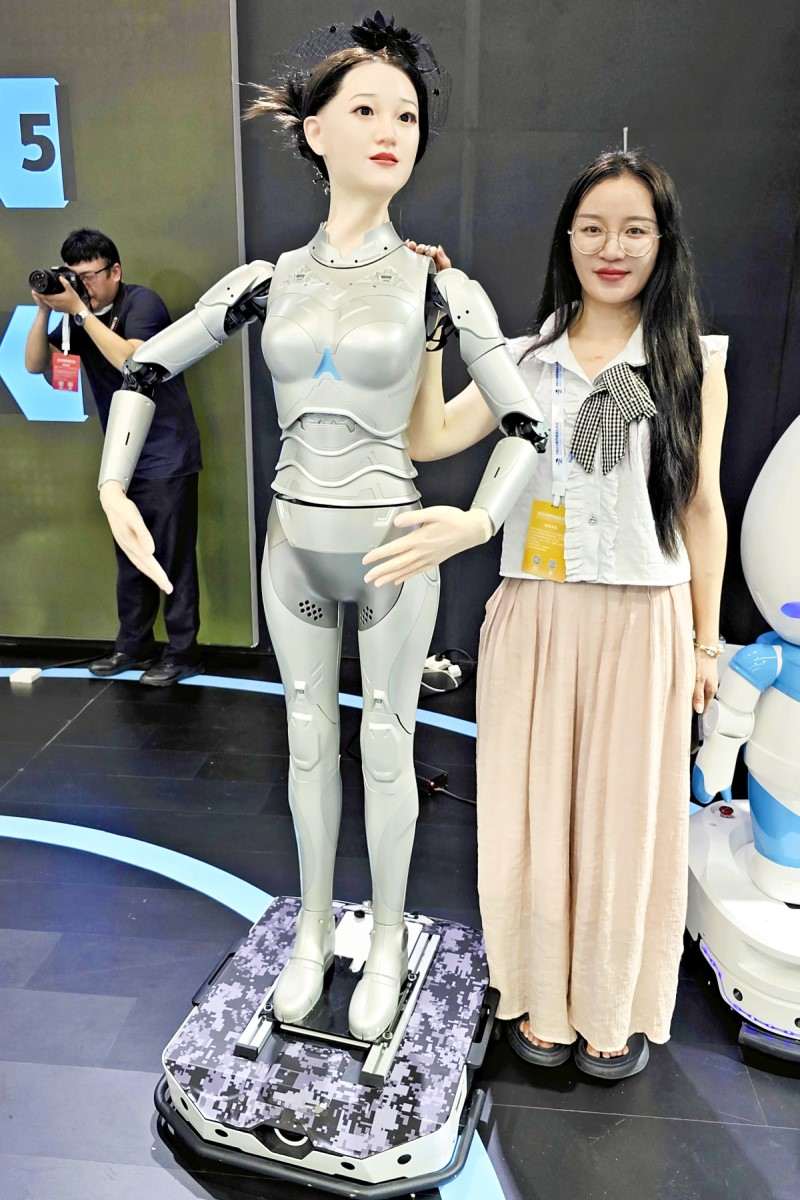
A humanoid robot is seen at the World Robot Conference in Beijing.
6:00 JST, August 28, 2024
BEIJING/SHANGHAI — The Chinese government aims to have humanoid robots be used in factories, stores, homes and elsewhere amid the ongoing rapid development and commercialization of these types of machines.
As China’s working-age population declines, Beijing is anticipating a severe labor shortage and is pushing to make the country a robotics powerhouse with generative AI-equipped humanoid robots.
At the World Robot Conference, which ran from Aug. 21 through Sunday in Beijing, 169 companies from more than 10 countries showcased over 600 innovative robot models, including 27 humanoid robots. Most of the companies displaying their products are based in China.
A humanoid robot, T1, developed by the Chinese venture company Sichuan Tianlian Robot Co. is about 160 centimeters tall and weighs 43 kilograms. The robot, with its exposed metal frame, has nearly 80 joints and can be used for various purposes, including working at a factory and piloting an aircraft, according to the company.
The company is already mass producing the robot, each costing 200,000-400,000 yuan (¥4 million-¥8 million).
“In the future, the work will be divided between humans and robots,” said a company official. “Robots will take on the more dangerous or simple tasks, while humans will take on the more sophisticated work that requires judgment.”
Meanwhile, a robot made by Dalian-based EX-Robots looks much more human, as it has materials that appears similar to real skin and hair. Equipped with generative AI, the robot can answer questions using a synthesized voice without hesitation.
The number of robotics-related companies in China has increased 30% over the past year to about 740,000. Currently, robots are mainly used in factory production lines. There are about 470 robots per 10,000 human workers, a nearly 20-time increase in the past decade.
Of the more than 550,000 industrial robots introduced in factories worldwide in 2022, more than half, or about 290,000, were made in China, far outpacing Japan, which came in second with about 50,000.
Robots built for specific skills, such as making tea or doing calligraphy, are also becoming commercialized. A robot that can perform surgery and another that can act as a guide dog for visually impaired people were also showcased at the conference.
Although China has been called the “world’s factory” due to its economic growth, its position is being threatened by India and African countries as a result of China’s declining birth rate.
According to United Nations estimates, China’s working-age population, which are people between the ages of 15 and 64, peaked at 1 billion in 2015 and is expected to decline by 20% to 807 million by 2045.
China’s Industry and Information Technology Ministry announced in October last year its plan to mass-produce humanoid robots by 2025.
Meanwhile, U.S. electric vehicle giant Tesla Inc. is aiming to have its humanoid robot Optimus, which is mainly designed for factory use, hit the market in 2026. The United States and China are likely to intensify their struggle for supremacy in the development of robots as well.





Most Read
Popular articles in the past 24 hours
-

Japan Figure Skating Legend Yuzuru Hanyu Is Proud Disaster Surviv...
-

Japan-U.S. Summit Likely to Focus on Middle East; Takaichi to Fac...
-

Hawaii Museum on Tsunami Including Japan's 2011 Disaster at Risk ...
-

15 Years since Great East Japan Earthquake: How Can Affected Area...
-

Japan Train Company to Increase Fares, Including in Tokyo Metropo...
-

Japan Holds Memorial Events to Mark 15th Anniversary of 2011 Eart...
-

Japan’s Mitsui O.S.K. Lines Container Ship Anchored in Persian Gu...
-

Struggling Onosato Pulls out of Spring Tourney
Popular articles in the past week
-

Ibaraki Pref.'s 1st Foreign Bus Driver Hired in Tsukuba
-
Japan Figure Skating Legend Yuzuru Hanyu Is Proud Disaster Surviv...
-

Nippon Life Insurance's U.S. Arm Sues OpenAI Over Legal Assistanc...
-

Govt to Utilize ODA for Ensuring Economic Security; Securing Ener...
-

Massive Sewer Pipe Found Jutting Out of Highway in Osaka
-

Amid Strait of Hormuz Blockade, Shipping Companies Scramble to Ge...
-

Beckoning Cats Get Makeover to Fit Modern Lifestyles with Sleek D...
-
Japan Govt Survey Finds Just 10% of Workers Want Working Hours to...
Popular articles in the past month
-

Producer Behind Pop Group XG Arrested for Cocaine Possession
-

Japan PM Takaichi’s Cabinet Resigns en Masse
-

Man Infected with Measles Reportedly Dined at Restaurant in Tokyo...
-

Videos Plagiarized, Reposted with False Subtitles Claiming ‘Ryuky...
-

iPS Treatments Pass Key Milestone, but Broader Applications Far f...
-

Sanae Takaichi Elected Prime Minister of Japan; Keeps All Cabinet...
-

Nepal Bus Crash Kills 19 People, Injures 25 Including One Japanes...
-

South Korea Tightens Rules on Foreigners Buying Homes in Seoul Me...
Top Articles in World
-
Videos Plagiarized, Reposted with False Subtitles Claiming ‘Ryukyu Belongs to China’; Anti-China False Information Also Posted in Japan
-
Nepal Bus Crash Kills 19 People, Injures 25 Including One Japanese National
-
South Korea Tightens Rules on Foreigners Buying Homes in Seoul Metro Area
-
Govt to Utilize ODA for Ensuring Economic Security; Securing Energy, Critical Minerals Sought
-

Ukrainian Ambassador Closely Watching Japan’s Revision of Defense Export Rules, Hopes for Future Arms Support
JN ACCESS RANKING
-
Producer Behind Pop Group XG Arrested for Cocaine Possession
-
Japan PM Takaichi’s Cabinet Resigns en Masse
-
Man Infected with Measles Reportedly Dined at Restaurant in Tokyo Station
-
Videos Plagiarized, Reposted with False Subtitles Claiming ‘Ryukyu Belongs to China’; Anti-China False Information Also Posted in Japan
-
iPS Treatments Pass Key Milestone, but Broader Applications Far from Guaranteed