
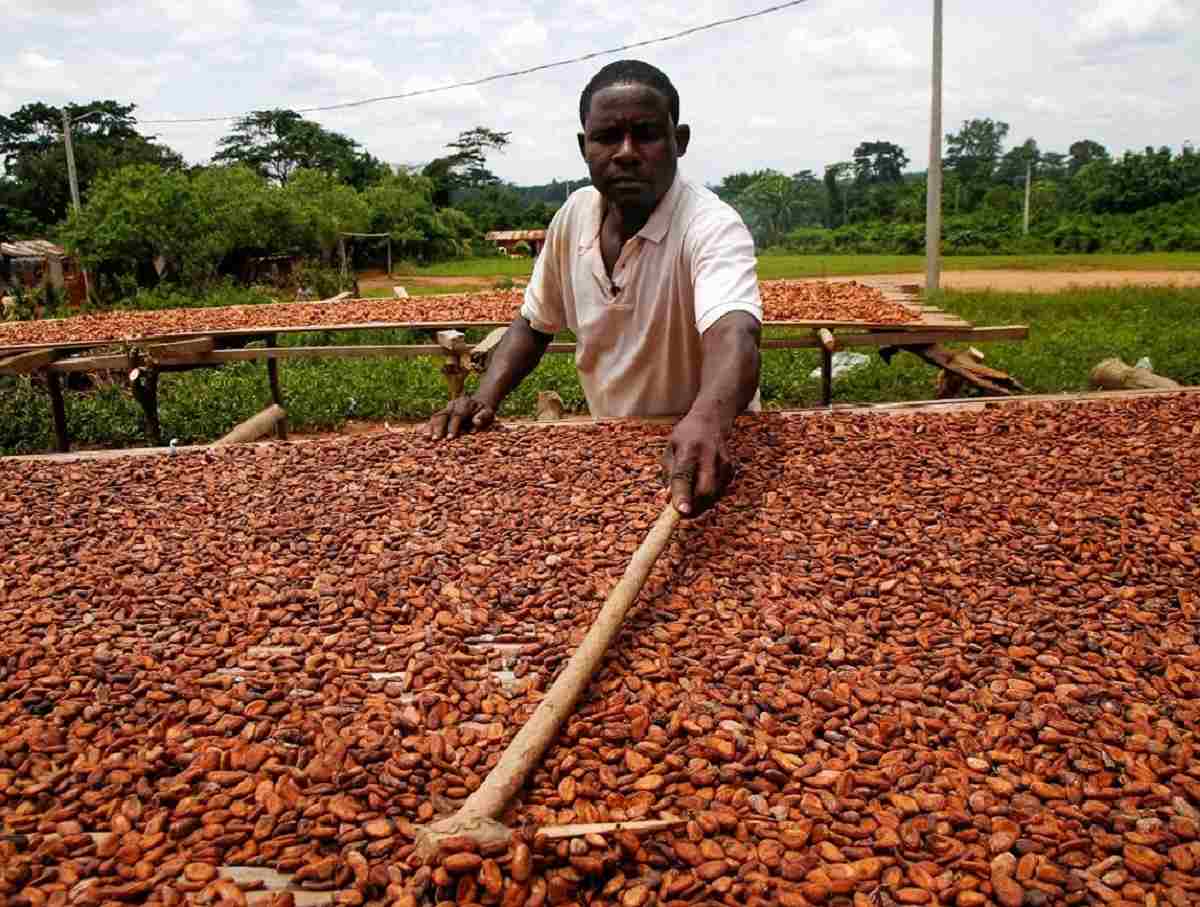
A farmer dries cocoa beans in Sinfra, Cote d’Ivoire, in April 2023.
10:46 JST, October 18, 2024
ABIDJAN (Reuters) — Damage inflicted by heavy rains on roads in Cote d’Ivoire’s west, southwest and coastal regions is hampering the harvest, drying and transportation of cocoa beans to ports, exporters and buyers have told Reuters.
Six exporters, five cooperatives and six buyers said cocoa arrivals at ports are down and the quality of beans has significantly deteriorated.
“Since the last week of September, we have noticed a resumption of rains that are quite heavy and have blocked roads and made village tracks totally impassable,” said Hamed Coulibaly, who buys cocoa in the region of Duekoue, Guiglo and Man.
He said he has not yet been able to recover 60 tons of the commodity that his middlemen have already collected in various villages.
“I have two trucks with cocoa that have been stuck on the tracks toward Blolequin for six days … we can’t do anything,” said Seydou Konate, another buyer in Guiglo.
Cocoa bean arrivals in ports were estimated at 13,000 tons from Oct. 1 to 6, compared to 50,000 tons last year, according to exporter figures.
In the towns of Man, Danane, Toulepleu, Guiglo, Duekoue and Tai in western Cote d’Ivoire, plantations have been flooded and roads cut off by the rain. Geyo, Yabayo and Buyo in the main cocoa producing part of the country have endured similar conditions.
The wet weather has also damaged cocoa beans, which turn black and ferment if stored in poor conditions and without being dried properly due to lack of sunlight.
“We are seeing a slowdown in cocoa arrivals at the ports … but what worries us the most is the quality of the beans that are arriving,” said an exporter based in San Pedro port who has received about 55 tons to date compared to 300 tons by the same point last year.
“We are receiving very poor quality products: poorly fermented, dried and too humid,” said an exporter in Abidjan who has received 45% less cocoa so far this season compared to last year.
Cote d’Ivoire’s Coffee and Cocoa Council (CCC), however, blamed the decrease in cocoa available so far this season to a delay of seed stock.
“We must put things into perspective: there is less cocoa in the ports because there is less cocoa at the moment; it is not because of the state of the roads,” a CCC official told Reuters on condition of anonymity.
“Usually, it is September’s stocks that supply the first weeks of October, but this year, that’s not the case,” another CCC official said.
“There’s no cocoa, but it’s coming — we must be patient.”



Most Read
Popular articles in the past 24 hours
-

3,000 Accounts Posting, Spreading Content Critical of Japan on X;...
-

Milano Cortina 2026: Sakamoto Serves as Flag Bearer; Japan Earns ...
-

My Spendthrift Mother Constantly Asks Me for Money
-
A Packed Bus Plunges off a Nepal Highway, Killing 19 and Injuring...
-
Emperor Receives Well-Wishes from Public on His 66th Birthday
-

Dozens of Jewelry, Other Items Stolen After Glass Door, Showcases...
-

1.2 Mil. Rapeseed Flowers Attract Cute Birds, People in Aichi Pre...
-

Mexican Army Kills Leader of Powerful Jalisco New Generation Cart...
Popular articles in the past week
-

Japan PM Takaichi’s Cabinet Resigns en Masse
-

Man Infected with Measles Reportedly Dined at Restaurant in Tokyo...
-

Sanae Takaichi Elected Prime Minister of Japan; Keeps All Cabinet...
-

Japan's Govt to Submit Road Map for Growth Strategy in March, PM ...
-

Bus Carrying 40 Passengers Catches Fire on Chuo Expressway; All E...
-

U.S. Firm to Build Training Hub in Fukushima N-plant for Debris R...
-

Japan, U.S. Name 3 Inaugural Investment Projects; Reached Agreeme...
-

Riku-Ryu Pair Wins Gold Medal: Their Strong Bond Leads to Major C...
Popular articles in the past month
-
Japan PM Takaichi’s Cabinet Resigns en Masse
-

Japan Institute to Use Domestic Commercial Optical Lattice Clock ...
-

Israeli Ambassador to Japan Speaks about Japan’s Role in the Reco...
-
Man Infected with Measles Reportedly Dined at Restaurant in Tokyo...
-

Videos Plagiarized, Reposted with False Subtitles Claiming ‘Ryuky...
-

Man Infected with Measles May Have Come in Contact with Many Peop...
-

Prudential Life Insurance Plans to Fully Compensate for Damages C...
-

Woman with Measles Visited Hospital in Tokyo Multiple Times Befor...
Top Articles in Science & Nature
-
Japan Institute to Use Domestic Commercial Optical Lattice Clock to Set Japan Standard Time
-

iPS Treatments Pass Key Milestone, but Broader Applications Far from Guaranteed
-
Record 700 Startups to Gather at SusHi Tech Tokyo in April; Event Will Center on Themes Like Artificial Intelligence and Robotics
-
iPS Cell Products for Parkinson’s, Heart Disease OK’d for Commercialization by Japan Health Ministry Panel
-
Japan to Ban Use of Power Banks on Airplanes
JN ACCESS RANKING
-
Japan PM Takaichi’s Cabinet Resigns en Masse
-
Japan Institute to Use Domestic Commercial Optical Lattice Clock to Set Japan Standard Time
-
Israeli Ambassador to Japan Speaks about Japan’s Role in the Reconstruction of Gaza
-
Man Infected with Measles Reportedly Dined at Restaurant in Tokyo Station
-
Videos Plagiarized, Reposted with False Subtitles Claiming ‘Ryukyu Belongs to China’; Anti-China False Information Also Posted in Japan