
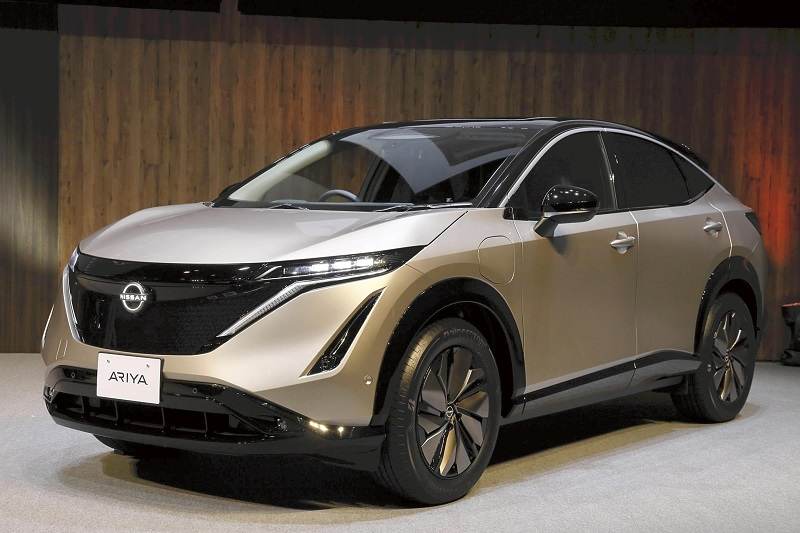
Nissan Motor Co.’s Ariya electric vehicle
12:20 JST, June 21, 2021
Leading automakers are ramping up efforts to overcome one of the biggest current roadblocks to the full electrification of vehicles — a steady supply of lithium-ion batteries.
As more decarbonization targets are being set around the globe, batteries for electric vehicles (EVs) are expected to run short of supply capacity at present output levels. Thus, automakers’ race for market survival is reckoned to be swayed by whether they can procure batteries stably while holding down their production costs.
Toyota Motor Corp. plans within this year to expand the production capacity at its lithium-ion battery plant in Himeji, Hyogo Prefecture, by the amount equivalent to roughly 80,000 EVs a year. The company will also step up annual production of batteries, increasing production capacity by those for 400,000 hybrid vehicles (HVs) a year at its plant in Dalian, China.
Toyota’s battery business will be assumed by the new joint venture Prime Planet Energy & Solutions, which the automaker set up with Panasonic Corp. in April 2020.
Toyota aims to increase sales of its electrified vehicles to 8 million units in 2030, roughly four times the current sales level. About 2 million of those units will be purely electric and fuel-cell vehicles.
To achieve these goals, the company estimates that it will need the “production of batteries 30 times the amount of the current output,” according to a senior official of Toyota.
According to an estimate by market research firm Fuji Keizai Group, global sales of EVs are expected to reach 19.69 million units in 2035, at least 10 times more than in 2020.
However, the production capacity of batteries for all types of electrified vehicles is estimated to stand at about several million units, with the trend of production trailing behind demand to intensify further down the road.
Regarding automotive lithium-ion batteries, the high production cost, which accounts for one-third of the price of an EV, will also pose a challenge for automakers. For automakers to increase their share in the global market, it is vital for them to boost their battery production capacity, and lower the unit prices for batteries at the same time
Tesla, Inc. of the United States, the world’s biggest seller of EVs, plans to halve the production costs of batteries on the way to boosting EV output to 20 million units year. Up to now, Tesla has procured batteries for EVs mainly from Panasonic, but it believes that by producing batteries on its own, it can reduce the unit cost.
For automakers, the issue of which battery manufacturers to partner with will hold sway over their fate in the market.
Nissan Motor Co. is partnering with China’s Envision Group on the joint venture Envision AESC Group to make batteries for its EVs. Envision has an 80% stake in the venture, while Nissan holds 20%. They are building a new plant in Ibaraki Prefecture that is expected to start production in fiscal 2024. Nissan also aims to build new plants running in China and the United Kingdom.
Toshihiro Mibe, president of Honda Motor Co., said, “Automakers that started early on building a structure for making a profit from the electrification of vehicles will be the ones who survive.”







Most Read
Most read in the last 24 hours
-

India's Arms Indigenization Quest for Self-Reliance / New Delhi S...
-

Most Serious Cyberattacks against the UK Now from Russia, Iran an...
-

Iran Fires on 3 Ships in the Strait of Hormuz as US Maintains Blo...
-
Trump Envoy Seeks to Replace Iran with Italy in Upcoming World Cu...
-

EU Close to Approving a $106B Loan for Ukraine after Months of De...
-

U.S. Extends Ceasefire: Lifting Blockades on Strait is Urgent for...
-

White Sox Rookie Munetaka Murakami Ties MLB Rookie Record with HR...
-
Navy Secretary John Phelan Is Leaving in Latest Departure of a To...
Most read in the last 7 days
-
Earthquake Hits Japan's Tohoku Region; 3-meter Tsunami Warning Is...
-

Trump Extends the Ceasefire with Iran but Keeps the Blockade
-

Olympic Gold Medal-Winning Figure Skaters Riku-Ryu Announce Retir...
-
China, South Korea Object to Japanese PM Takaichi's Ritual Offeri...
-
India's Arms Indigenization Quest for Self-Reliance / New Delhi S...
-
Japan to Ban Use of Portable Chargers on Airplanes from April 24,...
-
Most Serious Cyberattacks against the UK Now from Russia, Iran an...
-

¥1,000 Coins to Be Issued to Mark Anniversary of Beginning of Jap...
Most read in the last 30 days
-
Earthquake Hits Japan's Tohoku Region; 3-meter Tsunami Warning Is...
-

Police Find Child's Shoe During Search for Missing Boy in Nantan,...
-

Body Found in Nantan, Kyoto Prefecture, During Search for 11-Year...
-

Cherry Blossoms, Rapeseed Flowers Perform Colorful ‘Duet’ in Niig...
-
Trump Extends the Ceasefire with Iran but Keeps the Blockade
-
Olympic Gold Medal-Winning Figure Skaters Riku-Ryu Announce Retir...
-
Nori Prices Surge in Japan Due to Poor Seaweed Production Amid Ri...
-
Japanese Prime Minister Takaichi Speaks to Pakistani Prime Minist...
Top Articles in Business
-
Foreign Tourists Set New Record in March; 30% Drop in Visitors from Middle East
-
Japan’s ANA to Introduce Fuel Surcharges to Domestic Flights from Fy27, Driven by Rising Fuel Costs, Declining Profits
-
Middle Powers Should Create Alternative to WTO, Says Research Group
-
Airborne Cellular Stations to Be Tested in Ishikawa, Miyagi; Aim to Ensure Communication During Disasters
-
Toyota Motor to Begin Full-Scale Hydrogen Production in May; Mass Production and Sales of Equipment Planned to Start in 2029
JN ACCESS RANKING
-
Earthquake Hits Japan’s Tohoku Region; 3-meter Tsunami Warning Issued (Update 1)
-
Police Find Child’s Shoe During Search for Missing Boy in Nantan, Kyoto Prefecture
-
Body Found in Nantan, Kyoto Prefecture, During Search for 11-Year-Old Boy in Area (Update 1)
-
Cherry Blossoms, Rapeseed Flowers Perform Colorful ‘Duet’ in Niigata
-
Trump Extends the Ceasefire with Iran but Keeps the Blockade
Most read in the last 24 hours
-
India's Arms Indigenization Quest for Self-Reliance / New Delhi S...
-
Most Serious Cyberattacks against the UK Now from Russia, Iran an...
-
Iran Fires on 3 Ships in the Strait of Hormuz as US Maintains Blo...
-
Trump Envoy Seeks to Replace Iran with Italy in Upcoming World Cu...
-
EU Close to Approving a $106B Loan for Ukraine after Months of De...
Most read in the last 7 days
-
Earthquake Hits Japan's Tohoku Region; 3-meter Tsunami Warning Is...
-
Trump Extends the Ceasefire with Iran but Keeps the Blockade
-
Olympic Gold Medal-Winning Figure Skaters Riku-Ryu Announce Retir...
-
China, South Korea Object to Japanese PM Takaichi's Ritual Offeri...
-
India's Arms Indigenization Quest for Self-Reliance / New Delhi S...
Most read in the last 30 days
-
Earthquake Hits Japan's Tohoku Region; 3-meter Tsunami Warning Is...
-
Police Find Child's Shoe During Search for Missing Boy in Nantan,...
-
Body Found in Nantan, Kyoto Prefecture, During Search for 11-Year...
-
Cherry Blossoms, Rapeseed Flowers Perform Colorful ‘Duet’ in Niig...
-
Trump Extends the Ceasefire with Iran but Keeps the Blockade