
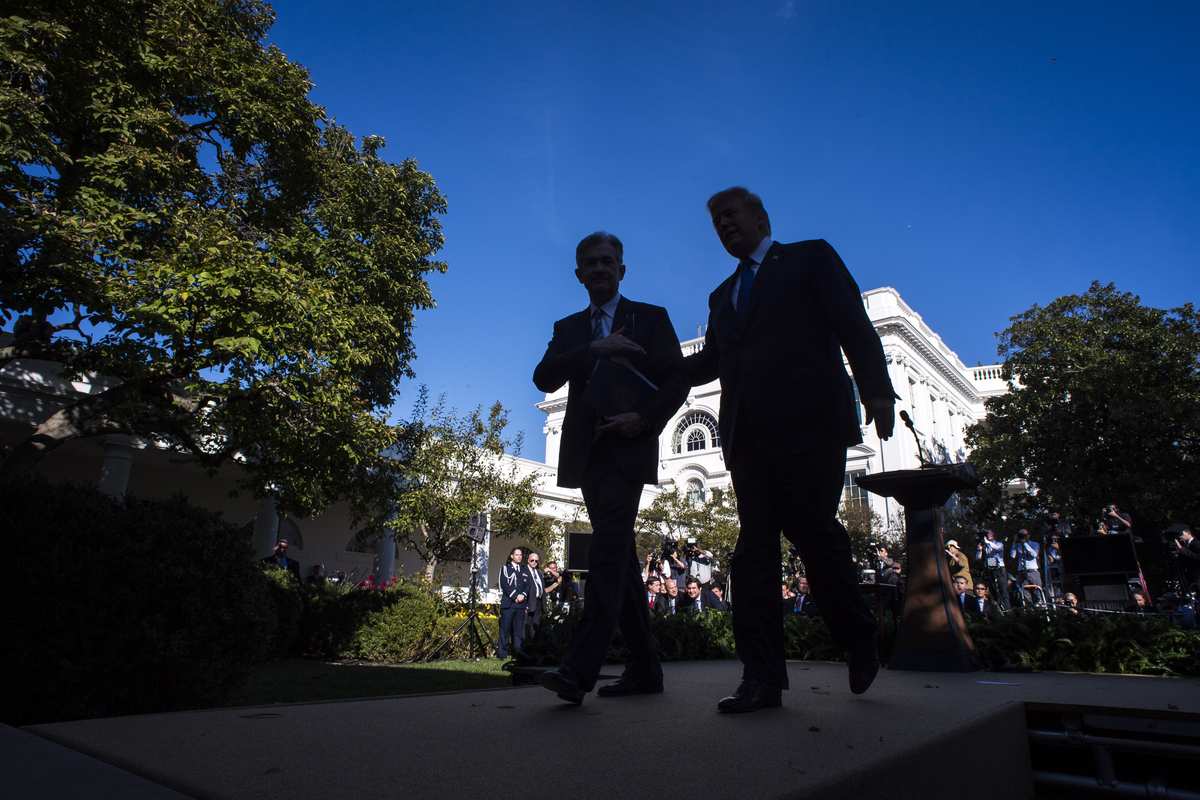
President Donald Trump with Federal Reserve Board Chair Jerome H. Powell in November. Trump has urged Powell to lower interest rates further, and the Justice Department has now launched a criminal inquiry of Powell.
15:09 JST, January 13, 2026
President Donald Trump’s Justice Department is considering prosecuting the head of the Federal Reserve, Jerome H. Powell, at the same time that Trump has pressured Powell to lower interest rates ahead of this year’s midterm elections.
Powell accused Trump of trying to pressure him to make economic decisions that politically benefit Trump.
The potential prosecution of the leader of the nation’s central bank is a possibly unprecedented move that economists and legal experts say could threaten the rule of law in a brazen way. And it was shaking the stock market Monday.
“A situation in which the president uses the threat of criminal prosecution to attempt to settle legitimate policy debates within the broader government really is an attack on the rule of law,” said Michael Strain, an economist with the right-leaning American Enterprise Institute, “on the institutions and norms that have substantially contributed to long-term prosperity in the U.S.”
Here’s what’s happening.
What the Federal Reserve is and does
It oversees interest rates and is hugely influential in shaping financial markets, prices and even employment. It’s set up to operate as an entity that is independent from the executive branch, because sometimes what’s right for the economy isn’t what political leaders want. As Jamie Cox, managing partner at Harris Financial Group, told The Washington Post last year: “They’re sometimes not very popular, but they need to be given independence from political whims, whether on the right or the left.”
What’s happening with Powell
There are no charges yet, but the Justice Department has opened a criminal investigation into him, tied to the renovation of the Fed’s headquarters, which is over budget.
Trump seized on the renovation months ago to criticize Powell’s leadership, even visiting the site with Powell in July.
It’s not immediately clear what could be prosecuted, legal experts say. The Fed was the one to announce the investigation Sunday, saying it received subpoenas related to Powell’s Senate testimony about the project.
“It just seems like there is waste with the renovation,” said Neama Rahmani, a former federal prosecutor, “but that happens all the time. That doesn’t make it criminal.”
Is this a pressure tactic to get the Fed to lower interest rates?
Trump doesn’t like Powell and has made clear he wants him to lower interest rates even more. In the short term that could make it easier to borrow money for a car or buy a house, but if done at the wrong time, it could also make inflation worse.
Trump has been open about pushing for prosecutions of his perceived political foes, including former FBI director James B. Comey, current New York Attorney General Letitia James (D) and Sen. Adam Schiff (D-California). Almost all of those prosecutions have struggled in court.
This isn’t even the first Fed board member whom Trump’s Justice Department has targeted: In September, the department opened a criminal mortgage fraud investigation into Federal Reserve governor Lisa Cook, whom Trump has been openly trying to fire. Cook has denied wrongdoing.
“While we don’t know all the facts that may be available to the Department of Justice, this investigation seems awfully similar to those against James Comey and Letitia James,” said former U.S. attorney Barbara McQuade, who now teaches at the University of Michigan Law School. “While no one is above the law, neither should they be targeted for doing their jobs.”
In the long run, economists warn, more political control of the Fed would make inflation and recessions harder to deal with and risks making the United States a less trustworthy place to do business.
“The threat of criminal charges is a consequence of the Federal Reserve setting interest rates based on our best assessment of what will serve the public, rather than following the preferences of the President,” Powell himself alleged in a video and statement posted to the central bank’s website Sunday.
Watch the Senate and the Supreme Court to see what happens next
If Trump succeeds in pushing Powell out, the Republican-controlled Senate will approve his successor.
One Republican senator said he would hold up nominees to the Fed until this legal matter is settled. “If there were any remaining doubt whether advisers within the Trump Administration are actively pushing to end the independence of the Federal Reserve, there should now be none,” Sen. Thom Tillis of North Carolina said on social media. “It is now the independence and credibility of the Department of Justice that are in question.”
Tillis is retiring, but other Republican lawmakers with more incentive to stay aligned with Trump are uneasy with this investigation, suggesting there could be more pushback.
The Supreme Court is also a potential player here. The justices said Cook could keep her job on the Fed for now, temporarily ruling against Trump. They are set to hear her case in full this month, and if the justices side with Trump, they could open the door to much more political influence of the nation’s monetary policy.
“The independence of the Fed and its ability to effect low and stable inflation and full employment is one of the most important things that our government does,” Strain said.






Popular Articles
Popular articles in the past 24 hours
-

China Used Amphibious Vehicles, Ro-Ro Ship in Attack Drill; Yomiu...
-

Memorials to Great Hanshin Earthquake Victims in Kobe Cleaned Ahe...
-

Saitama Super Arena to Close for Up to 1.5 Years for Major Renova...
-

Japan Students, Parents Pray for Entrance Exam Success; Wooden Em...
-

Scandal-Tainted Ex-Maebashi Mayor Akira Ogawa Re-Elected
-

Israeli President Herzog: Peace Plan Is “Golden Opportunity” to C...
-

Observing Hibernating Bears Through Peephole at Zoo in Morioka Dr...
-
Japan to Convene Ordinary Diet Session Jan. 23
Popular articles in the past week
-
JAL, ANA Cancel Flights During 3-day Holiday Weekend due to Blizz...
-
China Confirmed to Be Operating Drilling Vessel Near Japan-China ...
-

Tokaido Shinkansen, Sanyo Shinkansen Nozomi Trains to Have Reserv...
-

Univ. in Japan, Tokyo-Based Startup to Develop Satellite for Disa...
-

Taiwan Alarmed by China’s AI-Driven Election Interference; Beijin...
-
Business Leaders Praise Takaichi's Economic Policies; Executives ...
-

Tsunami Can Travel Vast Distances Before Striking, Warn Japanese ...
-

Japan's ANA to Introduce Nationwide Logistics Service Using Drone...
Popular articles in the past month
-

As Chinese Tourists Shun Japan, Hotels and Stores Suffer
-
Tokyo Economic Security Forum to Hold Inaugural Meeting Amid Tens...
-

Core Inflation in Tokyo Slows in December but Stays above BOJ Tar...
-

Osaka-Kansai Expo's Economic Impact Estimated at ¥3.6 Trillion, T...
-
Japan Govt Adopts Measures to Curb Mega Solar Power Plant Project...
-
BOJ Gov. Ueda: Highly Likely Mechanism for Rising Wages, Prices W...
-

Economic Security Panels Debate Supply Chains, Rare Earths; Parti...
-

Japan, U.S. Start Talks on Tokyo's $550 Bil. Investment in U.S.; ...
"News Services" POPULAR ARTICLE
-

Japan’s Princess Kako Marks 31st Birthday, Contributed to Key Events This Year
-
Arctic Sees Unprecedented Heat as Climate Impacts Cascade
-

Brigitte Bardot, 1960s Sultry sex Symbol Turned Militant Animal Rights Activist Dies at 91
-

At Least 7 Explosions and Low-Flying Aircraft Are Heard in Venezuela’s Caracas
-
◎竹増ローソン社長インタビュー〔1〕_20251228YGTGS000198_C-250x166.jpg)
Convenience Store Chain Lawson May Start OTC Drug Delivery in 2026
JN ACCESS RANKING
-
As Chinese Tourists Shun Japan, Hotels and Stores Suffer
-
Core Inflation in Tokyo Slows in December but Stays above BOJ Target
-
Osaka-Kansai Expo’s Economic Impact Estimated at ¥3.6 Trillion, Takes Actual Visitor Numbers into Account
-
Japan Govt Adopts Measures to Curb Mega Solar Power Plant Projects Amid Environmental Concerns
-
BOJ Gov. Ueda: Highly Likely Mechanism for Rising Wages, Prices Will Be Maintained