
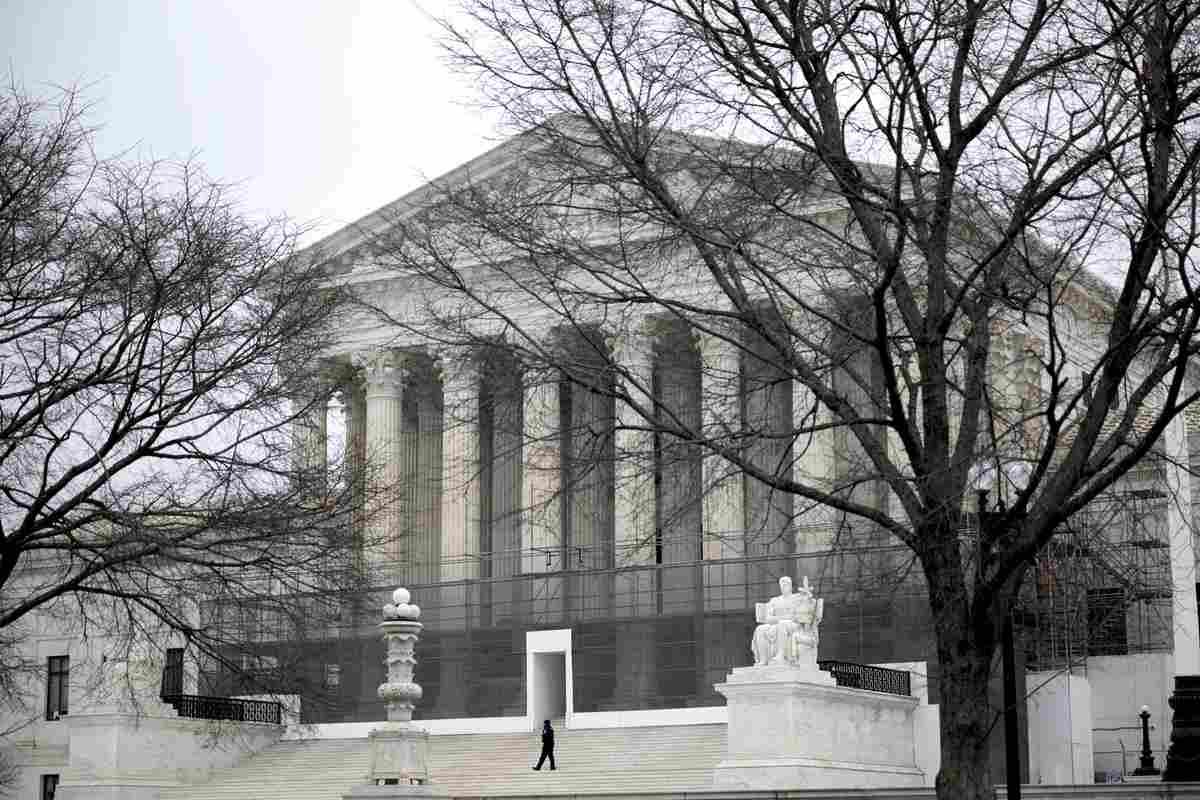
The case could affect the outcomes of nearly a dozen other lawsuits.
15:01 JST, January 13, 2026
Lawyers for the oil giant Chevron and a small Louisiana parish squared off Monday in a case that could have major consequences for how local communities can rectify environmental damage that may have been caused by oil company operations going back decades.
In April, a Louisiana state court jury ruled that Chevron must pay almost $745 million to help restore coastal wetlands in Plaquemines Parish that were damaged as far back as World War II. Chevron is asking the Supreme Court to order the case moved to federal court, where it could get more favorable terms.
The ripple effects could be large: If the justices rule that the company can move the case to federal court, the hefty award for Plaquemines Parish could be wiped out, legal experts say. Moreover, the case could affect the outcomes of nearly a dozen other lawsuits that make similar allegations about the oil and gas industry.
The justices on Monday questioned Chevron’s arguments that it should be allowed to take the case to federal court even though its federal contracts did not squarely deal with oil drilling, which Plaquemines Parish says caused the coastal damage. Chevron’s attorneys argued that the oil production was “related to” the production of aviation fuel for World War II, which they say should be enough to meet the test to have the case heard in federal court.
Chief Justice John G. Roberts Jr. asked whether there was a “butterfly effect problem” with their argument – a reference to the concept that a butterfly flapping its wings could set off a chain of causation that could eventually lead to a tornado – suggesting that he thought almost anything could be considered “related to” a government contract.
“It’s hard to see where you stop,” he said.
Justice Neil M. Gorsuch likewise referred to the butterfly effect issue.
“The Big Bang is ‘related to’ you being here today, counsel,” he told Aaron Z. Roper, an attorney with the solicitor general’s office, which is supporting Chevron.
Justice Samuel A. Alito Jr. was not present for arguments. On Thursday, Alito recused himself, citing financial interests in ConocoPhillips, the parent of Burlington Resources Oil & Gas Co., a party in a related case.
Although the case focused on a narrow legal question, experts highlighted its importance in how companies fight claims of environmental damage.
“The stakes are higher than just where this one case is going to be heard,” said Mark Davis, director of the Center for Environmental Law at Tulane University.
If the company prevails in having the verdict thrown out and the long-running case moved to federal court, other companies that do business with the federal government are likely to pursue similar arguments in the future, Davis said.
At the heart of Chevron’s case is the argument that during World War II, the firm’s predecessors played a key role in helping to expand oil extraction to meet the demands of the war. Because they were working on behalf of U.S. government interests, the company and its backers have argued, claims regarding the actions at the time should be heard in a federal court rather than at the state level.
Judges and juries in federal courts are less inclined to have a bias toward local interests, experts say. But John Carmouche, an attorney representing Plaquemines Parish, said that if his side loses at the high court, he would confidently litigate the case in federal court and seek an even higher sum.
“All they’re doing is playing the delay game, which they’ve played for 13 years,” Carmouche said in an interview.
Justice Clarence Thomas asked about the practical effect of having the case heard in state versus federal court.
Ben Aguiñaga, Louisiana’s solicitor general, which argued on behalf of Plaquemines Parish, replied that state courts were far better equipped to interpret state law.
“We want the actual experts interpreting state law, especially when we get to the Louisiana Supreme Court, on an important statute like this, and especially with respect to a problem that is so sweeping in scope,” he said.
But cases of national importance should be argued at the federal level, lawyers for Chevron argued in response to a question from Justice Brett M. Kavanaugh.
“If they can prove their case in federal court, then everybody’s going to accept the outcome and they’re not going to view it as something that’s a product of local prejudice,” said Paul D. Clement, the former U.S. solicitor general who represents the company.
Plaquemines Parish filed its lawsuit in 2013 alongside five other coastal parishes. It alleged that oil companies had caused environmental damage in violation of a 1978 state law aimed at conserving the imperiled coastline.
The case in front of the high court holds particular relevance in Louisiana, where the oil and gas industry remains a massive employer and the coastal region has steadily vanished in recent decades.
One 2017 analysis by the U.S. Geological Survey found that the state had lost about 2,000 square miles of land along its coast from 1932 to 2016. That equates to losing about a football field’s worth of coastal wetlands every 34 minutes during periods of most rapid loss.
The authors called Louisiana’s wetlands “one of the most critically threatened environments in the United States” and detailed how the state had lost more wetlands than all other states in the Lower 48 combined. Those losses are projected to persist in the years ahead.
Scientists have documented how oil and gas extraction has played a significant role in the degradation of such landscapes over time. Oil spills have stressed vegetation and wildlife. The dredging of canals and construction of pipelines have altered natural hydrology, increased saltwater intrusion and undermined wetlands.
But the fossil fuel industry is hardly the only threat facing the coast, where humans have built levees that have changed the flow of the Mississippi River and constrained its historical ability to deposit sediment and build land. The process of sinking land, also known as subsidence, has continued to affect the coast.
After the $745 million verdict in April, oil industry figures sharply criticized the decision.
The verdict “not only undermines Louisiana’s position as an energy leader but also threatens our country’s trajectory to America-first energy dominance,” Tommy Faucheux, president of the Louisiana Mid-Continent Oil & Gas Association, said at the time.
“These lawsuits were never about restoring the coast,” he said in a statement. “As the number-one private investor in our working coast, the energy industry is already doing that. Instead, this is deep-pocketed trial lawyers driving baseless lawsuits, hoping to make millions in legal fees.”
When the Supreme Court later agreed to take up the case, Faucheux said the decision presented “an opportunity for the high court to uphold fair and consistent application of the law and to help preserve legal stability for the industry that fuels America’s economy.”
The issue on the flip side, Davis of the Tulane Center said, is the question of what obligations oil and gas firms have to rectify environmental damage caused by their operations.
“What obligations do you have to fix what you broke?” he said.







Popular Articles
Popular articles in the past 24 hours
-

China Used Amphibious Vehicles, Ro-Ro Ship in Attack Drill; Yomiu...
-

Memorials to Great Hanshin Earthquake Victims in Kobe Cleaned Ahe...
-

Saitama Super Arena to Close for Up to 1.5 Years for Major Renova...
-

Scandal-Tainted Ex-Maebashi Mayor Akira Ogawa Re-Elected
-

Observing Hibernating Bears Through Peephole at Zoo in Morioka Dr...
-

Japan Students, Parents Pray for Entrance Exam Success; Wooden Em...
-

Japan to Convene Ordinary Diet Session Jan. 23
-

Israeli President Herzog: Peace Plan Is “Golden Opportunity” to C...
Popular articles in the past week
-

JAL, ANA Cancel Flights During 3-day Holiday Weekend due to Blizz...
-

China Confirmed to Be Operating Drilling Vessel Near Japan-China ...
-

Tokaido Shinkansen, Sanyo Shinkansen Nozomi Trains to Have Reserv...
-

Univ. in Japan, Tokyo-Based Startup to Develop Satellite for Disa...
-

Taiwan Alarmed by China’s AI-Driven Election Interference; Beijin...
-

Business Leaders Praise Takaichi's Economic Policies; Executives ...
-

Tsunami Can Travel Vast Distances Before Striking, Warn Japanese ...
-

Japan's ANA to Introduce Nationwide Logistics Service Using Drone...
Popular articles in the past month
-

As Chinese Tourists Shun Japan, Hotels and Stores Suffer
-
Tokyo Economic Security Forum to Hold Inaugural Meeting Amid Tens...
-

Core Inflation in Tokyo Slows in December but Stays above BOJ Tar...
-

Osaka-Kansai Expo's Economic Impact Estimated at ¥3.6 Trillion, T...
-

Japan Govt Adopts Measures to Curb Mega Solar Power Plant Project...
-

BOJ Gov. Ueda: Highly Likely Mechanism for Rising Wages, Prices W...
-

Economic Security Panels Debate Supply Chains, Rare Earths; Parti...
-

Japan, U.S. Start Talks on Tokyo's $550 Bil. Investment in U.S.; ...
"News Services" POPULAR ARTICLE
-

Japan’s Princess Kako Marks 31st Birthday, Contributed to Key Events This Year
-

Arctic Sees Unprecedented Heat as Climate Impacts Cascade
-

Brigitte Bardot, 1960s Sultry sex Symbol Turned Militant Animal Rights Activist Dies at 91
-

At Least 7 Explosions and Low-Flying Aircraft Are Heard in Venezuela’s Caracas
-
◎竹増ローソン社長インタビュー〔1〕_20251228YGTGS000198_C-250x166.jpg)
Convenience Store Chain Lawson May Start OTC Drug Delivery in 2026
JN ACCESS RANKING
-
As Chinese Tourists Shun Japan, Hotels and Stores Suffer
-
Core Inflation in Tokyo Slows in December but Stays above BOJ Target
-
Osaka-Kansai Expo’s Economic Impact Estimated at ¥3.6 Trillion, Takes Actual Visitor Numbers into Account
-
Japan Govt Adopts Measures to Curb Mega Solar Power Plant Projects Amid Environmental Concerns
-
BOJ Gov. Ueda: Highly Likely Mechanism for Rising Wages, Prices Will Be Maintained