
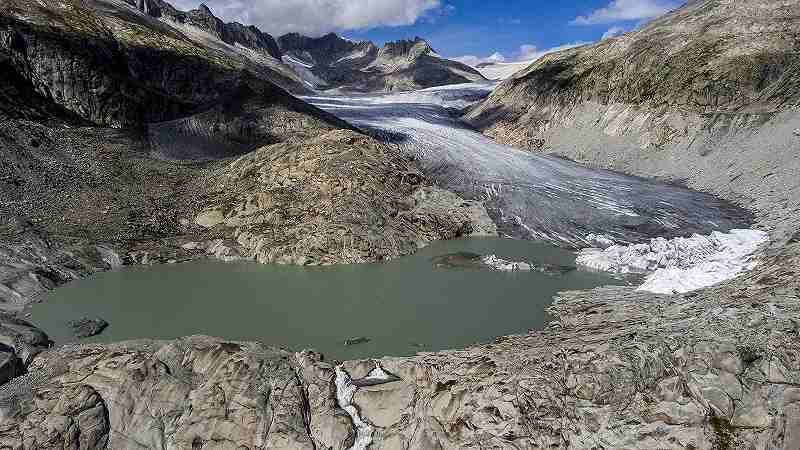
A lake at the bottom of the Rhone Glacier in Obergoms, Switzerland, is seen on Sept. 1.
17:15 JST, November 10, 2022
PARIS (Reuters) — Some of the world’s most famous glaciers, including in the Dolomites in Italy, the Yosemite and Yellowstone parks in the United States and Mount Kilimanjaro in Tanzania, are set to disappear by 2050 due to global warming, whatever the temperature rise scenario, according to a UNESCO report.
The United Nations cultural agency UNESCO monitors some 18,600 glaciers across 50 of its World Heritage sites and said that glaciers in one third of World Heritage sites will disappear by 2050 regardless of the applied climate scenario.
While the rest can be saved by keeping global temperature rise below 1.5 C relative to preindustrial levels, in a business-as-usual emissions scenario, about 50% of these World Heritage glaciers could almost entirely disappear by 2100.
“This report is a call to action. Only a rapid reduction in our CO2 emissions levels can save glaciers and the exceptional biodiversity that depends on them,” Audrey Azoulay, UNESCO’s Director General, said in a statement.
She added that the U.N.’s COP27 cimate conference will have a crucial role to help find solutions to this issue.
World Heritage glaciers as defined by UNESCO represent about 10% of the world’s glacier areas and include some of the world’s best-known glaciers, whose loss is highly visible as they are focal points for global tourism.
The report’s lead author Tales Carvalho told Reuters that World Heritage glaciers lose on average some 58 billion tons of ice every year — equivalent to the total annual volume of water used in France and Spain together — and contribute to almost 5% of global observed sea-level rise.
UNESCO recommends that given the inevitable further shrinking of many of these glaciers in the near future, local authorities should make glaciers a focus of policy, by improving monitoring and research and by implementing disaster risk reduction measures.
“As glacier lakes fill up, they can burst and can cause catastrophic floods downstream,” Carvalho said.







Most Read
Popular articles in the past 24 hours
-

Ransomware Attacks Hitting Japan's Small, Midsize Firms
-

German Journalist Traces Footsteps of Great-Grandfather Who Was P...
-

10 Foreign Tourists Sustain Injuries After Fire at Capsule Hotel ...
-

World Baseball Classic: Venezuela Beats Japan in Nail-biting Back...
-

Rapid Services Resume on JR Chuo Line; Suspension Caused by Accid...
-

Rapid Services on JR Chuo Line Suspended; Accident at Kokubunji S...
-

World Baseball Classic: Venezuela Beats Japan in Back-and-Forth Q...
-

World Baseball Classic: Red Sox’s Abreu Hits 3-run Homer, Giving ...
Popular articles in the past week
-

Japan Figure Skating Legend Yuzuru Hanyu Is Proud Disaster Surviv...
-
15 Measles Patients Confirmed in Tokyo in Past 6 Days; 1 May Have...
-

Massive Sewer Pipe Found Jutting Out of Highway in Osaka
-

Japan Govt to Tighten Requirements to Receive Permanent Residency...
-

Power Outage Forces About 980 Passengers in Yokohama to Walk to T...
-

JR Tokai Breaks Ground on Yamanashi Maglev Station; Will Be Part ...
-

Parents in Japan to Get Instagram Notifications When Teens Repeat...
-
'World's Oldest Bio-Business' Is Japan's Seed Koji Retailing, Mol...
Popular articles in the past month
-

Producer Behind Pop Group XG Arrested for Cocaine Possession
-

Japan PM Takaichi’s Cabinet Resigns en Masse
-

Man Infected with Measles Reportedly Dined at Restaurant in Tokyo...
-
Japan Figure Skating Legend Yuzuru Hanyu Is Proud Disaster Surviv...
-

iPS Treatments Pass Key Milestone, but Broader Applications Far f...
-

Sanae Takaichi Elected Prime Minister of Japan; Keeps All Cabinet...
-

South Korea Tightens Rules on Foreigners Buying Homes in Seoul Me...
-

Nepal Bus Crash Kills 19 People, Injures 25 Including One Japanes...
Top Articles in Science & Nature
-
iPS Treatments Pass Key Milestone, but Broader Applications Far from Guaranteed
-

Record 700 Startups to Gather at SusHi Tech Tokyo in April; Event Will Center on Themes Like Artificial Intelligence and Robotics
-
Parents in Japan to Get Instagram Notifications When Teens Repeatedly Search for Suicide Content
-
iPS Cell Products for Parkinson’s, Heart Disease OK’d for Commercialization by Japan Health Ministry Panel
-

Japan to Ban Use of Power Banks on Airplanes
JN ACCESS RANKING
-
Producer Behind Pop Group XG Arrested for Cocaine Possession
-
Japan PM Takaichi’s Cabinet Resigns en Masse
-
Man Infected with Measles Reportedly Dined at Restaurant in Tokyo Station
-
Japan Figure Skating Legend Yuzuru Hanyu Is Proud Disaster Survivor and Gold Medalist, Vows to Continue Support Efforts
-
iPS Treatments Pass Key Milestone, but Broader Applications Far from Guaranteed