
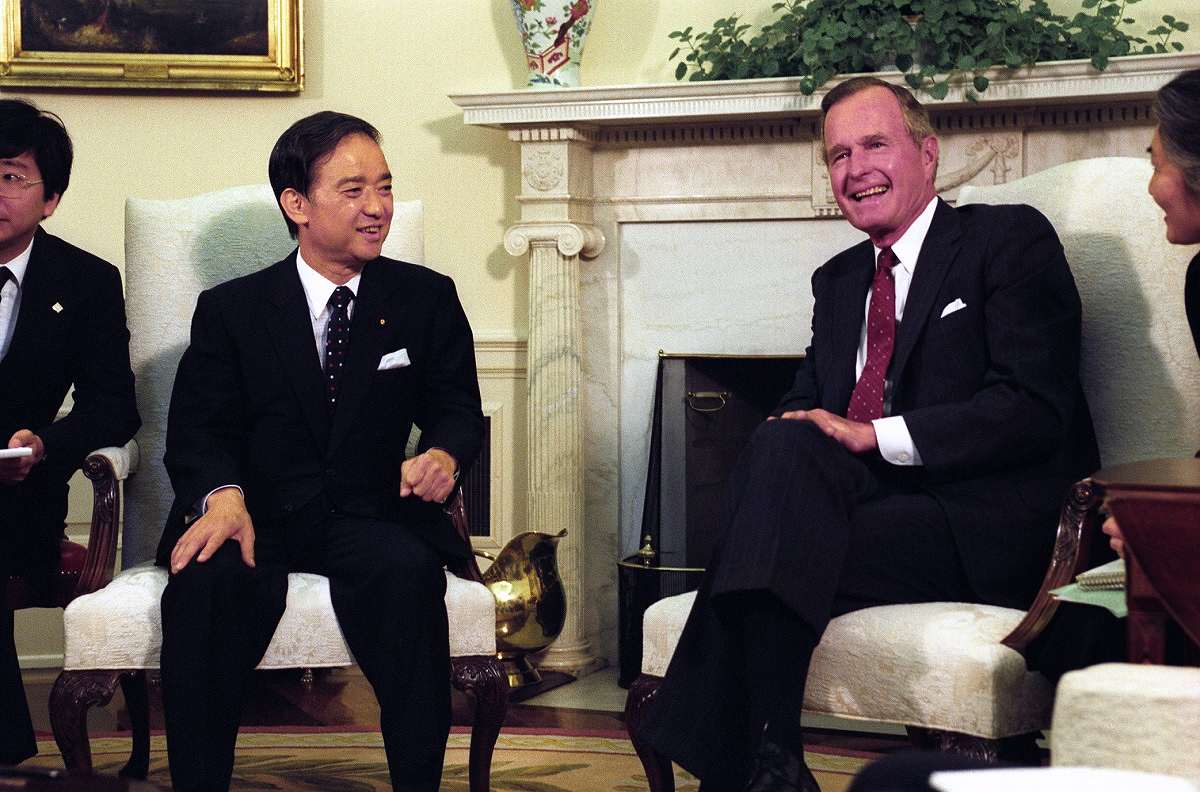
Prime Minister Toshiki Kaifu, left, and U.S. President George H. W. Bush at the White House on Sept. 1, 1989
15:52 JST, January 2, 2021
The 1989 diplomatic records released Dec. 23 vividly depict how Washington increased pressure on Tokyo in negotiations over Japan’s share of the cost of stationing U.S. forces in Japan and the joint development of the Air Self-Defense Force’s next-generation support fighter (FSX).
The documents also show that Washington itself had been pressed by the U.S. Congress to take a hard-line stance against Tokyo to fix its trade deficit, among other issues.
A preliminary meeting was held on Aug. 30, 1989, for the first summit on Sept. 1 between then Prime Minister Toshiki Kaifu and then President George H. W. Bush. At the preliminary meeting, the U.S. side indicated that Bush would propose at the summit that the issue of sharing defense costs be further discussed between the two nations’ foreign ministers.
In response, the Japanese side, which sought “quiet” dialogue at the administrative level, “got the impression that the United States would pressure Japan on a ministerial level.” Japan opposed the proposal out of concern that “the current administration would face a difficult situation.”
The U.S. side rejected Japan’s response, saying that the United States had its own situation, and that not raising the issue during the summit was not an option.
In the United States, the House of Representatives and the Senate passed bills on July 27 and Aug. 2, respectively, to require the Japanese government to bear the full cost of stationing U.S. troops in Japan. Then U.S. Secretary of State James Baker said at the foreign ministers meeting on Sept. 1 that Congress was pointing a “cutting edge” at the U.S. government.
In the end, the U.S. government showed consideration for the Kaifu administration, which had just been formed on an unstable foundation after the Liberal Democratic Party lost its majority in the House of Councillors election in July. At the summit meeting, Bush told Kaifu that he understood that burden sharing was a delicate point, but that the U.S. government was having very difficult relations with Congress.
At a foreign ministerial meeting held in Tokyo in February of the same year, Baker proposed that Japan commit to procuring the equivalent of 40% of the production cost in the United States related to the joint development of the FSX — later known as the F2 — as a way to help overcome the criticism of the opposition.
There were growing calls at the time from opponents in Congress claiming that joint FSX development would not help correct the trade imbalance.
Then Foreign Minister Sosuke Uno said that Japan could not simply say that it understood, as the negotiation stage on this issue already passed. Baker backed off and called it quits. Even so, the opposition from Congress did not abate, and on April 28, about two months after the meeting, Japan was forced to agree to provide the United States with about 40% of its production costs, as proposed by Baker.
The process and background of the negotiations at that time, which are revealed in the documents, may have something in common with the current discussions on defense cost-sharing and development of the successor aircraft to the F-2.







Most Read
Most read in the last 24 hours
-
Japan Monitoring Situation Surrounding Revocation of Taiwan Presi...
-
Promote Support, Respect to Help Prevent Harassment of Athletes
-
3 Japanese Megabanks Mull Loaning ¥3.6 Tril. as Part of Huge Inve...
-
Japan Should Serve as Bridge between Nuclear, Non-nuclear States,...
-

Japanese Company Zoom Wins ¥180 Mil. Lawsuit Against U.S. Operat...
-

Yamato Museum Reopens in Hiroshima Pref. Following Extensive Reno...
-
Man Admits to Abandoning Wife's Body in Zoo Incinerator in Hokkai...
-
Elegant Weeping Cherry Blossoms on Display at Water Purification ...
Most read in the last 7 days
-
Earthquake Hits Japan's Tohoku Region; 3-meter Tsunami Warning Is...
-

Trump Extends the Ceasefire with Iran but Keeps the Blockade
-
China, South Korea Object to Japanese PM Takaichi's Ritual Offeri...
-

India's Arms Indigenization Quest for Self-Reliance / New Delhi S...
-
Japan to Ban Use of Portable Chargers on Airplanes from April 24,...
-
¥1,000 Coins to Be Issued to Mark Anniversary of Beginning of Jap...
-

Most Serious Cyberattacks against the UK Now from Russia, Iran an...
-

Trump Opposes United–American Merger, Signals Support for Spirit
Most read in the last 30 days
-
Earthquake Hits Japan's Tohoku Region; 3-meter Tsunami Warning Is...
-
Police Find Child's Shoe During Search for Missing Boy in Nantan,...
-

Body Found in Nantan, Kyoto Prefecture, During Search for 11-Year...
-

Cherry Blossoms, Rapeseed Flowers Perform Colorful ‘Duet’ in Niig...
-
Trump Extends the Ceasefire with Iran but Keeps the Blockade
-

Olympic Gold Medal-Winning Figure Skaters Riku-Ryu Announce Retir...
-
China, South Korea Object to Japanese PM Takaichi's Ritual Offeri...
-
Japanese Prime Minister Takaichi Speaks to Pakistani Prime Minist...
Top Articles in World
-
China, South Korea Object to Japanese PM Takaichi’s Ritual Offering to Yasukuni Shrine
-
Japanese Prime Minister Takaichi Speaks to Pakistani Prime Minister Sharif, Emphasizes Importance of Reaching Agreement Through Dialogue
-

Japan Ekiden Road Relay Race Held near New Delhi to Deepen Japan-India Exchanges
-

Used School Backpacks Ready to Be Shipped to Afghanistan
-

Ishiba, Lee Meet in Seoul, Agree to Continue Future-Oriented, Cooperative Relations
JN ACCESS RANKING
-
Earthquake Hits Japan’s Tohoku Region; 3-meter Tsunami Warning Issued (Update 1)
-
Police Find Child’s Shoe During Search for Missing Boy in Nantan, Kyoto Prefecture
-
Body Found in Nantan, Kyoto Prefecture, During Search for 11-Year-Old Boy in Area (Update 1)
-
Cherry Blossoms, Rapeseed Flowers Perform Colorful ‘Duet’ in Niigata
-
Trump Extends the Ceasefire with Iran but Keeps the Blockade
Most read in the last 24 hours
-
Japan Monitoring Situation Surrounding Revocation of Taiwan Presi...
-
Promote Support, Respect to Help Prevent Harassment of Athletes
-
3 Japanese Megabanks Mull Loaning ¥3.6 Tril. as Part of Huge Inve...
-
Japan Should Serve as Bridge between Nuclear, Non-nuclear States,...
-
Japanese Company Zoom Wins ¥180 Mil. Lawsuit Against U.S. Operat...
Most read in the last 7 days
-
Earthquake Hits Japan's Tohoku Region; 3-meter Tsunami Warning Is...
-
Trump Extends the Ceasefire with Iran but Keeps the Blockade
-
China, South Korea Object to Japanese PM Takaichi's Ritual Offeri...
-
India's Arms Indigenization Quest for Self-Reliance / New Delhi S...
-
Japan to Ban Use of Portable Chargers on Airplanes from April 24,...
Most read in the last 30 days
-
Earthquake Hits Japan's Tohoku Region; 3-meter Tsunami Warning Is...
-
Police Find Child's Shoe During Search for Missing Boy in Nantan,...
-
Body Found in Nantan, Kyoto Prefecture, During Search for 11-Year...
-
Cherry Blossoms, Rapeseed Flowers Perform Colorful ‘Duet’ in Niig...
-
Trump Extends the Ceasefire with Iran but Keeps the Blockade