
Examining Generative AI: Cutting Through Chaos / Impersonations Via Generative AI Help Sway Polls; Interference Seen In U.S., Japan, Slovakia
6:00 JST, November 22, 2024
The harmful effects of generative artificial intelligence (AI) are widespread, causing confusion and chaos. This is the first installment in a series examining how society should deal with the situation.
***
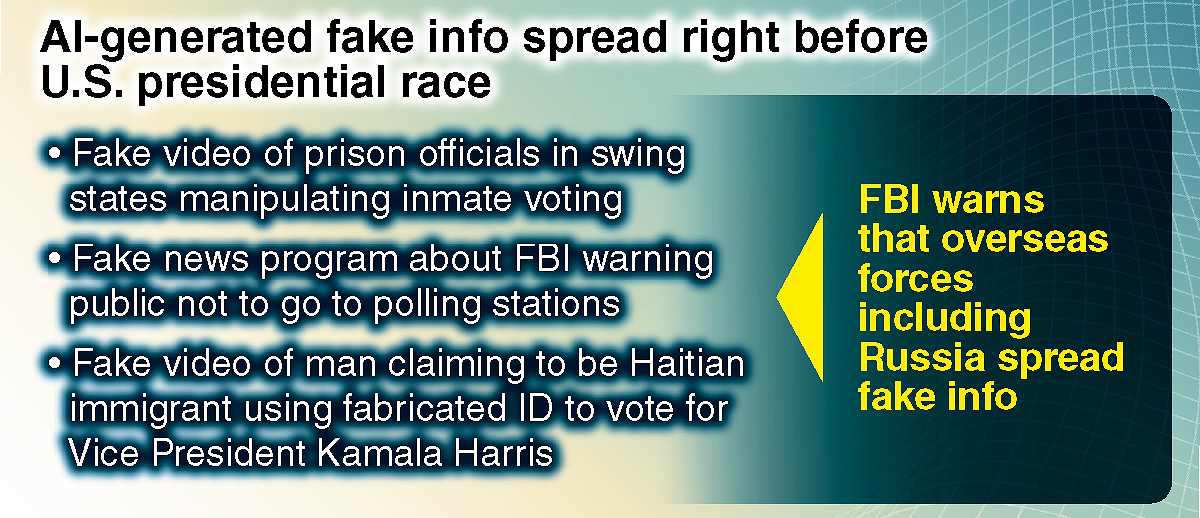
A fabricated video went viral on social media the day before the Nov. 5 U.S. presidential election. The video was created to look like a report from CBS News and said the Federal Bureau of Investigation was advising people to “vote remotely” due to a potential terrorist attack.
Taking the situation seriously, the FBI released a statement on Nov. 5 reading, “This video is not authentic and does not accurately represent the current threat posture or polling location safety.”
The video appeared to have been created with artificial intelligence by a group with links to Russia and was immediately deleted.
At the end of October, a fake video clip was posted in which a man posing as an election committee staff member sifted through mail-in ballots from the swing state of Pennsylvania and ripped up votes cast for Republican candidate Donald Trump one after another, murmuring “F—ing Trump!”
U.S. and European media reflected on the unprecedented scale of disinformation and conspiracy theories circulating online in the election, and forces hostile to the United States increased their interference. As the voting day approached, groups linked to Russia, China and others were said to have stepped up their interference by posting a succession of fake images and videos.
“The easiest way for foreign governments to win in an information operation is to sow chaos,” Bret Schafer, a senior fellow of the U.S. research organization Alliance for Securing Democracy, said. Shafer added that Russia tried to support Trump, who is friendly toward the country.
“As domestic turmoil deepens [due to disinformation], the United States is forced to focus on internal issues, leaving less attention and resources to address international affairs,” Schafer said.
The rapid technological improvement of generative AI has made it possible to instantly create a large number of elaborate fake images and videos, resulting in countless bits of unconfirmed information that denigrates rival candidates being sent from various camps, political parties and supporters via social media. The expansion of online echo chambers, in which people only hear from those whose opinions match their own, is said to have further divided the country.
President Joe Biden’s administration pledged to develop legislation to regulate AI, but it was not in time for the presidential election. Twenty states have passed state laws regulating AI, and some states have banned the spread of election-related false information created with AI, but the effect was limited.
Tim Harper, a senior policy analyst of the citizens group Center for Democracy & Technology, urged active implementation of a federal regulatory regime. “There are definitely solutions that the United States at the federal level can and should put in place to better protect elections from the spread of misinformation and disinformation from deceptive, manipulated AI content,” Harper said.
Fake voices of Kishida, Abe
In Japan, fake videos were spread around the time the campaign for the House of Representatives election that kicked off on Oct. 15. In the videos, voices apparently generated by having AI learn to mimic voices of former prime ministers were making anti-Liberal Democratic Party remarks.
One of them uses what is apparently AI-generated audio mimicking former Prime Minister Fumio Kishida’s voice to introduce more than 120 people — mainly LDP members — as “candidates who should lose” with such comments as “full of greed.” The fake voice urged people to “vote them down.” The clip got more than 30,000 views on YouTube and spread on X, formerly Twitter.
In another video, a voice that appeared to have been generated by having AI learn to imitate that of former Prime Minister Shinzo Abe was discussing the relationship between candidates and the Family Federation for World Peace and Unification, commonly known as the Unification Church. The videos came with a note stating that none of those comments were made by the prime ministers, but the posters apparently intended to enhance the videos’ credibility by using former prime ministers’ voices.
Before the start of the campaign, the Internal Affairs and Communications Ministry on Oct. 11 requested 14 social media companies, including Meta Platforms Inc. — which manages Facebook — and X Corp., to take measures against false information on the internet.
An official said the ministry “had not confirmed large-scale dissemination of false information,” but there are no provisions in the Public Offices Election Law specifically about generative AI, and no full-scale discussion has been underway for regulations.
‘Warning sign’ from Slovakia
In September last year, fake recordings emerged on the messaging app Telegram, which features a high degree of confidentiality, two days before Slovakia’s general elections. The recordings were purported to be conversations of pro-European liberal Progressive Slovakia (PS) party leader Michal Simecka discussing a plan to manipulate votes.
It was later revealed that the audio was an AI-generated fake, but the recordings had already gone viral on other social media. The PS came second in the election, and a left-wing party that opposed military support for Ukraine took power. The recordings were spread by mainly pro-Russian politicians.
“It really represents a threat to democracy,” PS member Jan Hargas said of generative AI. “I think that’s why I believe that it’s a warning sign for the elections to come in the future.”









Most Read
Popular articles in the past 24 hours
-

Ishinomaki Man Plush Toy Offers Hope to Children in Times of Disa...
-
Japan Eyes Introducing Prescreening System for Foreign Travelers,...
-

Microsoft Japan Raided by Antitrust Watchdog for Allegedly Blocki...
-

Party Representatives’ Questions in Diet: Takaichi Says Consumpti...
-

Milano Cortina 2026: News in Pictures / Feats of Japanese Athlete...
-

Pokémon Celebrates 30 Years with Japanese Pro Baseball Collab
-

Nikkei Tops 59,000 for First Time
-
New U.S. Tariff Unlikely to Significantly Impact Japan, BOJ Gov. ...
Popular articles in the past week
-

Producer Behind Pop Group XG Arrested for Cocaine Possession
-

iPS Treatments Pass Key Milestone, but Broader Applications Far f...
-

Tokyo Skytree's Elevator Stops, Trapping 20 People; All Rescued (...
-
Milano Cortina 2026: Japanese Gold Medalist Figure Skater Miura S...
-

Japan’s Major Real Estate Firms Expanding Overseas Businesses to ...
-

Nepal Bus Crash Kills 19 People, Injures 25 Including One Japanes...
-

Baby Monkey Punch Captures Hearts at Chiba Pref. Zoo, on Social M...
-

Milano Cortina 2026: Japanese Figure Skater Kaori Sakamoto’...
Popular articles in the past month
-
Producer Behind Pop Group XG Arrested for Cocaine Possession
-

Japan PM Takaichi’s Cabinet Resigns en Masse
-

Japan Institute to Use Domestic Commercial Optical Lattice Clock ...
-

Man Infected with Measles Reportedly Dined at Restaurant in Tokyo...
-

Israeli Ambassador to Japan Speaks about Japan’s Role in the Reco...
-

Videos Plagiarized, Reposted with False Subtitles Claiming ‘Ryuky...
-

Man Infected with Measles May Have Come in Contact with Many Peop...
-

Prudential Life Insurance Plans to Fully Compensate for Damages C...
Top Articles in Society
-
Producer Behind Pop Group XG Arrested for Cocaine Possession
-
Man Infected with Measles Reportedly Dined at Restaurant in Tokyo Station
-
Man Infected with Measles May Have Come in Contact with Many People in Tokyo, Went to Store, Restaurant Around When Symptoms Emerged
-

Woman with Measles Visited Hospital in Tokyo Multiple Times Before Being Diagnosed with Disease
-

Australian Woman Dies After Mishap on Ski Lift in Nagano Prefecture
JN ACCESS RANKING
-
Producer Behind Pop Group XG Arrested for Cocaine Possession
-
Japan PM Takaichi’s Cabinet Resigns en Masse
-
Man Infected with Measles Reportedly Dined at Restaurant in Tokyo Station
-
Israeli Ambassador to Japan Speaks about Japan’s Role in the Reconstruction of Gaza
-
Videos Plagiarized, Reposted with False Subtitles Claiming ‘Ryukyu Belongs to China’; Anti-China False Information Also Posted in Japan