
Aomori Quake Occurs in Area Hit by M7, M8 Earthquakes in Past, Hypocenter Located in Region of Anticipated Japan Trench Quake
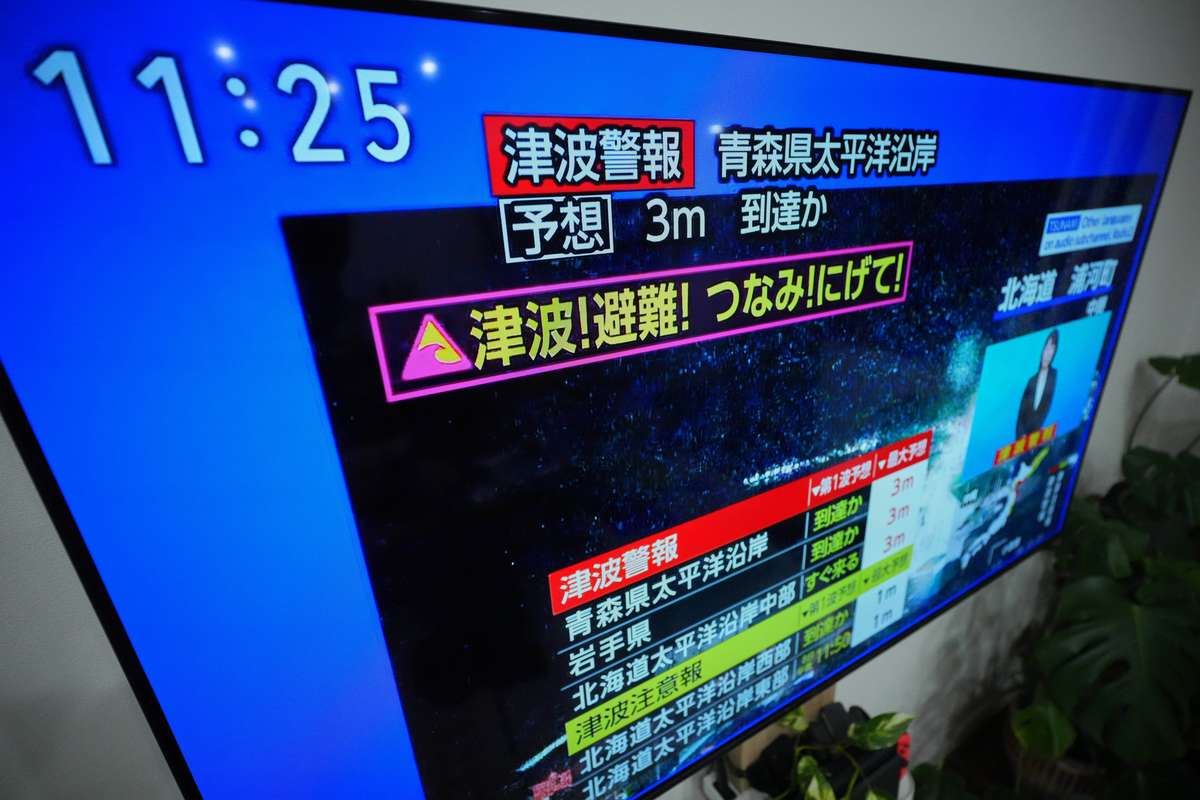
A tsunami warning is seen on a television in Yokohama on Monday after a strong earthquake rocked the Tohoku region and Hokkaido.
15:46 JST, December 10, 2025
The powerful earthquake that struck late on Monday, with its epicenter off the east coast of Aomori Prefecture, occurred in an area that has been hit by quakes in the past measuring magnitude 7 and magnitude 8.
The hypocenter was located within the presumed focal region of an anticipated quake along the Japan Trench or Chishima Trench, which could result in at least 100,000 deaths. The government is on the alert because a larger follow-up earthquake may occur in the area.
The Monday earthquake occurred north of the epicenter of the magnitude 9 Great East Japan Earthquake that struck in 2011. It was a trench-type quake, like the March 2011 earthquake, occurring at the boundary between the Pacific Plate on the sea side and the North American Plate on the land side. The quake occurred as the Pacific Plate subducted beneath the North American Plate.
You may also like to read
Strong Tremors, Tsunami Warnings Remind Residents of 2011 Great East Japan EarthquakeMajor earthquakes, including the magnitude 8 Tokachi-oki Earthquake in 2003 and the magnitude 7.6 Sanriku-Haruka-oki Earthquake in 1994, occurred in the area and its surroundings. Since the Monday tremor occurred in a “void” with few recorded earthquakes of comparable magnitude, some experts suggest it may have taken place after part of a plate boundary, which had not entirely broken, was ruptured.
The government’s Earthquake Research Committee has estimated that earthquakes of about magnitude 7.9 could occur in the area once every 97 years. According to the long-term assessment, earthquakes with a magnitude 7 to magnitude 7.5, which are of a similar magnitude to Monday’s tremor, could occur once every 8.8 years, and there is an “at least 90% probability” of the occurrence within the next 30 years.
“It is possible that the plate boundary deep underground, which had not moved, largely shifted,” said Tohoku University Prof. Shinji Toda, a seismology and geology specialist. “We need to be vigilant for larger follow-up quakes.”


Related Tags



Most Read
Most read in the last 24 hours
-
India’s Arms Indigenization Quest for Self-Reliance / Big Firms, ...
-
Shifts Startup Focus to Nurturing Global Winners
-

Princess Aiko Enjoys Imperial Court Music, Dance; Production, Cos...
-

Bibimbap with Spring Vegetables and Asari Clam Miso a Rich Taste ...
-

Mother Supports My Sister Too Much, Gives Her Kids Much More Than...
-

Umami History: Kyoto Chef Murata Worked to Share Japan’s Scientif...
-

Appeal of Japanese Food: Make Good Use of ‘Discoveries’ by People...
-
Official App to Help Startups Meet Other Participants
Most read in the last 7 days
-
Earthquake Hits Japan's Tohoku Region; 3-meter Tsunami Warning Is...
-

China, South Korea Object to Japanese PM Takaichi's Ritual Offeri...
-

Trump Extends the Ceasefire with Iran but Keeps the Blockade
-

India's Arms Indigenization Quest for Self-Reliance / New Delhi S...
-

¥1,000 Coins to Be Issued to Mark Anniversary of Beginning of Jap...
-

Most Serious Cyberattacks against the UK Now from Russia, Iran an...
-

Trump Opposes United–American Merger, Signals Support for Spirit
-
System Malfunction in Haneda Airport Causes 83 Flight Cancelation...
Most read in the last 30 days
-
Earthquake Hits Japan's Tohoku Region; 3-meter Tsunami Warning Is...
-
Police Find Child's Shoe During Search for Missing Boy in Nantan,...
-
Body Found in Nantan, Kyoto Prefecture, During Search for 11-Year...
-
China, South Korea Object to Japanese PM Takaichi's Ritual Offeri...
-
Cherry Blossoms, Rapeseed Flowers Perform Colorful ‘Duet’ in Niig...
-
Trump Extends the Ceasefire with Iran but Keeps the Blockade
-

Olympic Gold Medal-Winning Figure Skaters Riku-Ryu Announce Retir...
-

Japanese Prime Minister Takaichi Speaks to Pakistani Prime Minist...
Top Articles in Society
-
Earthquake Hits Japan’s Tohoku Region; 3-meter Tsunami Warning Issued (Update 1)
-
Police Find Child’s Shoe During Search for Missing Boy in Nantan, Kyoto Prefecture
-
Body Found in Nantan, Kyoto Prefecture, During Search for 11-Year-Old Boy in Area (Update 1)
-
Cherry Blossoms, Rapeseed Flowers Perform Colorful ‘Duet’ in Niigata
-
Japan to Ban Use of Portable Chargers on Airplanes from April 24, Number of Regular Chargers To Be Limited to 2
JN ACCESS RANKING
-
Earthquake Hits Japan’s Tohoku Region; 3-meter Tsunami Warning Issued (Update 1)
-
Police Find Child’s Shoe During Search for Missing Boy in Nantan, Kyoto Prefecture
-
Body Found in Nantan, Kyoto Prefecture, During Search for 11-Year-Old Boy in Area (Update 1)
-
China, South Korea Object to Japanese PM Takaichi’s Ritual Offering to Yasukuni Shrine
-
Cherry Blossoms, Rapeseed Flowers Perform Colorful ‘Duet’ in Niigata
Most read in the last 24 hours
-
India’s Arms Indigenization Quest for Self-Reliance / Big Firms, ...
-
Shifts Startup Focus to Nurturing Global Winners
-
Princess Aiko Enjoys Imperial Court Music, Dance; Production, Cos...
-
Bibimbap with Spring Vegetables and Asari Clam Miso a Rich Taste ...
-
Mother Supports My Sister Too Much, Gives Her Kids Much More Than...
Most read in the last 7 days
-
Earthquake Hits Japan's Tohoku Region; 3-meter Tsunami Warning Is...
-
China, South Korea Object to Japanese PM Takaichi's Ritual Offeri...
-
Trump Extends the Ceasefire with Iran but Keeps the Blockade
-
India's Arms Indigenization Quest for Self-Reliance / New Delhi S...
-
¥1,000 Coins to Be Issued to Mark Anniversary of Beginning of Jap...
Most read in the last 30 days
-
Earthquake Hits Japan's Tohoku Region; 3-meter Tsunami Warning Is...
-
Police Find Child's Shoe During Search for Missing Boy in Nantan,...
-
Body Found in Nantan, Kyoto Prefecture, During Search for 11-Year...
-
China, South Korea Object to Japanese PM Takaichi's Ritual Offeri...
-
Cherry Blossoms, Rapeseed Flowers Perform Colorful ‘Duet’ in Niig...