
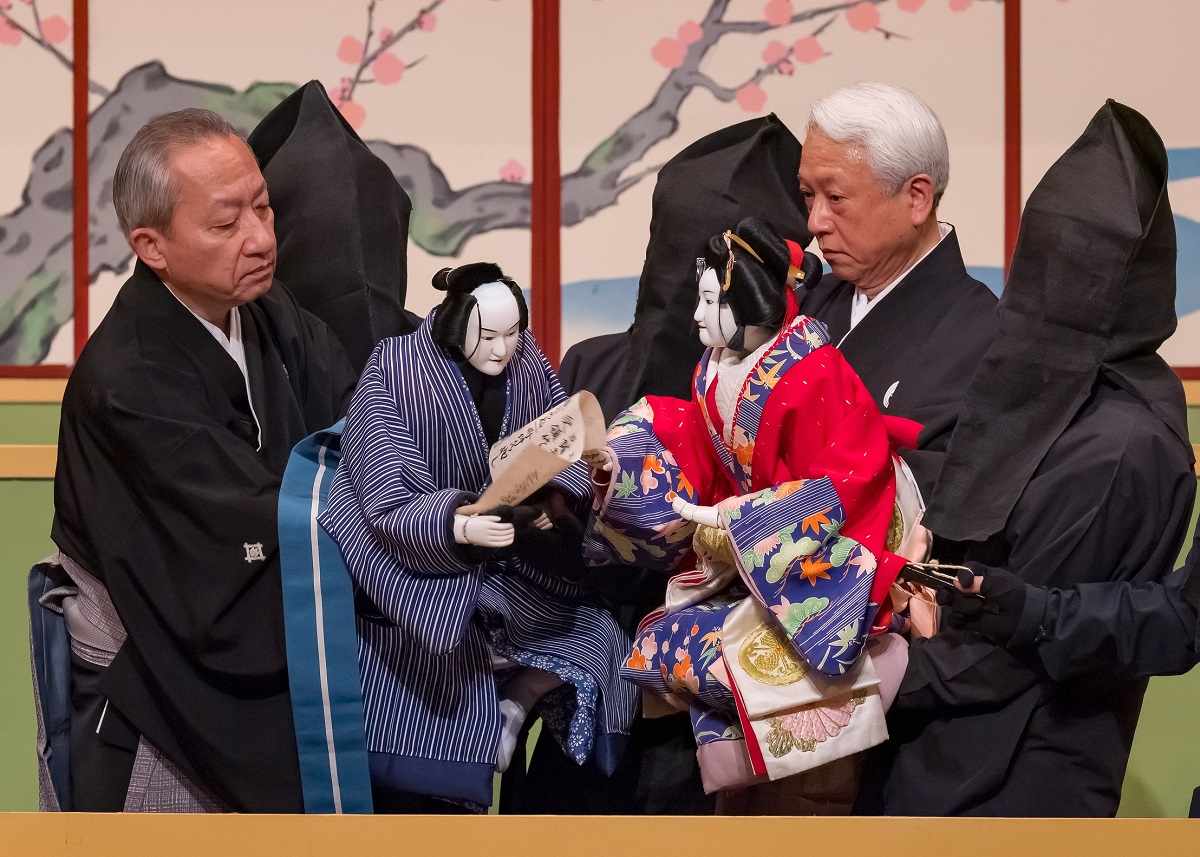
Kiritake Kanjuro, left, operates the puppet of Chubei, and Yoshida Kanya, right, operates the puppet of Umegawa during the “Fuin-kiri” scene from the play “Meido no Hikyaku” at the National Theatre in Chiyoda Ward, Tokyo, as part of the theater’s February bunraku program.
17:15 JST, February 23, 2021
Chikamatsu Monzaemon’s classic “Meido no Hikyaku” (The Courier for Hell) was staged at the National Theatre in Hanzomon, Tokyo, as part of their February bunraku program, which ran from Feb. 6 to 22. One scene from the play, “Fuin-kiri” (Breaking of the seal), is a particular crowd favorite that is also often performed on its own in the kabuki theatre. I would like to dissect some of the many differences between the bunraku puppet play and its human kabuki adaptation.
The play, based on a real incident, tells the story of doomed lovers Chubei, an adopted heir to the Kameya courier service in Osaka, and Umegawa, a courtesan in the city’s Shinmachi red-light district. Determined to buy the courtesan’s freedom, Chubei breaks the seal on a bundle of gold coins entrusted to him by a customer and pockets the money as payment to her brothel. In contemporary terms, Chubei would be akin to a post office clerk who embezzles a hefty envelope of cash in order to marry his sex worker sweetheart. Except in those days, breaking the seal was a crime punishable by death.
“Meido no Hikyaku” was originally written by Chikamatsu in the early 18th century for the ningyo joruri puppet theatre, which is now called bunraku. The work went on to inspire several adaptations, including “Koi-bikyaku Yamato Orai” (The love courier to Yamato). Nowadays, “Fuin-kiri” is typically performed as part of “Koi-bikyaku Yamato Orai” in kabuki and “Meido no Hikyaku” in bunraku.
There are a number of differences to note between the two versions. For example, when Chubei is played by Nakamura Ganjiro, a veteran actor of the Kamigata kabuki in Kyoto and Osaka, the character is portrayed as an essentially cheerful and upstanding man, who only accidentally breaks the seal after substantial provocation from his friend, Tanbaya Hachiemon.
By contrast, in the bunraku play I attended, Chubei was depicted rather more harshly by the capable hands of puppet master Kiritake Kanjuro. A hopeless reprobate with a habit for filching customers’ funds, the bunraku Chubei breaks the pivotal seal on his own accord, after flying into a desperate rage at Hachiemon and the others who try to stop him.
The differences between the plays are even more dramatic for Hachiemon’s character. In the kabuki version, Hachiemon is a vitriolic antagonist who tries to make Umegawa his own and insults Chubei, his rival in love. However, in the bunraku performance, Hachiemon (operated by Yoshida Bunshi) was introduced as a chivalrous figure who obligingly grants Chubei a reprieve on the repayment of his debt, and even admonishes Chubei, who seems headed toward ruin. But Hachiemon’s good intentions backfire and cause a tragic result.
Kabuki highlights Chubei’s suave and Hachiemon’s villainous persona. Interestingly, both characters seemed more like real people in the puppet theatre version.
For the “Fuin-kiri” scene, Takemoto Chitosedayu served as “tayu,” the voice actor and narrator. My favorite tayu of the moment, he gave an impressive performance, galvanized by the rousing, sharp-edged shamisen of Toyozawa Tomisuke. For over an hour, Chitosedayu passionately expounded on the sentiments of Chubei, Umegawa, and Hachiemon, painting a vivid picture of the folly of those who rush headlong down the road of love, as well as all the passion and energy they generate in the process.
As I left the venue a satisfied theatergoer, I found myself imagining what I would do if I were in Chubei’s shoes…
— Morishige covers traditional performing arts.






Most Read
Most read in the last 24 hours
-

India’s Arms Indigenization Quest for Self-Reliance / Big Firms, ...
-

Japan Moves Closer to Blocking Illegal Online Casinos as Governme...
-

Shifts Startup Focus to Nurturing Global Winners
-

Princess Aiko Enjoys Imperial Court Music, Dance; Production, Cos...
-

Bibimbap with Spring Vegetables and Asari Clam Miso a Rich Taste ...
-

Official App to Help Startups Meet Other Participants
-

Umami History: Kyoto Chef Murata Worked to Share Japan’s Scientif...
-

Mother Supports My Sister Too Much, Gives Her Kids Much More Than...
Most read in the last 7 days
-
Earthquake Hits Japan's Tohoku Region; 3-meter Tsunami Warning Is...
-

China, South Korea Object to Japanese PM Takaichi's Ritual Offeri...
-

Trump Extends the Ceasefire with Iran but Keeps the Blockade
-

India's Arms Indigenization Quest for Self-Reliance / New Delhi S...
-

¥1,000 Coins to Be Issued to Mark Anniversary of Beginning of Jap...
-

Most Serious Cyberattacks against the UK Now from Russia, Iran an...
-

Trump Opposes United–American Merger, Signals Support for Spirit
-

System Malfunction in Haneda Airport Causes 83 Flight Cancelation...
Most read in the last 30 days
-
Earthquake Hits Japan's Tohoku Region; 3-meter Tsunami Warning Is...
-
Police Find Child's Shoe During Search for Missing Boy in Nantan,...
-

Body Found in Nantan, Kyoto Prefecture, During Search for 11-Year...
-

Cherry Blossoms, Rapeseed Flowers Perform Colorful ‘Duet’ in Niig...
-
China, South Korea Object to Japanese PM Takaichi's Ritual Offeri...
-
Trump Extends the Ceasefire with Iran but Keeps the Blockade
-

Olympic Gold Medal-Winning Figure Skaters Riku-Ryu Announce Retir...
-

Japanese Prime Minister Takaichi Speaks to Pakistani Prime Minist...
Top Articles in Culture
-

Mobile Suit Gundam’s Haro-Like Robot to Assist Astronauts on ISS, Popular Japanese Character to Travel from Anime to Space
-

Japan to Train 1,000 Specialists Annually to Create Live-Action Content for Export; Dramas, Variety Shows Eyed for Distribution
-

Japanese Anime ‘Precure’ Takes on Detective Genre in 23rd Series, Solving Mysterious Cases
-

Kabuki Actor Nakamura Takanosuke Looking Forward to Seeing Audiences’ Reactions in Europe in His First Overseas Performances
-

Yamato Museum Reopens in Hiroshima Pref. Following Extensive Renovations
JN ACCESS RANKING
-
Earthquake Hits Japan’s Tohoku Region; 3-meter Tsunami Warning Issued (Update 1)
-
Police Find Child’s Shoe During Search for Missing Boy in Nantan, Kyoto Prefecture
-
Body Found in Nantan, Kyoto Prefecture, During Search for 11-Year-Old Boy in Area (Update 1)
-
Cherry Blossoms, Rapeseed Flowers Perform Colorful ‘Duet’ in Niigata
-
China, South Korea Object to Japanese PM Takaichi’s Ritual Offering to Yasukuni Shrine
Most read in the last 24 hours
-
India’s Arms Indigenization Quest for Self-Reliance / Big Firms, ...
-
Japan Moves Closer to Blocking Illegal Online Casinos as Governme...
-
Shifts Startup Focus to Nurturing Global Winners
-
Princess Aiko Enjoys Imperial Court Music, Dance; Production, Cos...
-
Bibimbap with Spring Vegetables and Asari Clam Miso a Rich Taste ...
Most read in the last 7 days
-
Earthquake Hits Japan's Tohoku Region; 3-meter Tsunami Warning Is...
-
China, South Korea Object to Japanese PM Takaichi's Ritual Offeri...
-
Trump Extends the Ceasefire with Iran but Keeps the Blockade
-
India's Arms Indigenization Quest for Self-Reliance / New Delhi S...
-
¥1,000 Coins to Be Issued to Mark Anniversary of Beginning of Jap...
Most read in the last 30 days
-
Earthquake Hits Japan's Tohoku Region; 3-meter Tsunami Warning Is...
-
Police Find Child's Shoe During Search for Missing Boy in Nantan,...
-
Body Found in Nantan, Kyoto Prefecture, During Search for 11-Year...
-
Cherry Blossoms, Rapeseed Flowers Perform Colorful ‘Duet’ in Niig...
-
China, South Korea Object to Japanese PM Takaichi's Ritual Offeri...