
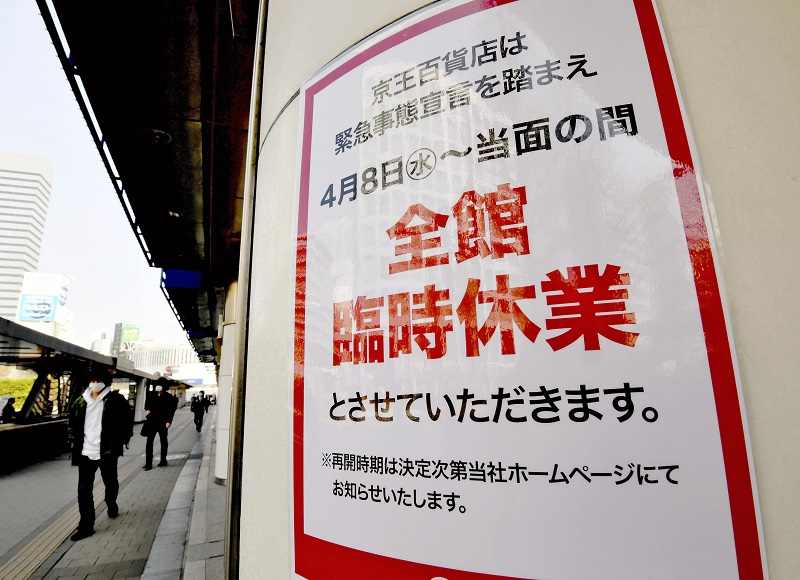
A sign saying “Temporary closure of whole store” was posted at a department store in Shinjuku Ward, Tokyo, on April 8, 2020, the day after the first declaration of the state of emergency.
18:11 JST, April 29, 2021
Public opinion was evenly split on how Japan as a whole has responded to the novel coronavirus and how successful government measures have been, according to a nationwide opinion poll conducted by The Yomiuri Shimbun in March and April.
Asked if they thought that Japanese society as a whole was effectively responding to the pandemic, 46% of respondents answered they “think so,” while 53% said they “think not,” including responses qualified with “if I had to choose” for both answers.
In regard to the Japanese government’s handling of the crisis, the respondents were asked if they thought Japan was more successful than other East Asian governments such as China and Taiwan. The answers were split almost exactly, with 49% saying they “think so” and 50% “think not.”
The novel coronavirus began surging in China in January last year before spreading to the rest of the world. But China was able to contain the virus with tight lockdowns in areas where the infection appeared likely to spread. Taiwan was able to limit the spread by using lessons learned during the severe acute respiratory syndrome (SARS) outbreak in 2003 that claimed many lives.
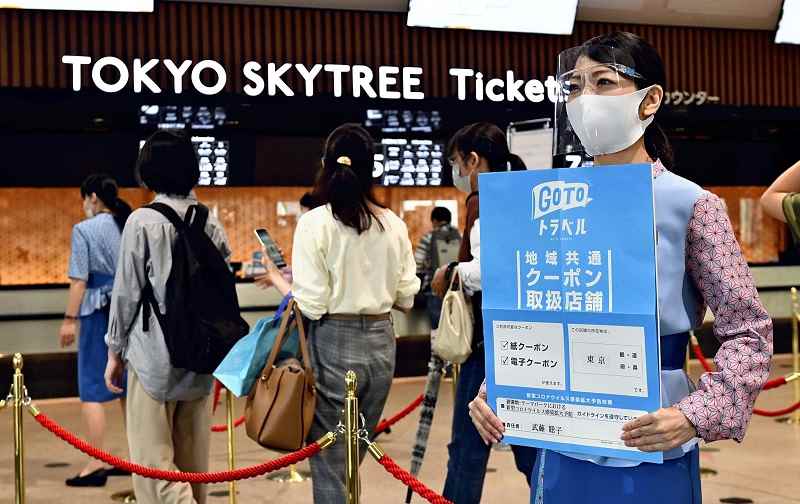
A staff member at Tokyo Skytree provides information on GoTo Travel campaign coupons in Sumida Ward, Tokyo, on Oct. 1, 2020.
Asked if Japan has handled the pandemic better than Western countries such as the United States and Britain, 60% of respondents “think so,” well above the 39% who answered “think not.”
This reflects the fact that while vaccinations in the U.S. are progressing better than in Japan, the number of new infections per day there has remained in the 30,000 to 80,000 range since the beginning of April.
When asked for reactions to each of eight measures taken by the central or local governments to deal with the novel coronavirus, opinions were sharply divided.
The measure that gained the most approval with 96% was “free vaccinations,” followed by 85% in favor of the “declaration of a state of emergency,” and 79% for “uniform cash payment of ¥100,000 per person.”
In contrast, the distribution of cloth masks to all households implemented during the Shinzo Abe administration had an approval rating of just 12%. Prime Minister Yoshihide Suga’s Go To campaigns fared only slightly better, with “Go To Travel” approved by 28% and “Go To Eat” by 33%.
The responses varied by age group, as younger respondents view the “Go To” schemes more favorably, with more than 40% of 18-29 year olds approving of both.






Most Read
Most read in the last 24 hours
-

Iran's Top Diplomat Briefly Returns to Pakistan but Trump Says th...
-

DC Gala Shooting Suspect Aired Grievances against Trump in Writin...
-

Tokyo Vice Governor: SusHi Tech Tokyo Garners Tangible Business O...
-
M6.1 Earthquake Hits Hokkaido, Japan; No Tsunami Expected
-
Japan to Host Leaders from Major Cities from Around the World for...
-
Japanese Police Storm Bus to Arrest Man with Knife; No Injuries R...
-
Japan's LDP Urges More Social Structures Against a ‘State of Emer...
-

Students’ ‘ITAMAE’ Project Boosts Interest in Starting Small Busi...
Most read in the last 7 days
-
China, South Korea Object to Japanese PM Takaichi's Ritual Offeri...
-

Trump Extends the Ceasefire with Iran but Keeps the Blockade
-

India's Arms Indigenization Quest for Self-Reliance / New Delhi S...
-
¥1,000 Coins to Be Issued to Mark Anniversary of Beginning of Jap...
-

Most Serious Cyberattacks against the UK Now from Russia, Iran an...
-

Trump Opposes United–American Merger, Signals Support for Spirit
-
System Malfunction in Haneda Airport Causes 83 Flight Cancelation...
-

Florida Launches Criminal Probe into OpenAI and ChatGPT over Dead...
Most read in the last 30 days
-
Earthquake Hits Japan's Tohoku Region; 3-meter Tsunami Warning Is...
-
Police Find Child's Shoe During Search for Missing Boy in Nantan,...
-
Body Found in Nantan, Kyoto Prefecture, During Search for 11-Year...
-
China, South Korea Object to Japanese PM Takaichi's Ritual Offeri...
-
Cherry Blossoms, Rapeseed Flowers Perform Colorful ‘Duet’ in Niig...
-
Trump Extends the Ceasefire with Iran but Keeps the Blockade
-

Olympic Gold Medal-Winning Figure Skaters Riku-Ryu Announce Retir...
-
Japanese Prime Minister Takaichi Speaks to Pakistani Prime Minist...
Top Articles in Society
-
Earthquake Hits Japan’s Tohoku Region; 3-meter Tsunami Warning Issued (Update 1)
-
Police Find Child’s Shoe During Search for Missing Boy in Nantan, Kyoto Prefecture
-
Body Found in Nantan, Kyoto Prefecture, During Search for 11-Year-Old Boy in Area (Update 1)
-
Cherry Blossoms, Rapeseed Flowers Perform Colorful ‘Duet’ in Niigata
-
Japan to Ban Use of Portable Chargers on Airplanes from April 24, Number of Regular Chargers To Be Limited to 2
JN ACCESS RANKING
-
Earthquake Hits Japan’s Tohoku Region; 3-meter Tsunami Warning Issued (Update 1)
-
Police Find Child’s Shoe During Search for Missing Boy in Nantan, Kyoto Prefecture
-
Body Found in Nantan, Kyoto Prefecture, During Search for 11-Year-Old Boy in Area (Update 1)
-
China, South Korea Object to Japanese PM Takaichi’s Ritual Offering to Yasukuni Shrine
-
Cherry Blossoms, Rapeseed Flowers Perform Colorful ‘Duet’ in Niigata
Most read in the last 24 hours
-
Iran's Top Diplomat Briefly Returns to Pakistan but Trump Says th...
-
DC Gala Shooting Suspect Aired Grievances against Trump in Writin...
-
Tokyo Vice Governor: SusHi Tech Tokyo Garners Tangible Business O...
-
M6.1 Earthquake Hits Hokkaido, Japan; No Tsunami Expected
-
Japan to Host Leaders from Major Cities from Around the World for...
Most read in the last 7 days
-
China, South Korea Object to Japanese PM Takaichi's Ritual Offeri...
-
Trump Extends the Ceasefire with Iran but Keeps the Blockade
-
India's Arms Indigenization Quest for Self-Reliance / New Delhi S...
-
¥1,000 Coins to Be Issued to Mark Anniversary of Beginning of Jap...
-
Most Serious Cyberattacks against the UK Now from Russia, Iran an...
Most read in the last 30 days
-
Earthquake Hits Japan's Tohoku Region; 3-meter Tsunami Warning Is...
-
Police Find Child's Shoe During Search for Missing Boy in Nantan,...
-
Body Found in Nantan, Kyoto Prefecture, During Search for 11-Year...
-
China, South Korea Object to Japanese PM Takaichi's Ritual Offeri...
-
Cherry Blossoms, Rapeseed Flowers Perform Colorful ‘Duet’ in Niig...