
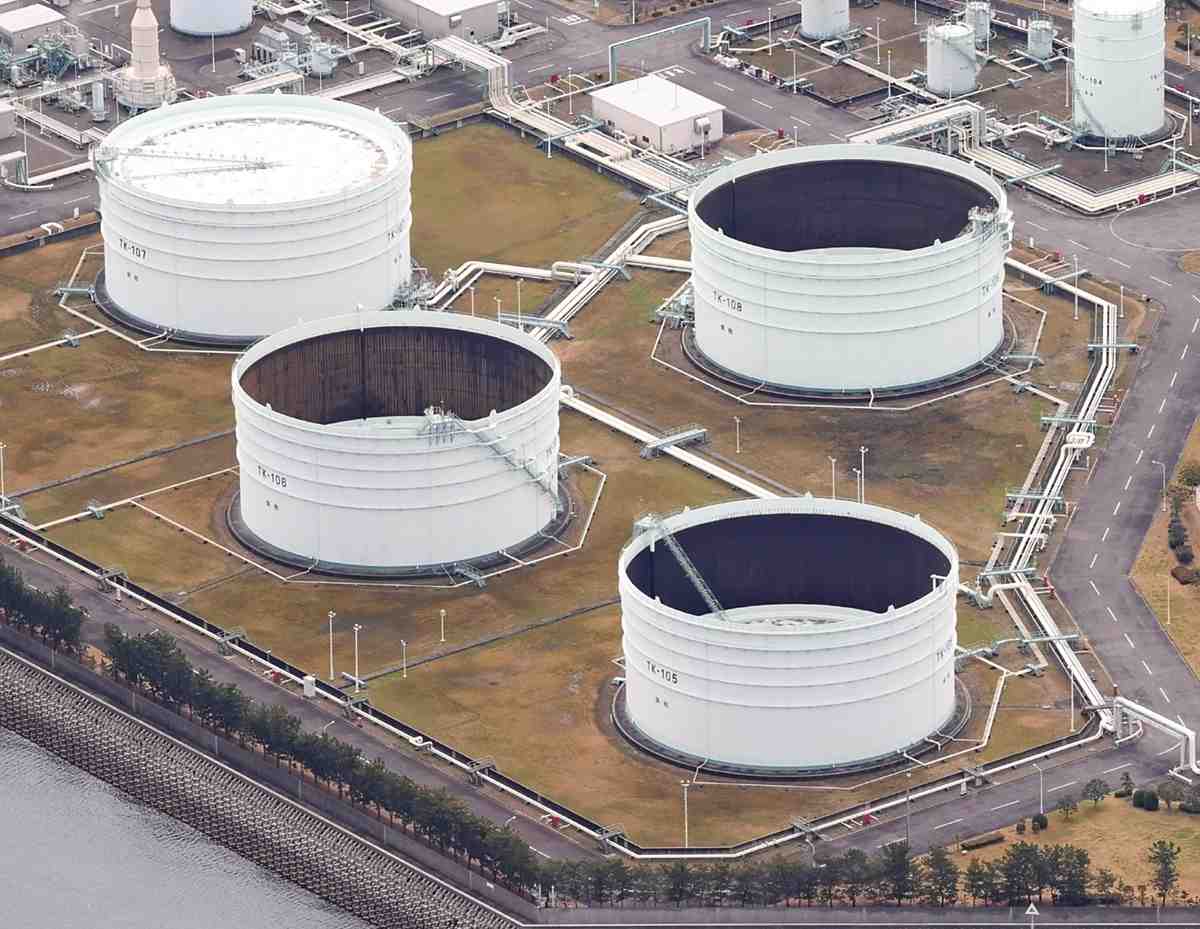
The Kikuma National Petroleum Stockpiling Base in Imabari, Ehime Prefecture, is seen in March.
17:17 JST, April 25, 2026
The government will begin releasing an additional 36 million barrels from national oil reserves from May 1 in response to the de facto blockade of the Strait of Hormuz, the Economy, Trade and Industry Ministry said Friday.
The amount set to be released is equivalent to about 20 days’ worth of domestic consumption. It will be released from 10 storage facilities, including the Shibushi National Petroleum Stockpiling Base in Kagoshima Prefecture.
The oil from this second release will be sold to four major oil wholesalers — Eneos Corp., Idemitsu Kosan Co., Cosmo Oil Co. and Taiyo Oil Co. — for a total of about ¥540 billion.
The first batch, which was about 53 million barrels and released from March 26, was sold for roughly the same amount. This shows a price increase of more than 40%, driven in part by rising international crude oil prices due to the deteriorating situation in the Middle East.
In addition to releasing reserves, the government is working to stabilize supply by securing alternative crude oil sources that do not pass through the Strait of Hormuz.
“As a result of making progress in securing alternative sources, we have a plan to ensure oil supply beyond the end of the year while keeping the amount of reserves released as low as possible,” said a ministry official.
The ministry also announced that a tanker carrying U.S. crude oil was scheduled to arrive at Cosmo Oil’s Chiba Refinery in Ichihara, Chiba Prefecture, as early as Sunday. It is the first delivery to Japan of U.S. crude oil that was procured after the start of the war in Iran.
It was to take the small tanker, which was able to pass through the Panama Canal, about 35 days to arrive in Japan, about 20 days faster than the standard route via the Cape of Good Hope at the southern tip of Africa.
The ministry expects that the volume of crude oil that will be procured from the United States in May will be about four times more compared to the previous year, which was about 90,000 barrels per day.








Most Read
Most read in the last 24 hours
-

Promote Support, Respect to Help Prevent Harassment of Athletes
-
Japan Should Serve as Bridge between Nuclear, Non-nuclear States,...
-

Yamato Museum Reopens in Hiroshima Pref. Following Extensive Reno...
-

Toyota Unveils New Development Hub in Woven City Repurposed from ...
-
Elegant Weeping Cherry Blossoms on Display at Water Purification ...
-

Fukui: Dinosaur Faculty Building Unveiled in Japanese University'...
-

Japanese Govt to Set Up Panel on Widening Access to Sports Broadc...
-
Man Admits to Abandoning Wife's Body in Zoo Incinerator in Hokkai...
Most read in the last 7 days
-
Earthquake Hits Japan's Tohoku Region; 3-meter Tsunami Warning Is...
-

Trump Extends the Ceasefire with Iran but Keeps the Blockade
-

China, South Korea Object to Japanese PM Takaichi's Ritual Offeri...
-

India's Arms Indigenization Quest for Self-Reliance / New Delhi S...
-
Japan to Ban Use of Portable Chargers on Airplanes from April 24,...
-
¥1,000 Coins to Be Issued to Mark Anniversary of Beginning of Jap...
-

Most Serious Cyberattacks against the UK Now from Russia, Iran an...
-

Trump Opposes United–American Merger, Signals Support for Spirit
Most read in the last 30 days
-
Earthquake Hits Japan's Tohoku Region; 3-meter Tsunami Warning Is...
-
Police Find Child's Shoe During Search for Missing Boy in Nantan,...
-
Body Found in Nantan, Kyoto Prefecture, During Search for 11-Year...
-
Cherry Blossoms, Rapeseed Flowers Perform Colorful ‘Duet’ in Niig...
-
Trump Extends the Ceasefire with Iran but Keeps the Blockade
-
China, South Korea Object to Japanese PM Takaichi's Ritual Offeri...
-

Olympic Gold Medal-Winning Figure Skaters Riku-Ryu Announce Retir...
-

Japanese Prime Minister Takaichi Speaks to Pakistani Prime Minist...
Top Articles in Society
-
Earthquake Hits Japan’s Tohoku Region; 3-meter Tsunami Warning Issued (Update 1)
-
Police Find Child’s Shoe During Search for Missing Boy in Nantan, Kyoto Prefecture
-
Body Found in Nantan, Kyoto Prefecture, During Search for 11-Year-Old Boy in Area (Update 1)
-
Cherry Blossoms, Rapeseed Flowers Perform Colorful ‘Duet’ in Niigata
-
Japan to Ban Use of Portable Chargers on Airplanes from April 24, Number of Regular Chargers To Be Limited to 2
JN ACCESS RANKING
-
Earthquake Hits Japan’s Tohoku Region; 3-meter Tsunami Warning Issued (Update 1)
-
Police Find Child’s Shoe During Search for Missing Boy in Nantan, Kyoto Prefecture
-
Body Found in Nantan, Kyoto Prefecture, During Search for 11-Year-Old Boy in Area (Update 1)
-
Cherry Blossoms, Rapeseed Flowers Perform Colorful ‘Duet’ in Niigata
-
Trump Extends the Ceasefire with Iran but Keeps the Blockade
Most read in the last 24 hours
-
Promote Support, Respect to Help Prevent Harassment of Athletes
-
Japan Should Serve as Bridge between Nuclear, Non-nuclear States,...
-
Yamato Museum Reopens in Hiroshima Pref. Following Extensive Reno...
-
Toyota Unveils New Development Hub in Woven City Repurposed from ...
-
Elegant Weeping Cherry Blossoms on Display at Water Purification ...
Most read in the last 7 days
-
Earthquake Hits Japan's Tohoku Region; 3-meter Tsunami Warning Is...
-
Trump Extends the Ceasefire with Iran but Keeps the Blockade
-
China, South Korea Object to Japanese PM Takaichi's Ritual Offeri...
-
India's Arms Indigenization Quest for Self-Reliance / New Delhi S...
-
Japan to Ban Use of Portable Chargers on Airplanes from April 24,...
Most read in the last 30 days
-
Earthquake Hits Japan's Tohoku Region; 3-meter Tsunami Warning Is...
-
Police Find Child's Shoe During Search for Missing Boy in Nantan,...
-
Body Found in Nantan, Kyoto Prefecture, During Search for 11-Year...
-
Cherry Blossoms, Rapeseed Flowers Perform Colorful ‘Duet’ in Niig...
-
Trump Extends the Ceasefire with Iran but Keeps the Blockade