
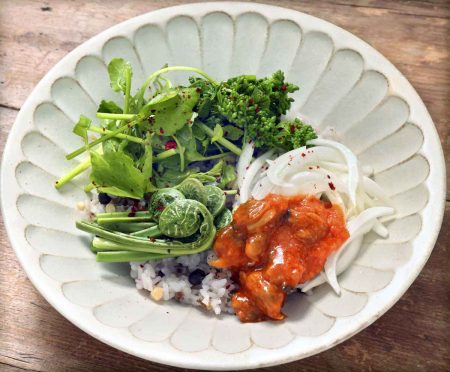
Spring vegetables and asari clam miso bibimbap
12:00 JST, April 26, 2026
Cooking expert Kentetsu Koh shares a recipe for spring vegetables and asari clam miso bibimbap. It is a one-plate dish that richly captures the essence of spring.
Koh is well-known for his healthy, easy-to-cook recipes that focus on Korean cuisine and seasonal ingredients. This bibimbap features rice mixed with a topping of several types of namul and asari clam miso. Namul is made with slightly bitter spring vegetables and edible sansai wild greens. Asari clam miso is asari clams, when in season, simmered with miso. The clams add a pleasant texture.
In Japan, namul is usually boiled daikon radish or spinach tossed with sesame oil and other seasonings.
“My mother used to make namul with seasonal vegetables for my bento boxed meals. They made me feel the seasons,” Koh said. “Using a variety of vegetables is the Korean way.”
To make the namul of nanohana (edible canola flower buds with leaves and stems), first only dip the stem part in boiling water for about 15 seconds, and then blanch them entirely for about 15 seconds. Doing so prevents the leaves from becoming too soft.
To make the namuls of seri water dropwort, nanohana and kogomi ostrich fern, toss each in a separate bowl with soy sauce and sesame oil.
To make the namul of shin-tamanegi spring harvested onion, season it with salt instead of soy sauce.
“I make them separately, as I want to preserve the color of each namul. I season white ingredients with salt,” Koh said.
The asari clams are steamed with sake. The steaming broth is then strained and set aside. The broth is simmered with the miso and other seasonings until it thickens, making a flavorful asari clam miso.
On top of the rice on a plate, the namuls and asari clam miso are arranged to maximize the effect of their colors. As I was admiring the beautiful presentation, Koh told me, “Some Japanese people eat it without mixing it much, but people in South Korea mix it thoroughly to enjoy the unified flavor.”
Spring vegetables and asari clam miso bibimbap
Ingredients (serves 2)
- 200 grams asari clams (after washing out sand)
- 1 tbsp green onions (finely chopped)
- 1/2 bunch seri water dropwort
- 1/2 shin-tamanegi spring harvested onion
- 1/2 bunch nanohana greens (edible canola flower buds with leaves and stems)
- 10 kogomi ostrich fern
- Appropriate amount of multigrain rice
- 1/2 tbsp gochujang
- 1 tbsp sake
- 1 tbsp miso
- 40 milliliters sesame oil
- 1 tsp sugar
- 1 tsp soy sauce
- 2 tsp vinegar
- Pinch of salt
- Korean chili powder to taste
Directions:
1. Wash the asari clams well and place them in a frying pan. Add sake, cover and steam.
2. Once the shells open, remove the asari clam meat. Strain the steaming broth.
3. Wipe the frying pan clean, and then add the asari clam meat, broth, green onions, gochujang, miso, sugar and sesame oil. Simmer until thickened to make the asari clam miso.
4. Cut the seri water dropwort into pieces 4-5 centimeters long. Thinly slice the shin-tamanegi spring harvested onions along the grain.
5. Bring water to a boil in a pan, add the nanohana, and blanch for about 30 seconds. Plunge into cold water, squeeze and cut them into two or three pieces of equal length. Next, blanch the kogomi ostrich ferns for about 2 minutes and then drain in a colander. Pat dry and cut in half.
6. Place the seri water dropwort, nanohana and kogomi ostrich ferns in separate bowls. Make their namuls by tossing with soy sauce and sesame oil. Make the namul of shin-tamanegi onion by tossing with the vinegar, sesame oil and a pinch of salt.
7. Serve the multigrain rice on a plate, and top with the four types of namul and the asari clam miso. Sprinkle with Korean chili powder to taste.







Most Read
Most read in the last 24 hours
-

Milano Cortina 2026: Miura, Kihara Among Participants at Tokyo Pa...
-

Japan to Release Additional Oil Reserves from May 1
-
Iwate Pref. Forest Fires Continue into 4th Day, with 30% of Town'...
-

Mazda to End Domestic Production of Mazda2 Compact Car
-

Former Staff Members at Japan's Osaka-Kansai Expo Use Skills from...
-

Ehime: Elderly Polar Bear Peace Makes Speedy Health Recovery, Bac...
-

India’s Arms Indigenization Quest for Self-Reliance / Big Firms, ...
-

Japan Moves Closer to Blocking Illegal Online Casinos as Governme...
Most read in the last 7 days
-
Earthquake Hits Japan's Tohoku Region; 3-meter Tsunami Warning Is...
-

China, South Korea Object to Japanese PM Takaichi's Ritual Offeri...
-

Trump Extends the Ceasefire with Iran but Keeps the Blockade
-

India's Arms Indigenization Quest for Self-Reliance / New Delhi S...
-

¥1,000 Coins to Be Issued to Mark Anniversary of Beginning of Jap...
-

Most Serious Cyberattacks against the UK Now from Russia, Iran an...
-

Trump Opposes United–American Merger, Signals Support for Spirit
-

System Malfunction in Haneda Airport Causes 83 Flight Cancelation...
Most read in the last 30 days
-
Earthquake Hits Japan's Tohoku Region; 3-meter Tsunami Warning Is...
-
Police Find Child's Shoe During Search for Missing Boy in Nantan,...
-
Body Found in Nantan, Kyoto Prefecture, During Search for 11-Year...
-
Cherry Blossoms, Rapeseed Flowers Perform Colorful ‘Duet’ in Niig...
-
China, South Korea Object to Japanese PM Takaichi's Ritual Offeri...
-
Trump Extends the Ceasefire with Iran but Keeps the Blockade
-

Olympic Gold Medal-Winning Figure Skaters Riku-Ryu Announce Retir...
-

Japanese Prime Minister Takaichi Speaks to Pakistani Prime Minist...
Top Articles in Features
-
Cherry Blossoms in Full Bloom Draw Crowds in Sendai, Miyagi Pref.; Aquarium Creates Underwater ‘Cherry Blossom Viewing’ Show
-
Cherry Blossom Viewing Season at Peak in Japan’s Kanazawa
-
Cherry Blossoms, Tulips, Snow-Capped Peaks Create Picturesque Scene in Toyama Pref., Japan
-
Cherry Blossoms Reach Peak in Fukushima Pref., Including Trees Planted to Commemorate Birth of Princess Aiko
-
Cherry Blossom Viewers Enjoy Picnic Under the Trees in Full Bloom in Famous Osaka Spot
JN ACCESS RANKING
-
Earthquake Hits Japan’s Tohoku Region; 3-meter Tsunami Warning Issued (Update 1)
-
Police Find Child’s Shoe During Search for Missing Boy in Nantan, Kyoto Prefecture
-
Body Found in Nantan, Kyoto Prefecture, During Search for 11-Year-Old Boy in Area (Update 1)
-
Cherry Blossoms, Rapeseed Flowers Perform Colorful ‘Duet’ in Niigata
-
China, South Korea Object to Japanese PM Takaichi’s Ritual Offering to Yasukuni Shrine
Most read in the last 24 hours
-
Milano Cortina 2026: Miura, Kihara Among Participants at Tokyo Pa...
-
Japan to Release Additional Oil Reserves from May 1
-
Iwate Pref. Forest Fires Continue into 4th Day, with 30% of Town'...
-
Mazda to End Domestic Production of Mazda2 Compact Car
-
Former Staff Members at Japan's Osaka-Kansai Expo Use Skills from...
Most read in the last 7 days
-
Earthquake Hits Japan's Tohoku Region; 3-meter Tsunami Warning Is...
-
China, South Korea Object to Japanese PM Takaichi's Ritual Offeri...
-
Trump Extends the Ceasefire with Iran but Keeps the Blockade
-
India's Arms Indigenization Quest for Self-Reliance / New Delhi S...
-
¥1,000 Coins to Be Issued to Mark Anniversary of Beginning of Jap...
Most read in the last 30 days
-
Earthquake Hits Japan's Tohoku Region; 3-meter Tsunami Warning Is...
-
Police Find Child's Shoe During Search for Missing Boy in Nantan,...
-
Body Found in Nantan, Kyoto Prefecture, During Search for 11-Year...
-
Cherry Blossoms, Rapeseed Flowers Perform Colorful ‘Duet’ in Niig...
-
China, South Korea Object to Japanese PM Takaichi's Ritual Offeri...