
Japan Eyes Domestic Geologic Hydrogen Production, with Use as Energy Source from 2040
18:01 JST, April 4, 2026
The government plans to launch a project to identify suitable locations for the production of geologic hydrogen this fiscal year, with an aim to start using it as an energy source by 2040.
Hydrogen is seen as a key tool in decarbonization efforts, and the government plans to develop the geologic hydrogen industry from the viewpoint of economic security.
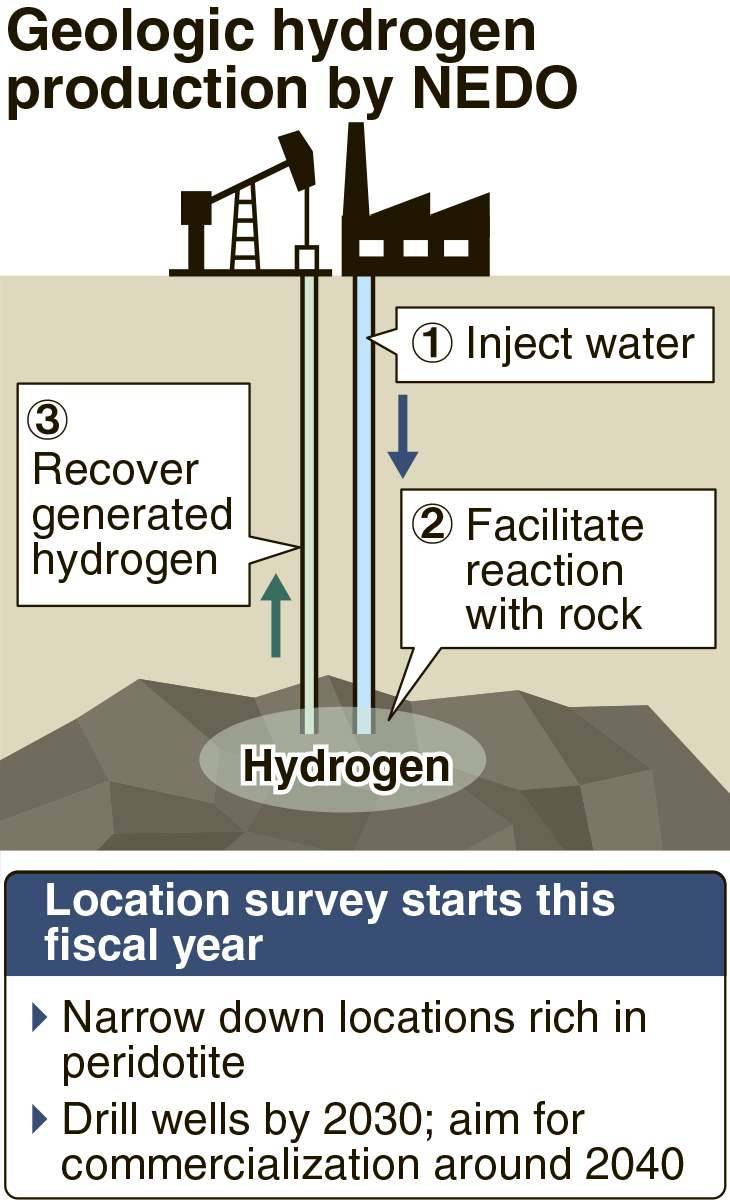
Geologic hydrogen, also known as natural hydrogen, is generated underground primarily through a process called serpentinization, where peridotite rocks react with water in a high-temperature, high-pressure environment.
The government-affiliated New Energy and Industrial Technology Development Organization (NEDO) will develop a method of injecting water underground to stimulate geologic hydrogen generation.
Geologic hydrogen is found around the world in such countries as the United States, Australia and Mali. In Japan, for example, geologic hydrogen has been detected in a hot spring in the village of Hakuba, Nagano Prefecture.
The U.S. Geological Survey estimates as much as 5 trillion tons of geologic hydrogen is trapped in the Earth’s subsurface, enough to meet centuries of hydrogen demand. The volume of geologic hydrogen deposits in Japan is unclear because peridotite rocks are often cracked by earthquakes.
In the location survey, NEDO will try to identify locations with concentrated deposits of peridotite at a depth of 1,000 meters by analyzing geological data in cooperation with research institutes and companies.
NEDO will carry out experiments in which collected rock samples are reacted with water. This aim is to determine what types of peridotite easily react with water and determine the duration of the reaction.
Based on the results of the experiment, NEDO will determine locations suitable for geologic hydrogen development and select candidate sites for test drilling by 2030, with the aim of realizing commercial production in around 2040. The Economy, Trade and Industry Ministry has earmarked the cost of the survey in the government’s fiscal 2026 budget proposal.
Currently, hydrogen is mainly used in oil refining and ammonia production, in addition to being the fuel in fuel cell vehicles.
Hydrogen is seen as a clean energy source because no carbon dioxide is emitted when hydrogen is burned. However, “green hydrogen” produced by splitting water through electrolysis using renewable energy such as solar power is costly and “gray hydrogen” produced using fossil fuels such as natural gas emits CO2. Thus, geologic hydrogen is believed to be an advantageous option from the viewpoints of cost and the environment.
Japan aims to achieve net-zero greenhouse gas emissions by 2050. A U.S. government agency estimates the supply cost for geologic hydrogen would be about ¥7 to ¥20 per cubic meter, while that for green hydrogen is ¥54 to ¥202.
The government targets ¥20 for the supply cost of hydrogen in general, below the level for conventional gas-fired power generation, in 2050.
The United States, Australia and France, among others, are carrying out technological development related to geologic hydrogen. In the United States, drilling and extraction of accumulated geologic hydrogen is expected to start in 2027 in Kansas.
“If [Japan’s] dependency on oil resources were to be lowered by securing domestic geologic hydrogen, it would significantly contribute to energy security as well as anti-global warming measures,” said NEDO project leader Shigeru Niki.





Most Read
Most read in the last 24 hours
-
Promote Support, Respect to Help Prevent Harassment of Athletes
-
Japan Should Serve as Bridge between Nuclear, Non-nuclear States,...
-

Yamato Museum Reopens in Hiroshima Pref. Following Extensive Reno...
-
Japanese Govt to Set Up Panel on Widening Access to Sports Broadc...
-
Toyota Unveils New Development Hub in Woven City Repurposed from ...
-
Elegant Weeping Cherry Blossoms on Display at Water Purification ...
-
Man Admits to Abandoning Wife's Body in Zoo Incinerator in Hokkai...
-

Fukui: Dinosaur Faculty Building Unveiled in Japanese University'...
Most read in the last 7 days
-
Earthquake Hits Japan's Tohoku Region; 3-meter Tsunami Warning Is...
-

Trump Extends the Ceasefire with Iran but Keeps the Blockade
-

China, South Korea Object to Japanese PM Takaichi's Ritual Offeri...
-

India's Arms Indigenization Quest for Self-Reliance / New Delhi S...
-
Japan to Ban Use of Portable Chargers on Airplanes from April 24,...
-

¥1,000 Coins to Be Issued to Mark Anniversary of Beginning of Jap...
-

Most Serious Cyberattacks against the UK Now from Russia, Iran an...
-

Trump Opposes United–American Merger, Signals Support for Spirit
Most read in the last 30 days
-
Earthquake Hits Japan's Tohoku Region; 3-meter Tsunami Warning Is...
-
Police Find Child's Shoe During Search for Missing Boy in Nantan,...
-
Body Found in Nantan, Kyoto Prefecture, During Search for 11-Year...
-
Cherry Blossoms, Rapeseed Flowers Perform Colorful ‘Duet’ in Niig...
-
Trump Extends the Ceasefire with Iran but Keeps the Blockade
-
China, South Korea Object to Japanese PM Takaichi's Ritual Offeri...
-

Olympic Gold Medal-Winning Figure Skaters Riku-Ryu Announce Retir...
-
Japanese Prime Minister Takaichi Speaks to Pakistani Prime Minist...
Top Articles in Politics
-
India’s Arms Indigenization Quest for Self-Reliance / New Delhi Sticks to Its ‘All-Alignment’ Guns Even after Iran Warship Attack
-
Japan Aims to Enhance Deterrence, Defense Industry by Allowing Exports of Weapons
-

Former Japan PM Murayama’s Farewell Ceremony Held; Former Deputy PM Kono Vows to ‘Carry on Path Toward Peace’
-

Chinese Warships Cruise Past Japanese Islands in Retaliation for MSDF Ship Using Taiwan Strait
-

Japan’s PM Takaichi Seeks to Advance Policies Bearing Her Own ‘Color,’ Eyes Amending Constitution, Building Strong Economy
JN ACCESS RANKING
-
Earthquake Hits Japan’s Tohoku Region; 3-meter Tsunami Warning Issued (Update 1)
-
Police Find Child’s Shoe During Search for Missing Boy in Nantan, Kyoto Prefecture
-
Body Found in Nantan, Kyoto Prefecture, During Search for 11-Year-Old Boy in Area (Update 1)
-
Cherry Blossoms, Rapeseed Flowers Perform Colorful ‘Duet’ in Niigata
-
Trump Extends the Ceasefire with Iran but Keeps the Blockade
Most read in the last 24 hours
-
Promote Support, Respect to Help Prevent Harassment of Athletes
-
Japan Should Serve as Bridge between Nuclear, Non-nuclear States,...
-
Yamato Museum Reopens in Hiroshima Pref. Following Extensive Reno...
-
Japanese Govt to Set Up Panel on Widening Access to Sports Broadc...
-
Toyota Unveils New Development Hub in Woven City Repurposed from ...
Most read in the last 7 days
-
Earthquake Hits Japan's Tohoku Region; 3-meter Tsunami Warning Is...
-
Trump Extends the Ceasefire with Iran but Keeps the Blockade
-
China, South Korea Object to Japanese PM Takaichi's Ritual Offeri...
-
India's Arms Indigenization Quest for Self-Reliance / New Delhi S...
-
Japan to Ban Use of Portable Chargers on Airplanes from April 24,...
Most read in the last 30 days
-
Earthquake Hits Japan's Tohoku Region; 3-meter Tsunami Warning Is...
-
Police Find Child's Shoe During Search for Missing Boy in Nantan,...
-
Body Found in Nantan, Kyoto Prefecture, During Search for 11-Year...
-
Cherry Blossoms, Rapeseed Flowers Perform Colorful ‘Duet’ in Niig...
-
Trump Extends the Ceasefire with Iran but Keeps the Blockade