
Kesennuma, Miyagi Pref., Locals Raise Carp Streamers as Symbol of Courage; City Hopes to Demonstrate Recovery on 15th Anniversary of Tsunami
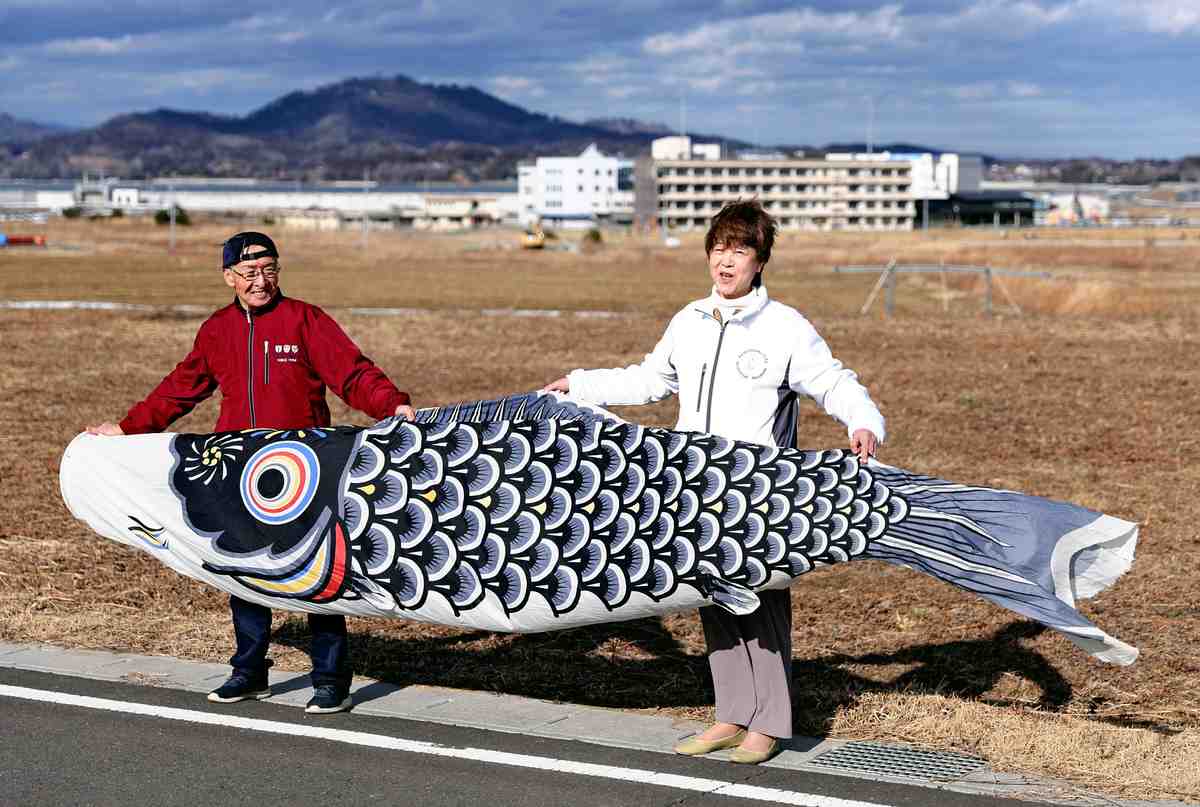
Kazuo Sato, left, and Keiko Onodera hold a carp streamer that they will raise on a site that was once a residential area in Kesennuma, Miyagi Prefecture, on Thursday.
16:24 JST, March 10, 2026
KESENNUMA, Miyagi — People in Kesennuma, Miyagi Prefecture, who lost loved ones in the Great East Japan Earthquake will mark the 15th anniversary of the disaster on Wednesday by raising koinobori carp streamers, which served as a symbol of courage for locals during that dark time.
The event, meant to commemorate the victims and show how Kesennuma has recovered, was organized by an association of people who lost family in the disaster in the city’s Suginoshita district, where a group of 85 homes was swept away in its entirety by the tsunami, leaving 93 people dead.
About a month after the 2011 earthquake and tsunami, four carp streamers could be seen fluttering in the sky above a flooded, rubble-strewn plot, which had been a residential area before the disaster.
“I felt my heart lighten seeing how delighted everyone was [with the streamers],” Kazuo Sato, 72, reminisced.
Sato, who serves as deputy head of the association, lost his mother, Tamoko, 80, in the tsunami.
His mother is believed to have been swept away by the tsunami as she was evacuating to higher ground, while Sato, a volunteer firefighter, was guiding locals to areas of safety.
He was tormented by guilt, asking himself, “If only I had taken my mother with me and fled.”
That was when his younger brother, who lived in Niigata Prefecture, brought him some carp streamers along with groceries. They set the streamers fluttering in the sky alongside a handwritten banner reading “Hang in there.”
Neighbors and others approached him to express their gratitude, saying things like: “It gave me courage. Thank you.” These words touched him deeply.
There were 312 people living in the district before the quake, and they had developed strong bonds through events such as festivals and sports days.
On March 11, 2011, many residents evacuated to an area of high ground about 13 meters above sea level, which the city had designated as a safe height, just as they had practiced in disaster drills. But the tsunami that struck was higher than that, and it claimed the lives of 30% of the residents and devastated the district.
The entire area was designated a disaster hazard zone, leading the residents to relocate, which scattered them across the map. The association was formed by members of 52 households. It has engaged in activities such as erecting a memorial monument and compiling a self-published journal. Three years ago, it held a memorial service to mark the 12th anniversary of the disaster.
It was group member Keiko Onodera, 64, who suggested hoisting carp streamers, as she wished “to see these carp again, to truly feel that [the city has] recovered from 15 years ago.”
Onodera lost her father, Yorozu, then 80, to the tsunami. He was swept away when he went to check on a bedridden relative.
Back then, she ran around morgues searching for her father. About a year later, she happened to see a photo of the carp streamers, which gave her a charge.
Today, the monument is the district’s only remaining reminder of what happened on that day. Suginoshita is now called the “lost village.”
Said Onodera: “I don’t want people to forget about my hometown. I want many people to see Suginoshita’s carp streamers as a symbol of never giving up.”


Related Tags






Most Read
Most read in the last 24 hours
-

Former Staff Members at Japan's Osaka-Kansai Expo Use Skills from...
-

India’s Arms Indigenization Quest for Self-Reliance / Big Firms, ...
-

Japan Moves Closer to Blocking Illegal Online Casinos as Governme...
-

Shifts Startup Focus to Nurturing Global Winners
-

Princess Aiko Enjoys Imperial Court Music, Dance; Production, Cos...
-

Bibimbap with Spring Vegetables and Asari Clam Miso a Rich Taste ...
-

Official App to Help Startups Meet Other Participants
-
Umami History: Kyoto Chef Murata Worked to Share Japan’s Scientif...
Most read in the last 7 days
-
Earthquake Hits Japan's Tohoku Region; 3-meter Tsunami Warning Is...
-

China, South Korea Object to Japanese PM Takaichi's Ritual Offeri...
-

Trump Extends the Ceasefire with Iran but Keeps the Blockade
-

India's Arms Indigenization Quest for Self-Reliance / New Delhi S...
-

¥1,000 Coins to Be Issued to Mark Anniversary of Beginning of Jap...
-

Most Serious Cyberattacks against the UK Now from Russia, Iran an...
-

Trump Opposes United–American Merger, Signals Support for Spirit
-
System Malfunction in Haneda Airport Causes 83 Flight Cancelation...
Most read in the last 30 days
-
Earthquake Hits Japan's Tohoku Region; 3-meter Tsunami Warning Is...
-
Police Find Child's Shoe During Search for Missing Boy in Nantan,...
-
Body Found in Nantan, Kyoto Prefecture, During Search for 11-Year...
-
Cherry Blossoms, Rapeseed Flowers Perform Colorful ‘Duet’ in Niig...
-
China, South Korea Object to Japanese PM Takaichi's Ritual Offeri...
-
Trump Extends the Ceasefire with Iran but Keeps the Blockade
-

Olympic Gold Medal-Winning Figure Skaters Riku-Ryu Announce Retir...
-

Japanese Prime Minister Takaichi Speaks to Pakistani Prime Minist...
Top Articles in Society
-
Earthquake Hits Japan’s Tohoku Region; 3-meter Tsunami Warning Issued (Update 1)
-
Police Find Child’s Shoe During Search for Missing Boy in Nantan, Kyoto Prefecture
-
Body Found in Nantan, Kyoto Prefecture, During Search for 11-Year-Old Boy in Area (Update 1)
-
Cherry Blossoms, Rapeseed Flowers Perform Colorful ‘Duet’ in Niigata
-
Japan to Ban Use of Portable Chargers on Airplanes from April 24, Number of Regular Chargers To Be Limited to 2
JN ACCESS RANKING
-
Earthquake Hits Japan’s Tohoku Region; 3-meter Tsunami Warning Issued (Update 1)
-
Police Find Child’s Shoe During Search for Missing Boy in Nantan, Kyoto Prefecture
-
Body Found in Nantan, Kyoto Prefecture, During Search for 11-Year-Old Boy in Area (Update 1)
-
Cherry Blossoms, Rapeseed Flowers Perform Colorful ‘Duet’ in Niigata
-
China, South Korea Object to Japanese PM Takaichi’s Ritual Offering to Yasukuni Shrine
Most read in the last 24 hours
-
Former Staff Members at Japan's Osaka-Kansai Expo Use Skills from...
-
India’s Arms Indigenization Quest for Self-Reliance / Big Firms, ...
-
Japan Moves Closer to Blocking Illegal Online Casinos as Governme...
-
Shifts Startup Focus to Nurturing Global Winners
-
Princess Aiko Enjoys Imperial Court Music, Dance; Production, Cos...
Most read in the last 7 days
-
Earthquake Hits Japan's Tohoku Region; 3-meter Tsunami Warning Is...
-
China, South Korea Object to Japanese PM Takaichi's Ritual Offeri...
-
Trump Extends the Ceasefire with Iran but Keeps the Blockade
-
India's Arms Indigenization Quest for Self-Reliance / New Delhi S...
-
¥1,000 Coins to Be Issued to Mark Anniversary of Beginning of Jap...
Most read in the last 30 days
-
Earthquake Hits Japan's Tohoku Region; 3-meter Tsunami Warning Is...
-
Police Find Child's Shoe During Search for Missing Boy in Nantan,...
-
Body Found in Nantan, Kyoto Prefecture, During Search for 11-Year...
-
Cherry Blossoms, Rapeseed Flowers Perform Colorful ‘Duet’ in Niig...
-
China, South Korea Object to Japanese PM Takaichi's Ritual Offeri...