
Reopened Fukushima Municipalities Lure New Residents with Education, Subsidies, but Struggle to Build Enough Housing
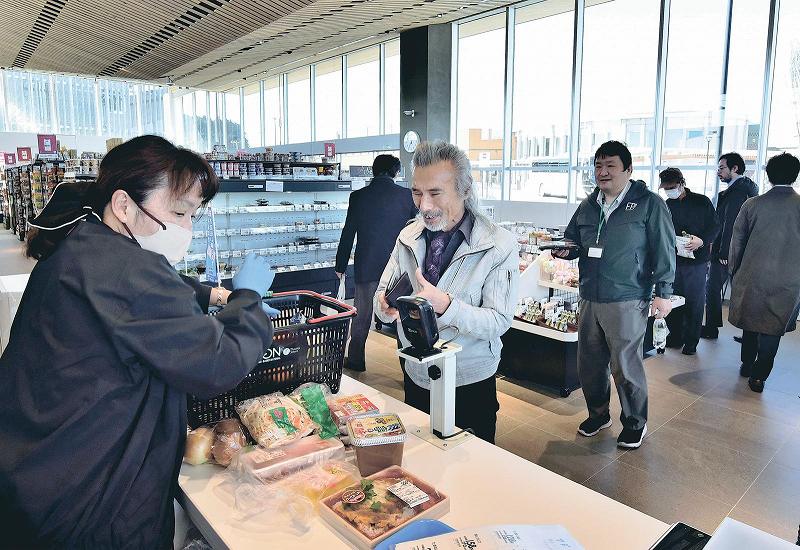
People shop at the Aeon Futaba supermarket in Futaba, Fukushima Prefecture, on Feb. 4.
2:10 JST, March 10, 2026
The return of residents has plateaued to the 11 municipalities in Fukushima Prefecture that had been subject to evacuation orders issued following the 2011 accident at Tokyo Electric Power Company Holdings, Inc.’s Fukushima No. 1 nuclear power plant.
Local governments have been working to attract new residents to increase the population, and some areas have seen an increase in families with children. However, this has led to a new challenge: a shortage of housing for the newcomers.
Supermarket opens in Futaba
In the town of Futaba, residents and employees from nearby businesses can be found at the Aeon Futaba supermarket, which opened in August. The new store stocks about 4,500 items including fresh produce, medicine and daily necessities. Previously, the only options within the town were convenience stores and mobile vendors.
“When we first returned, there were only empty houses, but it’s become much livelier now,” a 70-year-old resident said.
In August 2022, evacuation orders in place since the March 2011 disaster were lifted for a section of the town. A clinic and 86 town-owned housing units have been built there, and 24 companies, including joint ventures, have moved into the industrial park.
“With the area being depopulated for a prolonged time, it is necessary for the government, residents and the private sector to collaborate to realize sustainable development,” said Masanobu Tsuji, president of Aeon Tohoku Co. in Akita, which opened the supermarket.
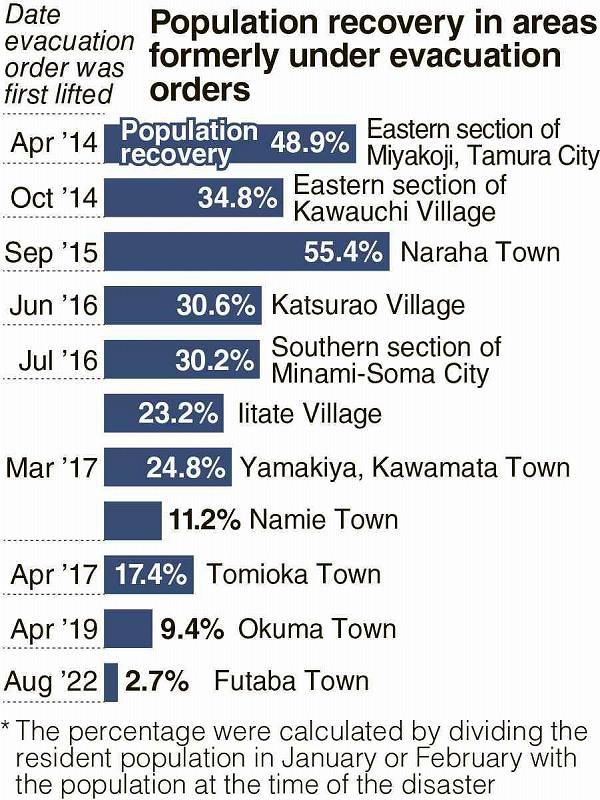
The population of Futaba was about 7,100 at the time of the disaster, and has only recovered to 193. The total population across the evacuation order zones in the 11 municipalities had been 88,330 and had only recovered to 17,818 according to data collected in January and February, with an increase of just 511 over the previous year.
The aging of the population is also progressing in the areas that had been under evacuation orders. The proportion of residents aged 65 and over there is 41%, exceeding the national average of 29.3%. In the town of Kawamata and the villages of Kawauchi and Iitate, the figure exceeds 60%.
Luring families with education
With few residents returning, each municipality is focusing its efforts on attracting newcomers.
The Fukushima prefectural government provides relocation support funds to municipalities near the nuclear plant, offering about twice the level of other prefectures: ¥2 million for a multi-person household and ¥1.2 million for a single-person household. With this support, prefectural data shows that the number of people moving into the affected areas from outside the prefecture reached 822 in fiscal 2024, over five times the number five years ago. The town of Okuma, in particular, has seen a steady increase, with 748 of its 1,086 residents, about 70%, being newcomers.
The town opened a combined elementary and junior high school with an attached certified childcare facility in 2023. The number of children enrolled was initially 26, but has since grown to 100.
“I was attracted to the education that values children’s imagination and independence,” said a 47-year-old man, who moved from Atami, Shizuoka Prefecture, and whose daughter, 8, is a second-grade elementary student at the school.
The influx of child-rearing families has raised the number of residents aged 39 and under to 559, a little over half the population.
Futaba also plans to open a school in April 2028, introducing a curriculum focused on English and international education, and anticipates a rise in educational migration.
Soaring construction costs
While the number those moving into the areas is increasing, housing development is lagging. Due to soaring material costs, expenses related to building houses have risen to 1.5 to 2 times pre-disaster levels.
Housing starts across the 11 municipalities dropped from 3,463 units in 2016 to 863 units in 2024. There is a particular shortage of housing for multi-person households.
“Public housing alone has its limits. We need the private sector’s cooperation,” said an official of the housing and waterworks division of the Namie town government.
Some municipalities have established support systems to promote private rental housing development. Futaba, for example, is providing developers with subsidies of up to ¥5 million for land acquisition and ¥100 million for construction. The town is also planning to develop residential lots on town-owned land, where housing manufacturers will build rental housing for 100 households.
“To sustain the town, we need new residents. The demand exists, and if we can secure housing, the population should grow,” Futaba Mayor Shiro Izawa said.


Related Tags








Most Read
Most read in the last 24 hours
-

Former Staff Members at Japan's Osaka-Kansai Expo Use Skills from...
-

India’s Arms Indigenization Quest for Self-Reliance / Big Firms, ...
-

Japan Moves Closer to Blocking Illegal Online Casinos as Governme...
-

Shifts Startup Focus to Nurturing Global Winners
-

Bibimbap with Spring Vegetables and Asari Clam Miso a Rich Taste ...
-

Official App to Help Startups Meet Other Participants
-

Princess Aiko Enjoys Imperial Court Music, Dance; Production, Cos...
-

Umami History: Kyoto Chef Murata Worked to Share Japan’s Scientif...
Most read in the last 7 days
-
Earthquake Hits Japan's Tohoku Region; 3-meter Tsunami Warning Is...
-

China, South Korea Object to Japanese PM Takaichi's Ritual Offeri...
-

Trump Extends the Ceasefire with Iran but Keeps the Blockade
-

India's Arms Indigenization Quest for Self-Reliance / New Delhi S...
-

¥1,000 Coins to Be Issued to Mark Anniversary of Beginning of Jap...
-

Most Serious Cyberattacks against the UK Now from Russia, Iran an...
-

Trump Opposes United–American Merger, Signals Support for Spirit
-
System Malfunction in Haneda Airport Causes 83 Flight Cancelation...
Most read in the last 30 days
-
Earthquake Hits Japan's Tohoku Region; 3-meter Tsunami Warning Is...
-
Police Find Child's Shoe During Search for Missing Boy in Nantan,...
-
Body Found in Nantan, Kyoto Prefecture, During Search for 11-Year...
-

Cherry Blossoms, Rapeseed Flowers Perform Colorful ‘Duet’ in Niig...
-
China, South Korea Object to Japanese PM Takaichi's Ritual Offeri...
-
Trump Extends the Ceasefire with Iran but Keeps the Blockade
-

Olympic Gold Medal-Winning Figure Skaters Riku-Ryu Announce Retir...
-

Japanese Prime Minister Takaichi Speaks to Pakistani Prime Minist...
Top Articles in Society
-
Earthquake Hits Japan’s Tohoku Region; 3-meter Tsunami Warning Issued (Update 1)
-
Police Find Child’s Shoe During Search for Missing Boy in Nantan, Kyoto Prefecture
-
Body Found in Nantan, Kyoto Prefecture, During Search for 11-Year-Old Boy in Area (Update 1)
-
Cherry Blossoms, Rapeseed Flowers Perform Colorful ‘Duet’ in Niigata
-

Japan to Ban Use of Portable Chargers on Airplanes from April 24, Number of Regular Chargers To Be Limited to 2
JN ACCESS RANKING
-
Earthquake Hits Japan’s Tohoku Region; 3-meter Tsunami Warning Issued (Update 1)
-
Police Find Child’s Shoe During Search for Missing Boy in Nantan, Kyoto Prefecture
-
Body Found in Nantan, Kyoto Prefecture, During Search for 11-Year-Old Boy in Area (Update 1)
-
Cherry Blossoms, Rapeseed Flowers Perform Colorful ‘Duet’ in Niigata
-
China, South Korea Object to Japanese PM Takaichi’s Ritual Offering to Yasukuni Shrine
Most read in the last 24 hours
-
Former Staff Members at Japan's Osaka-Kansai Expo Use Skills from...
-
India’s Arms Indigenization Quest for Self-Reliance / Big Firms, ...
-
Japan Moves Closer to Blocking Illegal Online Casinos as Governme...
-
Shifts Startup Focus to Nurturing Global Winners
-
Bibimbap with Spring Vegetables and Asari Clam Miso a Rich Taste ...
Most read in the last 7 days
-
Earthquake Hits Japan's Tohoku Region; 3-meter Tsunami Warning Is...
-
China, South Korea Object to Japanese PM Takaichi's Ritual Offeri...
-
Trump Extends the Ceasefire with Iran but Keeps the Blockade
-
India's Arms Indigenization Quest for Self-Reliance / New Delhi S...
-
¥1,000 Coins to Be Issued to Mark Anniversary of Beginning of Jap...
Most read in the last 30 days
-
Earthquake Hits Japan's Tohoku Region; 3-meter Tsunami Warning Is...
-
Police Find Child's Shoe During Search for Missing Boy in Nantan,...
-
Body Found in Nantan, Kyoto Prefecture, During Search for 11-Year...
-
Cherry Blossoms, Rapeseed Flowers Perform Colorful ‘Duet’ in Niig...
-
China, South Korea Object to Japanese PM Takaichi's Ritual Offeri...