
Donald Keene’s Drinking Buddy and Translator Yukio Kakuchi Pays Tribute to Japanologist’s Lifelong Work
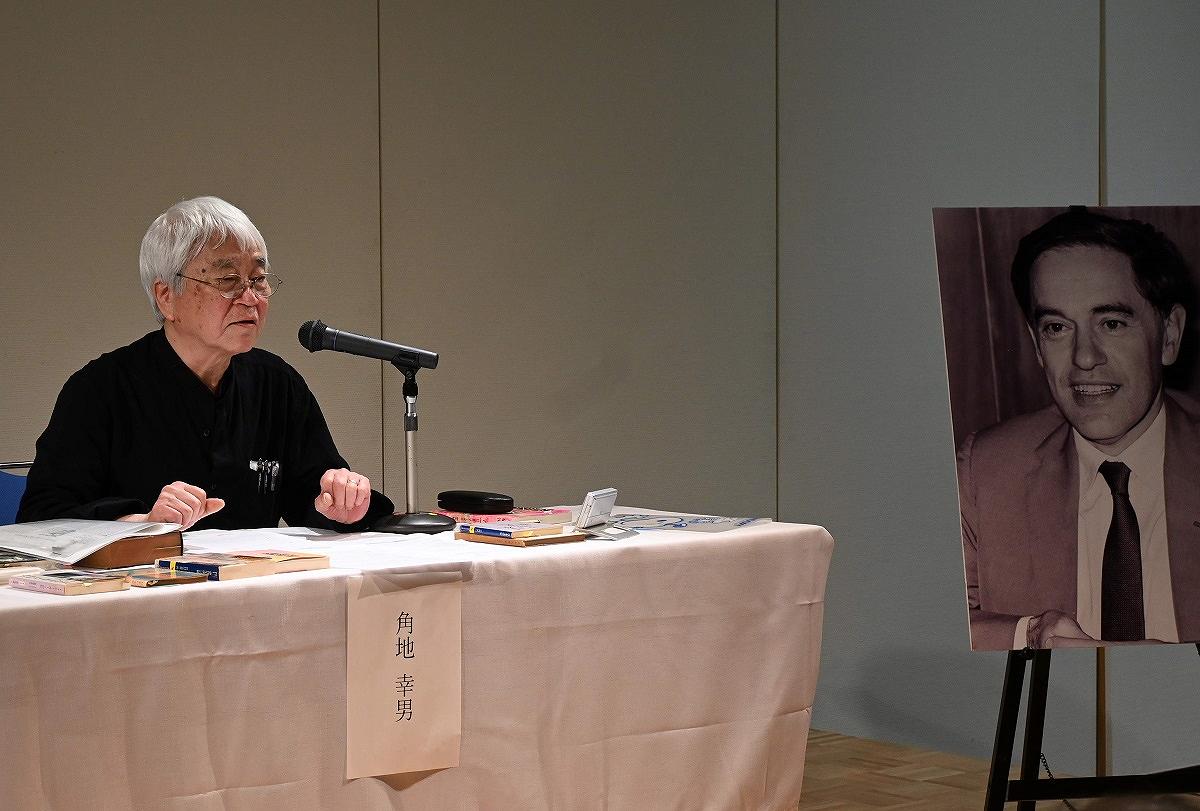
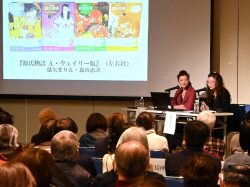
Translator Yukio Kakuchi speaks beside Keene’s portrait at the Setagaya Literary Museum, Tokyo, on Sunday.
14:17 JST, March 6, 2026
Yukio Kakuchi, a longtime “drinking friend” whom Donald Keene trusted deeply and who translated many of Keene’s later works, gave a lecture on Sunday at Tokyo’s Setagaya Literary Museum, where a Donald Keene exhibition is currently being held.
Sharing his personal views on a series of books that was Keene’s lifelong work, “A History of Japanese Literature,” Kakuchi also reminisced about his nearly half-century friendship with Keene, speaking to an audience of over 100 people who packed the venue. The event was a grateful tribute to Keene by Kakuchi, who knew him as well as anyone.
“‘He’s so young.’ That was my impression when I first met Keene, then a professor at Columbia University,” the now 77-year-old Kakuchi began his story. “From the day I interviewed him, we became drinking buddies.”
Their first meeting took place in 1972 when Kakuchi, then a reporter for The Student Times published by The Japan Times, interviewed him. Keene was already renowned as the foremost authority who had introduced Japanese literature to the world. Kakuchi, 24, felt nervous, but Keene, 50, gave off no air of being a distinguished scholar. Despite their father-son age gap, he seemed like a friend.
Kakuchi was invited to Keene’s home almost every week, where they shared drinks and conversation while enjoying Keene’s home-cooked meals. Keene had lost his best friend, Yukio Mishima, to suicide in 1970. In my 2024 interview with Kakuchi, he recounted: “After Mishima’s death, Keene’s friends like Kobo Abe and Kenzaburo Oe were extremely busy, and I, being free, was fortunate enough to benefit from that circumstance.”
Their friendship continued until Keene died in 2019 at the age of 96. About 15 years after their first meeting, Kakuchi began supporting Keene as the translator of his works. This was because Takao Tokuoka, who had previously translated Keene’s books, had parted ways with Keene due to certain circumstances. Keene was suddenly forced into a situation where he absolutely had to find a new translator.
Kakuchi, who had never translated a book before, was chosen for the task. He initially declined, saying, “It’s impossible,” but Keene persuaded him, saying, “You can do it.” He ended up accepting the great responsibility. Kakuchi reflected in the lecture: “It wasn’t just anyone who could be the translator. It had to be someone he could truly trust.”
After that, Kakuchi translated about a dozen of Keene’s works during the author’s lifetime, including “Emperor of Japan: Meiji and His World, 1852-1912,” “Watanabe Kazan” and “Masaoka Shiki.” Subsequently, he also translated manuscripts discovered after Keene’s death. He has even published his own book about Keene.
‘Silenced History’
“Scholars and researchers [in Japan] still haven’t properly discussed Keene’s masterpiece, ‘A History of Japanese Literature,’” Kakuchi said.
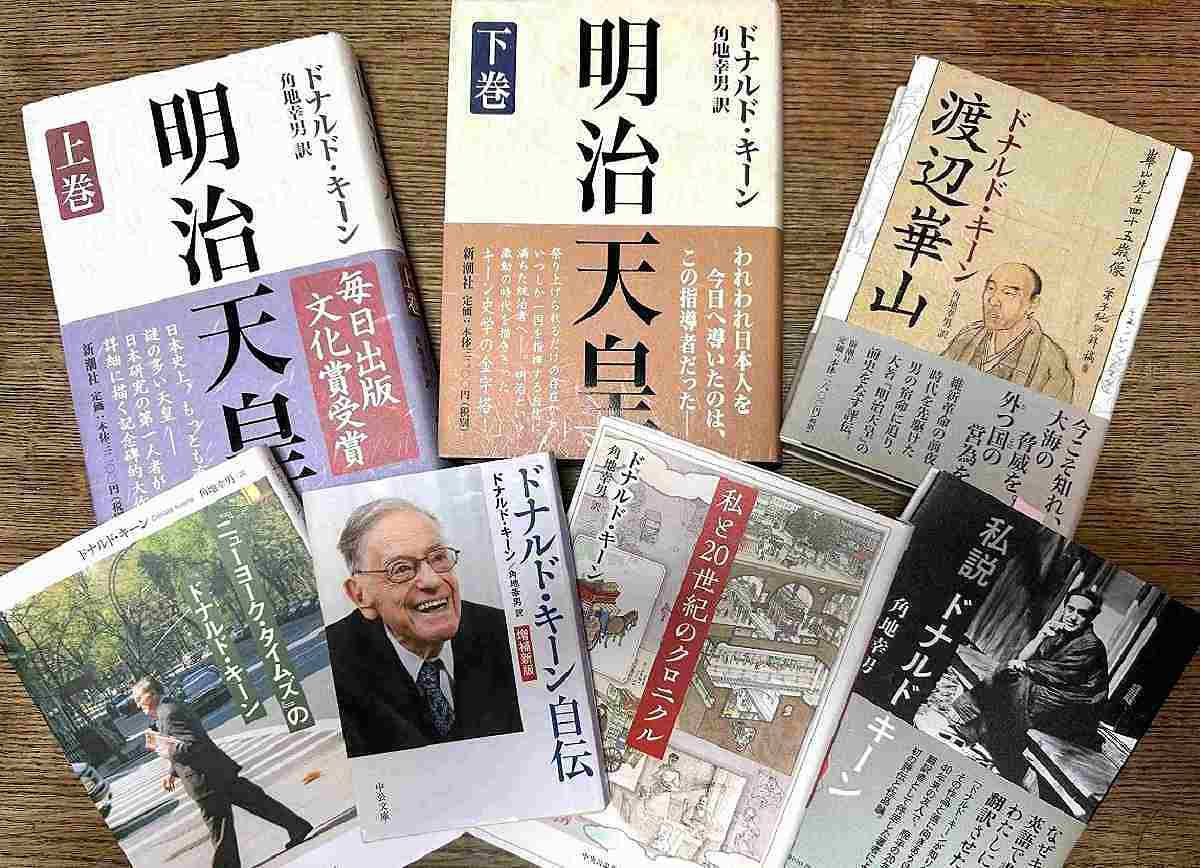
Some of Donald Keene’s works translated by Yukio Kakuchi, and Kakuchi’s own book, lower right
Keene’s “History of Japanese Literature” spans four volumes in English and 18 volumes in Japanese. The first English volume, “World Within Walls,” covering the early modern period, was published in 1976. Subsequently, he published “Dawn to the West: Fiction” and “Dawn to the West: Poetry, Drama, Criticism” in 1984, covering the modern and contemporary periods, followed by “Seeds in the Heart” in 1993, covering the ancient and medieval periods.
Today, exactly half a century has passed since the first of these four books was published. Keene described his work on Japanese literary history as “something like my self-justification,” making it truly his life’s work as a scholar. But in Kakuchi’s view, it has never been properly recognized in this country despite its international renown. He implored, “What on earth have Japanese scholars been doing for the past 50 years?”
One reason for this neglect, Kakuchi explained, was that “in the Japanese literary world at the time, it was common to have specialists for each era and genre. To put it extremely, there was a specialist for each work, and they didn’t meddle in other fields. For a single scholar like Keene to write a comprehensive history of Japanese literature from ancient to modern times was considered intolerable.”
Keene himself wrote, “To write a chapter on the Kojiki, no author could surpass a scholar who had devoted his entire life to its study.” Kakuchi said, “The reaction of most scholars was that Keene, a fearless foreigner, was an amateur and not worth engaging with.” In Kakuchi’s analysis, this was a problem that arose before even considering whether Keene’s literary history was good or bad.
Kakuchi wrote about his personal views in an article titled “The Silenced History of Japanese Literature,” published last year in the July edition of the Japanese monthly literary magazine Shincho.
However, Keene’s achievement in writing a comprehensive Japanese literary history alone is significant. Keene wrote in his own book, “Wouldn’t a literary history with a consistent view on literature or life be easier to read?” Furthermore, he wrote it for the general reader. Thanks to this, many people in Japan and abroad developed a greater interest in Japanese literature, and it helped them understand it.
Kakuchi stated in his lecture, “For Keene, reader engagement was paramount above all else.” Illustrating this view, he quoted Keene’s words from a lecture he gave in Japanese: “Even if every fact is written correctly, that alone is boring. The author — me — must be present.”
Sartorial peace offering
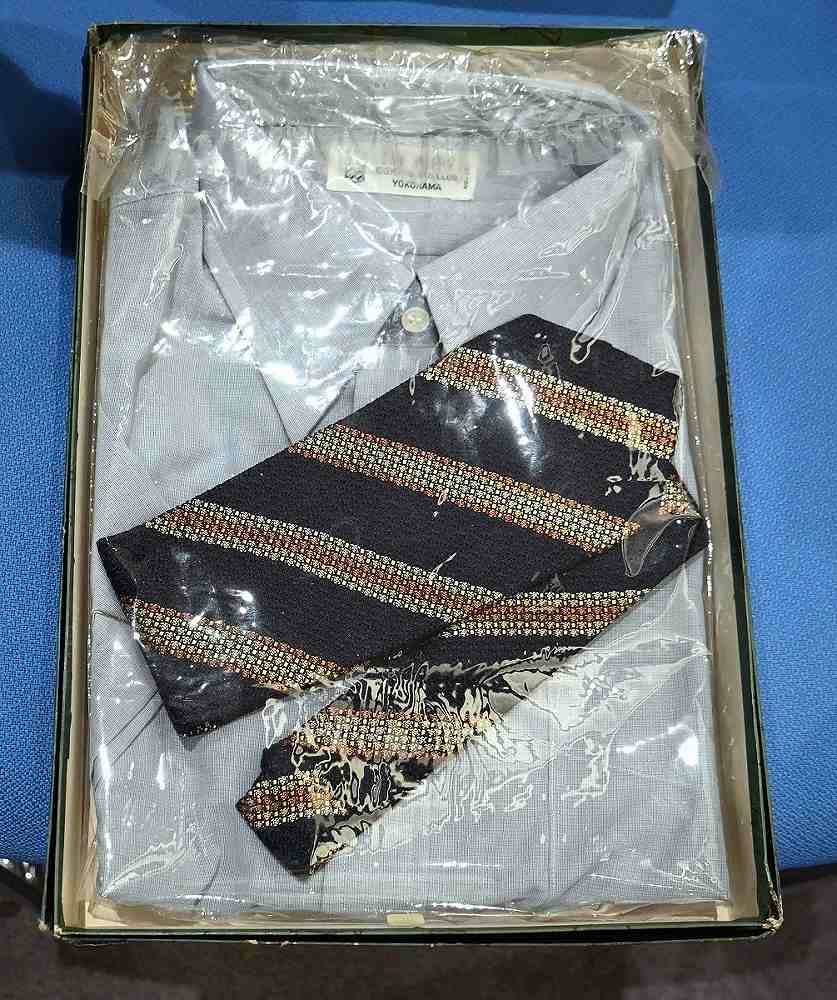
This shirt and tie, a gift from the wife of Keene’s former translator Takao Tokuoka, features in an anecdote about the scholar.
At the end of the lecture, Keene’s adopted son, Seiki, took the stage. He addressed the audience, noting that Kakuchi’s lecture was the final related event for the Donald Keene exhibition currently being held at the Setagaya Literary Museum.
Seiki also shared an anecdote: The wife of Tokuoka, the first translator of Keene’s works, gave Keene a light blue short-sleeved shirt and tie, saying, “When you make up with my husband, please wear these when you meet him.” She died in 2000. Afterward, Keene and Tokuoka’s relationship was repaired, but Keene never wore the shirt and tie; they remained stored in a box. Seiki said, “I think he must have been too embarrassed.” One day, when Seiki told Tokuoka about the shirt and tie, Tokuoka said it was the first time he’d heard about it. “My wife sure was bold,” he said, sounding deeply moved. Tokuoka died last year.
The Donald Keene exhibition runs until Sunday.






Most Read
Most read in the last 24 hours
-

Japan Monitoring Situation Surrounding Revocation of Taiwan Presi...
-
Promote Support, Respect to Help Prevent Harassment of Athletes
-
Japan Should Serve as Bridge between Nuclear, Non-nuclear States,...
-

Yamato Museum Reopens in Hiroshima Pref. Following Extensive Reno...
-
Elegant Weeping Cherry Blossoms on Display at Water Purification ...
-
Toyota Unveils New Development Hub in Woven City Repurposed from ...
-
Man Admits to Abandoning Wife's Body in Zoo Incinerator in Hokkai...
-

Fukui: Dinosaur Faculty Building Unveiled in Japanese University'...
Most read in the last 7 days
-
Earthquake Hits Japan's Tohoku Region; 3-meter Tsunami Warning Is...
-

Trump Extends the Ceasefire with Iran but Keeps the Blockade
-

China, South Korea Object to Japanese PM Takaichi's Ritual Offeri...
-

India's Arms Indigenization Quest for Self-Reliance / New Delhi S...
-
Japan to Ban Use of Portable Chargers on Airplanes from April 24,...
-
¥1,000 Coins to Be Issued to Mark Anniversary of Beginning of Jap...
-

Most Serious Cyberattacks against the UK Now from Russia, Iran an...
-

Trump Opposes United–American Merger, Signals Support for Spirit
Most read in the last 30 days
-
Earthquake Hits Japan's Tohoku Region; 3-meter Tsunami Warning Is...
-
Police Find Child's Shoe During Search for Missing Boy in Nantan,...
-

Body Found in Nantan, Kyoto Prefecture, During Search for 11-Year...
-
Cherry Blossoms, Rapeseed Flowers Perform Colorful ‘Duet’ in Niig...
-
Trump Extends the Ceasefire with Iran but Keeps the Blockade
-

Olympic Gold Medal-Winning Figure Skaters Riku-Ryu Announce Retir...
-
China, South Korea Object to Japanese PM Takaichi's Ritual Offeri...
-
Japanese Prime Minister Takaichi Speaks to Pakistani Prime Minist...
Top Articles in JN Specialities
-

How to Prepare for Power Outages Caused by Natural Disasters
-
Tokyo Wards Train Volunteer Tour Guides for Locals Passionate About Their Area’s Charms
-

Tateyama Soup Curry in Chiba Challenges Its Sapporo Roots, Cafe Owner Looks to Local Area for Best Ingredients
-
Japan May Build ‘Rescue City’ in Noto Region to Train Disaster Experts
-

Personal History Helps You Look Back, Move Forward; Editor Gives Advice to Those Writing Their Story
JN ACCESS RANKING
-
Earthquake Hits Japan’s Tohoku Region; 3-meter Tsunami Warning Issued (Update 1)
-
Police Find Child’s Shoe During Search for Missing Boy in Nantan, Kyoto Prefecture
-
Body Found in Nantan, Kyoto Prefecture, During Search for 11-Year-Old Boy in Area (Update 1)
-
Cherry Blossoms, Rapeseed Flowers Perform Colorful ‘Duet’ in Niigata
-
Trump Extends the Ceasefire with Iran but Keeps the Blockade
Most read in the last 24 hours
-
Japan Monitoring Situation Surrounding Revocation of Taiwan Presi...
-
Promote Support, Respect to Help Prevent Harassment of Athletes
-
Japan Should Serve as Bridge between Nuclear, Non-nuclear States,...
-
Yamato Museum Reopens in Hiroshima Pref. Following Extensive Reno...
-
Elegant Weeping Cherry Blossoms on Display at Water Purification ...
Most read in the last 7 days
-
Earthquake Hits Japan's Tohoku Region; 3-meter Tsunami Warning Is...
-
Trump Extends the Ceasefire with Iran but Keeps the Blockade
-
China, South Korea Object to Japanese PM Takaichi's Ritual Offeri...
-
India's Arms Indigenization Quest for Self-Reliance / New Delhi S...
-
Japan to Ban Use of Portable Chargers on Airplanes from April 24,...
Most read in the last 30 days
-
Earthquake Hits Japan's Tohoku Region; 3-meter Tsunami Warning Is...
-
Police Find Child's Shoe During Search for Missing Boy in Nantan,...
-
Body Found in Nantan, Kyoto Prefecture, During Search for 11-Year...
-
Cherry Blossoms, Rapeseed Flowers Perform Colorful ‘Duet’ in Niig...
-
Trump Extends the Ceasefire with Iran but Keeps the Blockade