

European Union flags are seen outside the EU Commission headquarters in Brussels on July 16.
21:00 JST, December 20, 2025
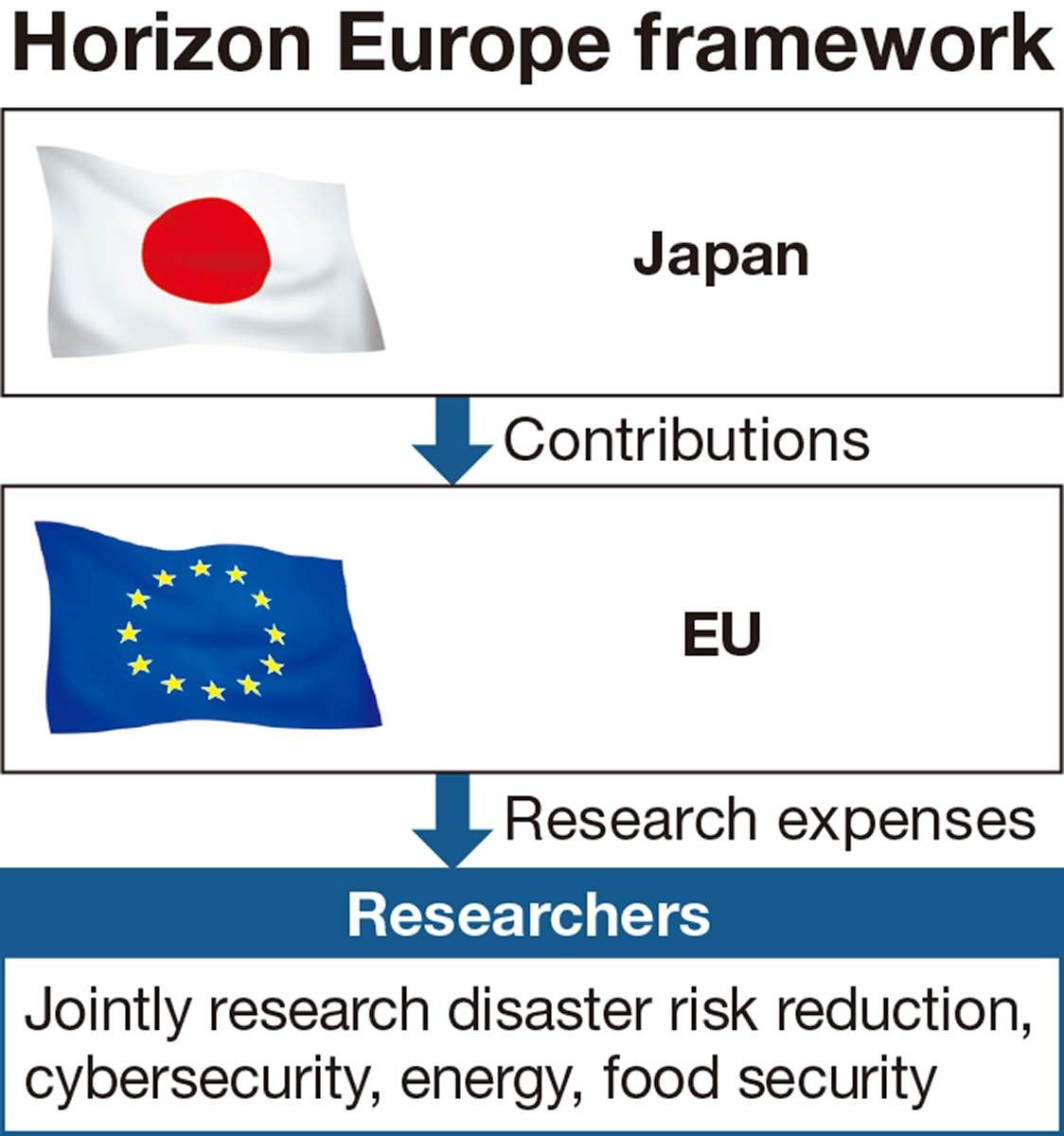
Japan and the European Union have reached a general agreement on Japan’s participation in Horizon Europe, the EU’s key framework for research and development, according to Japanese government sources.
An official announcement regarding the agreement is expected to be made soon.
Japan reportedly aims to strengthen cooperation with the EU in such fields as digital technology, space and energy, thereby enhancing the R&D capabilities of Japanese universities and companies, as the United States is increasingly looking more inward.
Horizon Europe is one of the world’s largest frameworks to support R&D, and the EU will invest €95.5 billion (¥15 trillion) between 2021-27. Framework participants include EU member states, Britain, Canada and South Korea.
Japan has been in negotiations to participate in 2026 or 2027 since the end of the last year.
Japan will participate in applied research, among other areas, related to such fields as disaster risk reduction, cybersecurity, batteries and other energies as well as food security. Any university or company researcher will be able to apply, and those selected will be able to participate in individual projects.
Japanese researchers’ financial burden will be reduced thanks to the EU’s funding. The Japanese government will include about ¥1.2 billion in the fiscal 2026 budget proposal to contribute its required share to the EU to participate in the framework.
By advancing cooperation with the EU and others, Japan can expect more R&D activities at universities and businesses, while expanding its presence in the European market. Japan also hopes to participate in the setting of international standards for industrial and other products in order to make it easier for the country to promote its goods in the overseas market.
The administration of U.S. President Donald Trump, touting an “America First” policy, could reduce its engagement with its allies and partner nations, including Japan. Consequently, Japan needs to secure markets and a research environment that are not overly dependent on the United States.
“Cooperation with the EU could serve as one way [to lessen Japan’s dependence on the United States],” a Japanese government official said.







Most Read
Most read in the last 24 hours
-
Promote Support, Respect to Help Prevent Harassment of Athletes
-

Yamato Museum Reopens in Hiroshima Pref. Following Extensive Reno...
-
Japanese Govt to Set Up Panel on Widening Access to Sports Broadc...
-

New Budget Framework for Investments: Work to Achieve Both Growth...
-
Toyota Unveils New Development Hub in Woven City Repurposed from ...
-
Elegant Weeping Cherry Blossoms on Display at Water Purification ...
-

Fukui: Dinosaur Faculty Building Unveiled in Japanese University'...
-
Man Admits to Abandoning Wife's Body in Zoo Incinerator in Hokkai...
Most read in the last 7 days
-
Earthquake Hits Japan's Tohoku Region; 3-meter Tsunami Warning Is...
-
China, South Korea Object to Japanese PM Takaichi's Ritual Offeri...
-

Trump Extends the Ceasefire with Iran but Keeps the Blockade
-

India's Arms Indigenization Quest for Self-Reliance / New Delhi S...
-
Japan to Ban Use of Portable Chargers on Airplanes from April 24,...
-
¥1,000 Coins to Be Issued to Mark Anniversary of Beginning of Jap...
-

Most Serious Cyberattacks against the UK Now from Russia, Iran an...
-

Trump Opposes United–American Merger, Signals Support for Spirit
Most read in the last 30 days
-
Earthquake Hits Japan's Tohoku Region; 3-meter Tsunami Warning Is...
-
Police Find Child's Shoe During Search for Missing Boy in Nantan,...
-

Body Found in Nantan, Kyoto Prefecture, During Search for 11-Year...
-
Cherry Blossoms, Rapeseed Flowers Perform Colorful ‘Duet’ in Niig...
-
China, South Korea Object to Japanese PM Takaichi's Ritual Offeri...
-
Trump Extends the Ceasefire with Iran but Keeps the Blockade
-

Olympic Gold Medal-Winning Figure Skaters Riku-Ryu Announce Retir...
-
Japanese Prime Minister Takaichi Speaks to Pakistani Prime Minist...
Top Articles in Science & Nature
-

Govt Aims to Establish Bear Population Control by FY30, Hopes to Achieve ‘Coexistence’ with Bears
-
Japan’s Panasonic Develops Automated System to Produce Ips Cells from Patient’s Blood
-
Punch The Monkey Getting Used to Life Without Stuffed ‘Mother’
-

‘Electric Aircraft’ to Begin Test Flights from Kitakyushu Airport, Aiming for Practical Use in Cargo Transport Route
-

New Robotics Center to Conduct Experiments Around the Clock; New Facility Aims to Accelerate Research Efforts
JN ACCESS RANKING
-
Earthquake Hits Japan’s Tohoku Region; 3-meter Tsunami Warning Issued (Update 1)
-
Police Find Child’s Shoe During Search for Missing Boy in Nantan, Kyoto Prefecture
-
Body Found in Nantan, Kyoto Prefecture, During Search for 11-Year-Old Boy in Area (Update 1)
-
Cherry Blossoms, Rapeseed Flowers Perform Colorful ‘Duet’ in Niigata
-
China, South Korea Object to Japanese PM Takaichi’s Ritual Offering to Yasukuni Shrine
Most read in the last 24 hours
-
Promote Support, Respect to Help Prevent Harassment of Athletes
-
Yamato Museum Reopens in Hiroshima Pref. Following Extensive Reno...
-
Japanese Govt to Set Up Panel on Widening Access to Sports Broadc...
-
New Budget Framework for Investments: Work to Achieve Both Growth...
-
Toyota Unveils New Development Hub in Woven City Repurposed from ...
Most read in the last 7 days
-
Earthquake Hits Japan's Tohoku Region; 3-meter Tsunami Warning Is...
-
China, South Korea Object to Japanese PM Takaichi's Ritual Offeri...
-
Trump Extends the Ceasefire with Iran but Keeps the Blockade
-
India's Arms Indigenization Quest for Self-Reliance / New Delhi S...
-
Japan to Ban Use of Portable Chargers on Airplanes from April 24,...
Most read in the last 30 days
-
Earthquake Hits Japan's Tohoku Region; 3-meter Tsunami Warning Is...
-
Police Find Child's Shoe During Search for Missing Boy in Nantan,...
-
Body Found in Nantan, Kyoto Prefecture, During Search for 11-Year...
-
Cherry Blossoms, Rapeseed Flowers Perform Colorful ‘Duet’ in Niig...
-
China, South Korea Object to Japanese PM Takaichi's Ritual Offeri...