
Trump Agreed to Tariff Deal With Japan After 70-Minute Talks; U.S. President Tried to Trade Concessions for 1% Reductions
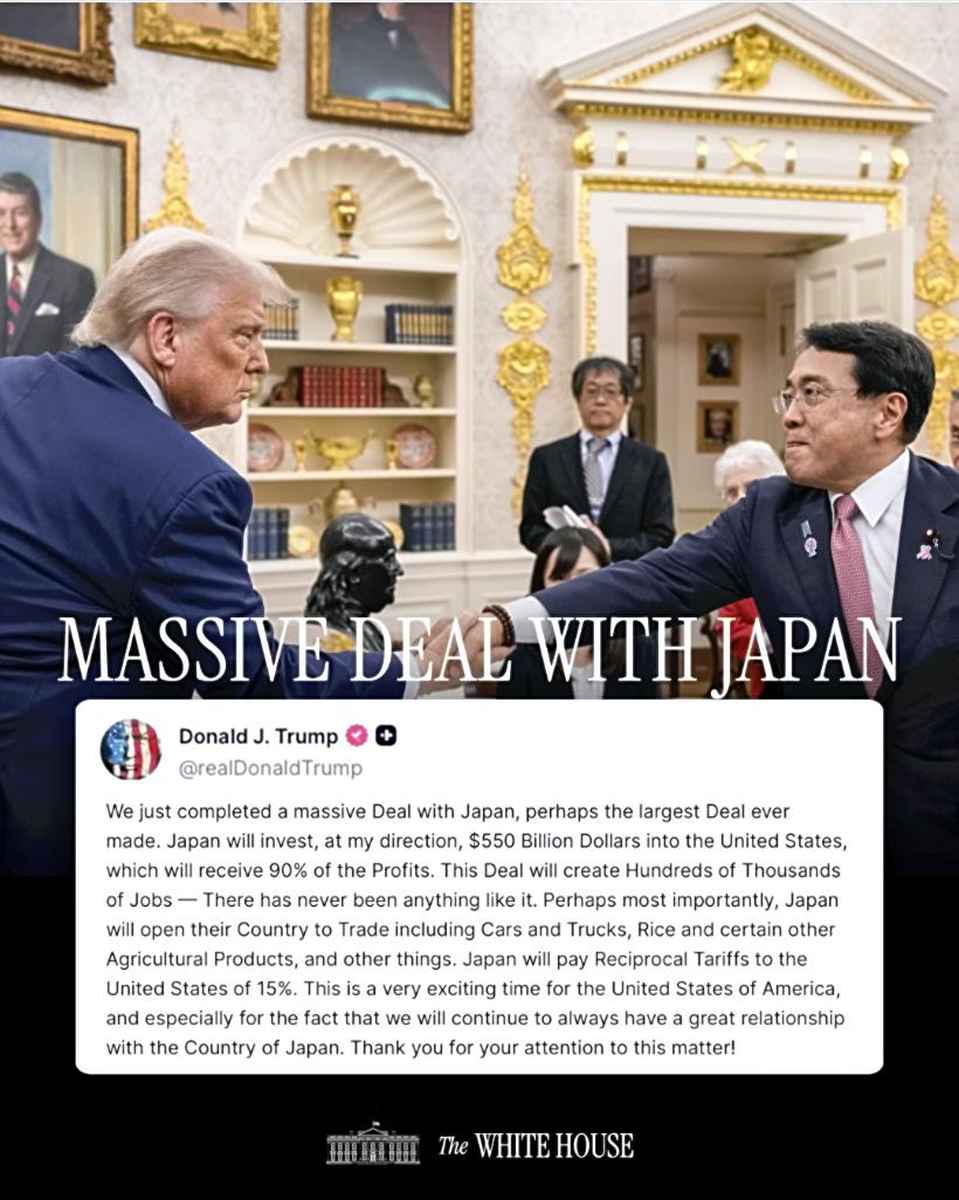
An image the White House posted Tuesday on X
20:00 JST, July 24, 2025
There was just about one week remaining until the Aug. 1 deadline when Japan and the United States reached a 15% tariff deal. Tokyo had managed to avoid the worst-case scenario of U.S. President Donald Trump’s administration levying duties of 25% from next month.
Japan succeeded in lowering not only what Trump calls “reciprocal tariffs,” imposed on dozens of countries including Japan, but also the automobile tariff that was a top priority for this nation.
Patience
Economic revitalization minister Ryosei Akazawa faced off against Trump at the White House on Tuesday. The talks had been arranged just the previous day and represented the first such meeting since April. U.S. Treasury Secretary Scott Bessent and U.S. Secretary of State Marco Rubio were also present.
According to sources involved in the negotiations, the U.S. side made detailed demands — asking Japan, for example, to provide a certain item in return for lowering tariffs by 1%, and to increase rice imports and boost investment and support for semiconductors.
Trump was said to have pushed for a deal in which he would lower tariffs by 1% in exchange for each concession.
“Mr. Trump made demands, citing specific figures. It felt like we needed at least 10 people to handle it,” one source said.
In response, Akazawa patiently persuaded Trump, using various bargaining chips. After about 70 minutes of talks, Trump finally agreed, stood up and asked Akazawa for a handshake.
‘Automobiles are Japan’s bedrock’
In the negotiations that began in April, Akazawa prioritized the revision of a proposed automobile tariff. In their first face-off at the Oval Office, Trump threatened Akazawa, saying steel was the bedrock of America, and Akazawa riposted with “Automobiles are the bedrock of Japan.”
As negotiations progressed, the Japanese side concluded that it was impossible to get the United States to withdraw its demands and shifted its goal to a reduction.
The United States and the United Kingdom reached an agreement on May 8 in which the U.S. levy on British vehicles was dropped to 10% in exchange for British carmakers being limited to exporting 100,000 cars a year to the United States.
Japan has a bitter history of voluntarily restricting its automobile exports to the United States in response to trade friction in the 1970s. Focusing on avoiding a limit on the quantity of its auto exports, Japan gradually lowered its goal, believing that “if the United Kingdom was hit with 10%, it will be hard for Japan to get a 10% tariff,” according to a Japanese government official.
The negotiations made significant progress in mid-May, according to Japanese government officials. The Japanese side presented investment plans in nine areas, including automobiles, iron and important minerals and also proposed the integration of supply chains.
U.S. Commerce Secretary Howard Lutnick and others praised the proposals, and an agreement was reached between the ministers at the end of May. Before the Japan-U.S. summit in June, Prime Minister Shigeru Ishiba told those around him that “negotiations are 90% complete.”
However, Trump was not satisfied with the plans and increased pressure on Japan, saying Japan was “very tough” and “so spoiled.” He hinted at raising tariffs to 30%-35%.
Mission accomplished
Nevertheless, Japan did not change its proposals. Instead, it changed the way it prepared documents and explained them in order to gain Trump’s understanding. Lutnick, meanwhile, explained the proposals to Trump nearly 10 times, and the green light was given for an agreement in the middle of July.
The day before Tuesday’s meeting, Lutnick invited Akazawa to his home to rehearse the meeting. After the meeting with Trump, Akazawa posted on X “Mission accomplished.”
A senior government official recalled: “Only Trump has the authority to make the final decision on the numbers. Some countries have had their decisions overturned at the last minute. We could not let our guard down at all.”


Related Tags


Most Read
Most read in the last 24 hours
-
Promote Support, Respect to Help Prevent Harassment of Athletes
-
Yamato Museum Reopens in Hiroshima Pref. Following Extensive Reno...
-
Japanese Govt to Set Up Panel on Widening Access to Sports Broadc...
-
Toyota Unveils New Development Hub in Woven City Repurposed from ...
-
Elegant Weeping Cherry Blossoms on Display at Water Purification ...
-

New Budget Framework for Investments: Work to Achieve Both Growth...
-
Man Admits to Abandoning Wife's Body in Zoo Incinerator in Hokkai...
-
Fukui: Dinosaur Faculty Building Unveiled in Japanese University'...
Most read in the last 7 days
-
Earthquake Hits Japan's Tohoku Region; 3-meter Tsunami Warning Is...
-
Trump Extends the Ceasefire with Iran but Keeps the Blockade
-
China, South Korea Object to Japanese PM Takaichi's Ritual Offeri...
-

India's Arms Indigenization Quest for Self-Reliance / New Delhi S...
-
Japan to Ban Use of Portable Chargers on Airplanes from April 24,...
-
¥1,000 Coins to Be Issued to Mark Anniversary of Beginning of Jap...
-
Most Serious Cyberattacks against the UK Now from Russia, Iran an...
-
Trump Opposes United–American Merger, Signals Support for Spirit
Most read in the last 30 days
-
Earthquake Hits Japan's Tohoku Region; 3-meter Tsunami Warning Is...
-
Police Find Child's Shoe During Search for Missing Boy in Nantan,...
-
Body Found in Nantan, Kyoto Prefecture, During Search for 11-Year...
-
Cherry Blossoms, Rapeseed Flowers Perform Colorful ‘Duet’ in Niig...
-
Trump Extends the Ceasefire with Iran but Keeps the Blockade
-
China, South Korea Object to Japanese PM Takaichi's Ritual Offeri...
-
Olympic Gold Medal-Winning Figure Skaters Riku-Ryu Announce Retir...
-
Japanese Prime Minister Takaichi Speaks to Pakistani Prime Minist...
Top Articles in Business
-
Foreign Tourists Set New Record in March; 30% Drop in Visitors from Middle East
-
Japan’s ANA to Introduce Fuel Surcharges to Domestic Flights from Fy27, Driven by Rising Fuel Costs, Declining Profits
-
Middle Powers Should Create Alternative to WTO, Says Research Group
-
Toyota Motor to Begin Full-Scale Hydrogen Production in May; Mass Production and Sales of Equipment Planned to Start in 2029
-
Airborne Cellular Stations to Be Tested in Ishikawa, Miyagi; Aim to Ensure Communication During Disasters
JN ACCESS RANKING
-
Earthquake Hits Japan’s Tohoku Region; 3-meter Tsunami Warning Issued (Update 1)
-
Police Find Child’s Shoe During Search for Missing Boy in Nantan, Kyoto Prefecture
-
Body Found in Nantan, Kyoto Prefecture, During Search for 11-Year-Old Boy in Area (Update 1)
-
Cherry Blossoms, Rapeseed Flowers Perform Colorful ‘Duet’ in Niigata
-
Trump Extends the Ceasefire with Iran but Keeps the Blockade
Most read in the last 24 hours
-
Promote Support, Respect to Help Prevent Harassment of Athletes
-
Yamato Museum Reopens in Hiroshima Pref. Following Extensive Reno...
-
Japanese Govt to Set Up Panel on Widening Access to Sports Broadc...
-
Toyota Unveils New Development Hub in Woven City Repurposed from ...
-
Elegant Weeping Cherry Blossoms on Display at Water Purification ...
Most read in the last 7 days
-
Earthquake Hits Japan's Tohoku Region; 3-meter Tsunami Warning Is...
-
Trump Extends the Ceasefire with Iran but Keeps the Blockade
-
China, South Korea Object to Japanese PM Takaichi's Ritual Offeri...
-
India's Arms Indigenization Quest for Self-Reliance / New Delhi S...
-
Japan to Ban Use of Portable Chargers on Airplanes from April 24,...
Most read in the last 30 days
-
Earthquake Hits Japan's Tohoku Region; 3-meter Tsunami Warning Is...
-
Police Find Child's Shoe During Search for Missing Boy in Nantan,...
-
Body Found in Nantan, Kyoto Prefecture, During Search for 11-Year...
-
Cherry Blossoms, Rapeseed Flowers Perform Colorful ‘Duet’ in Niig...
-
Trump Extends the Ceasefire with Iran but Keeps the Blockade