
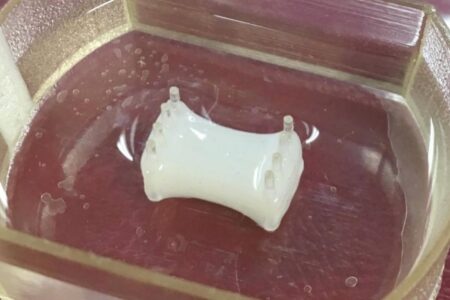
Cultured meat is studied in a lab.
13:04 JST, May 16, 2023
TOKYO (Jiji Press) — Cultured meat is attracting attention in Japan, as global population growth and improvements in living standards push up demand for meat.
Unlike plant-derived meat, including soybean meat, and insect food, cultured meat is made from real meat such as beef, pork and chicken. Also, it can be produced anywhere as long as there is electricity, culture solution and livestock cells, boosting hopes for the product as a new source of protein.
Many issues need to be solved before cultured meat is accepted widely, however, such as overcoming its negative image and formulating distribution rules.
To make lab-grown meat, cells taken from livestock are cultured in bioreactors until they are large enough to be eaten.
Although this is still in the research stage in Japan, Singapore became the first country in the world to approve sales of cultured meat in December 2020 and subsequently started commercial production. Development competition is intensifying around the world, including the United States and European countries.
Demand for meat in 2050 is expected to rise 70% from 2015. According to Japan’s agriculture ministry, the domestic market for cultured meat is projected to reach ¥9 billion in 2050, while the global market is seen reaching ¥700 billion.
The Japanese government is eager to foster cultured meat production as a future growth industry. The Ministry of Economy, Trade and Industry provides financial support for technological development, viewing the business as part of “bio-manufacturing.”
The agriculture ministry, for its part, has set up a public-private council on food technologies in order to support cultured meat production. “The aim is to help [producers] meet food demand while contributing to the economy,” a senior ministry official said.
If a sterile culture plant is built, production of cultured meat does not require farmland and is little affected by external factors such as weather.
NUProtein Co., based in Tokushima, is involved in the development of cultured meat technology. “If the industrialization of cultured meat makes headway and mass production starts, it could lead to regional revitalization by attracting factories to rural areas where vast land plots are available for use,” Masataka Minami, CEO of NUProtein, said.
Megumi Avigail Yoshitomi, representative director of the Japan Association for Cellular Agriculture, which is working on rules for cultured meat, said that if livestock farmers who own meat brands donate cells, there will be a business opportunity for licensing. “In order to help cells and brands in the field of cultured meat to be priced properly, we need a mechanism to ensure that they are not abused,” Yoshitomi said.
It is also essential to improve the public image of cultured meat. According to a survey conducted by major Japanese meatpacker NH Foods Ltd. in November last year, of 324 people aged 20 or older nationwide, 42.9% felt that cultured meat was “less delicious” than conventional meat.
Drawing up rules related to the distribution of lab-grown meat, including those on food labeling and measures for safety, has been taking time. “Businesses can’t start mass production unless the government shows its policy,” Yoshitomi said. “But the government wants businesses to be fully prepared for mass production first, leaving their talks going in circles.”
Overseas, by contrast, discussions on the issues have made progress. If the situation is left unattended, Japan may end up having to accept the outcome of discussions led by the United States and Europe.
“Japan is three to four years behind the rest of the world in the distribution of cultured meat,” Minami said. More efforts are needed before cultured meat, dubbed “meat for a new era,” is served on domestic dining tables.





Most Read
Most read in the last 24 hours
-

Iran's Top Diplomat Briefly Returns to Pakistan but Trump Says th...
-
Tokyo Vice Governor: SusHi Tech Tokyo Garners Tangible Business O...
-

DC Gala Shooting Suspect Aired Grievances against Trump in Writin...
-
Japan to Host Leaders from Major Cities from Around the World for...
-
M6.1 Earthquake Hits Hokkaido, Japan; No Tsunami Expected
-

Japanese Police Storm Bus to Arrest Man with Knife; No Injuries R...
-
Japan's LDP Urges More Social Structures Against a ‘State of Emer...
-
Students’ ‘ITAMAE’ Project Boosts Interest in Starting Small Busi...
Most read in the last 7 days
-
China, South Korea Object to Japanese PM Takaichi's Ritual Offeri...
-

Trump Extends the Ceasefire with Iran but Keeps the Blockade
-

India's Arms Indigenization Quest for Self-Reliance / New Delhi S...
-
¥1,000 Coins to Be Issued to Mark Anniversary of Beginning of Jap...
-

Most Serious Cyberattacks against the UK Now from Russia, Iran an...
-

Trump Opposes United–American Merger, Signals Support for Spirit
-
System Malfunction in Haneda Airport Causes 83 Flight Cancelation...
-

Florida Launches Criminal Probe into OpenAI and ChatGPT over Dead...
Most read in the last 30 days
-
Earthquake Hits Japan's Tohoku Region; 3-meter Tsunami Warning Is...
-
Police Find Child's Shoe During Search for Missing Boy in Nantan,...
-
Body Found in Nantan, Kyoto Prefecture, During Search for 11-Year...
-
China, South Korea Object to Japanese PM Takaichi's Ritual Offeri...
-

Cherry Blossoms, Rapeseed Flowers Perform Colorful ‘Duet’ in Niig...
-
Trump Extends the Ceasefire with Iran but Keeps the Blockade
-

Olympic Gold Medal-Winning Figure Skaters Riku-Ryu Announce Retir...
-
Japanese Prime Minister Takaichi Speaks to Pakistani Prime Minist...
Top Articles in Business
-
Foreign Tourists Set New Record in March; 30% Drop in Visitors from Middle East
-

Japan’s ANA to Introduce Fuel Surcharges to Domestic Flights from Fy27, Driven by Rising Fuel Costs, Declining Profits
-
Toyota Motor to Begin Full-Scale Hydrogen Production in May; Mass Production and Sales of Equipment Planned to Start in 2029
-
Middle Powers Should Create Alternative to WTO, Says Research Group
-
Airborne Cellular Stations to Be Tested in Ishikawa, Miyagi; Aim to Ensure Communication During Disasters
JN ACCESS RANKING
-
Earthquake Hits Japan’s Tohoku Region; 3-meter Tsunami Warning Issued (Update 1)
-
Police Find Child’s Shoe During Search for Missing Boy in Nantan, Kyoto Prefecture
-
Body Found in Nantan, Kyoto Prefecture, During Search for 11-Year-Old Boy in Area (Update 1)
-
China, South Korea Object to Japanese PM Takaichi’s Ritual Offering to Yasukuni Shrine
-
Cherry Blossoms, Rapeseed Flowers Perform Colorful ‘Duet’ in Niigata
Most read in the last 24 hours
-
Iran's Top Diplomat Briefly Returns to Pakistan but Trump Says th...
-
Tokyo Vice Governor: SusHi Tech Tokyo Garners Tangible Business O...
-
DC Gala Shooting Suspect Aired Grievances against Trump in Writin...
-
Japan to Host Leaders from Major Cities from Around the World for...
-
M6.1 Earthquake Hits Hokkaido, Japan; No Tsunami Expected
Most read in the last 7 days
-
China, South Korea Object to Japanese PM Takaichi's Ritual Offeri...
-
Trump Extends the Ceasefire with Iran but Keeps the Blockade
-
India's Arms Indigenization Quest for Self-Reliance / New Delhi S...
-
¥1,000 Coins to Be Issued to Mark Anniversary of Beginning of Jap...
-
Most Serious Cyberattacks against the UK Now from Russia, Iran an...
Most read in the last 30 days
-
Earthquake Hits Japan's Tohoku Region; 3-meter Tsunami Warning Is...
-
Police Find Child's Shoe During Search for Missing Boy in Nantan,...
-
Body Found in Nantan, Kyoto Prefecture, During Search for 11-Year...
-
China, South Korea Object to Japanese PM Takaichi's Ritual Offeri...
-
Cherry Blossoms, Rapeseed Flowers Perform Colorful ‘Duet’ in Niig...