
Takaichi’s Strategy of Preemptively Telling Trump Plan to Increase Defense Expense Appears Successful for Now
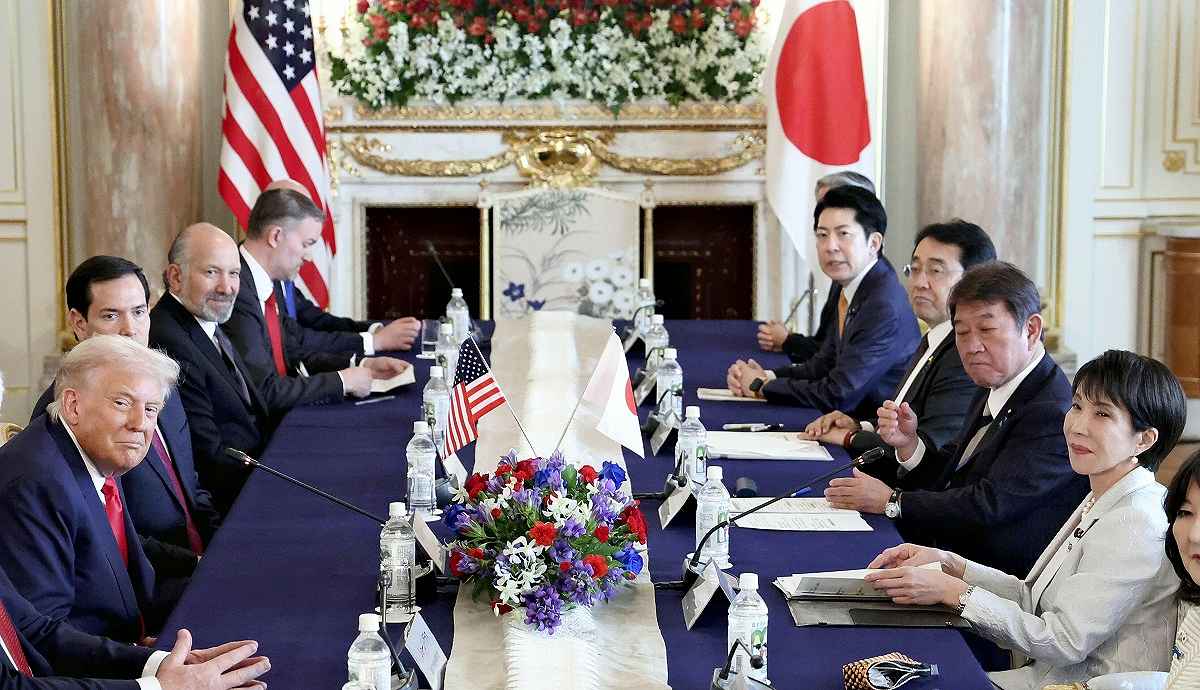
Prime Minister Sanae Takaichi, far right, and U.S. President Donald Trump, far left, hold a Japan-U.S. summit meeting on Tuesday at the State Guest House Akasaka Palace in Tokyo.
14:02 JST, October 29, 2025
One of the main subjects that was expected to be discussed in Tuesday’s Japan-U.S. summit was an increase in defense spending, which U.S. President Donald Trump has been demanding of many allies and like-minded nations.
Prime Minister Sanae Takaichi told Trump about her plan to increase Japan’s defense spending before he could demand it; however, it remains possible that he will ask for Japan to specify the exact size of the increase in the future.
“I told him that Japan is determined to make proactive efforts to increase defense spending and boost its defense capabilities,” Takaichi said to reporters after she met with Trump.
She is believed to have explained to Trump her plan to work on raising security-related expenditures, including defense spending — which sat at approximately ¥8.47 trillion for fiscal 2025, to 2% of the gross domestic product this fiscal year, as well as to revise the three security documents, including the National Security Strategy, ahead of schedule.
Japanese officials were aware that Trump did not make any specific demand for Australia to increase defense spending during his summit meeting with that country’s leadership this month. Thus, there was speculation within the Foreign Ministry that Trump might not make such a demand of Japan, either. Takaichi, however, chose a strategy of seeking to satisfy him by preemptively telling him of the increase.
The Japanese government’s preparation was so thorough that the Defense Ministry had coordinated and obtained approval from the Finance Ministry beforehand regarding Takaichi’s plan to tell Trump of the intended budget increase.
This strategy succeeded, and Trump did not mention the scale of the defense spending increase. A senior government official breathed a sigh of relief, saying, “He basically understood Japan’s efforts.”
However, the North Atlantic Treaty Organization (NATO) has decided to raise its requirement for defense-related spending, including infrastructure development, to 5% of each member country’s GDP by 2035, reflecting Trump’s demands. Taiwan has also decided to increase its defense spending to 3.32% of GDP in its next fiscal year budget proposal. Japan may eventually have no choice but to specify exactly how much it will add to its defense budget.
Negotiations over Japan’s share of the cost of stationing U.S. forces in Japan are also expected to be difficult. The current deal expires in March 2027. During the first Trump administration, the U.S. government demanded that Japan pay shoulder a significantly greater part of the financial burden.
A senior Defense Ministry official said, “We are prepared for intense discussions with representatives of the U.S.”


Related Tags



Most Read
Most read in the last 24 hours
-

India’s Arms Indigenization Quest for Self-Reliance / Big Firms, ...
-
Shifts Startup Focus to Nurturing Global Winners
-

Princess Aiko Enjoys Imperial Court Music, Dance; Production, Cos...
-

Bibimbap with Spring Vegetables and Asari Clam Miso a Rich Taste ...
-

Mother Supports My Sister Too Much, Gives Her Kids Much More Than...
-
Umami History: Kyoto Chef Murata Worked to Share Japan’s Scientif...
-
Official App to Help Startups Meet Other Participants
-

Appeal of Japanese Food: Make Good Use of ‘Discoveries’ by People...
Most read in the last 7 days
-
Earthquake Hits Japan's Tohoku Region; 3-meter Tsunami Warning Is...
-
China, South Korea Object to Japanese PM Takaichi's Ritual Offeri...
-
Trump Extends the Ceasefire with Iran but Keeps the Blockade
-

India's Arms Indigenization Quest for Self-Reliance / New Delhi S...
-
¥1,000 Coins to Be Issued to Mark Anniversary of Beginning of Jap...
-

Most Serious Cyberattacks against the UK Now from Russia, Iran an...
-

Trump Opposes United–American Merger, Signals Support for Spirit
-
System Malfunction in Haneda Airport Causes 83 Flight Cancelation...
Most read in the last 30 days
-
Earthquake Hits Japan's Tohoku Region; 3-meter Tsunami Warning Is...
-
Police Find Child's Shoe During Search for Missing Boy in Nantan,...
-
Body Found in Nantan, Kyoto Prefecture, During Search for 11-Year...
-
China, South Korea Object to Japanese PM Takaichi's Ritual Offeri...
-
Cherry Blossoms, Rapeseed Flowers Perform Colorful ‘Duet’ in Niig...
-
Trump Extends the Ceasefire with Iran but Keeps the Blockade
-

Olympic Gold Medal-Winning Figure Skaters Riku-Ryu Announce Retir...
-
Japanese Prime Minister Takaichi Speaks to Pakistani Prime Minist...
Top Articles in Politics
-
India’s Arms Indigenization Quest for Self-Reliance / New Delhi Sticks to Its ‘All-Alignment’ Guns Even after Iran Warship Attack
-
Japan Aims to Enhance Deterrence, Defense Industry by Allowing Exports of Weapons
-
Former Japan PM Murayama’s Farewell Ceremony Held; Former Deputy PM Kono Vows to ‘Carry on Path Toward Peace’
-

Chinese Warships Cruise Past Japanese Islands in Retaliation for MSDF Ship Using Taiwan Strait
-
Japan Monitoring Situation Surrounding Revocation of Taiwan President’s Flight Permit by 3 Island Countries
JN ACCESS RANKING
-
Earthquake Hits Japan’s Tohoku Region; 3-meter Tsunami Warning Issued (Update 1)
-
Police Find Child’s Shoe During Search for Missing Boy in Nantan, Kyoto Prefecture
-
Body Found in Nantan, Kyoto Prefecture, During Search for 11-Year-Old Boy in Area (Update 1)
-
China, South Korea Object to Japanese PM Takaichi’s Ritual Offering to Yasukuni Shrine
-
Cherry Blossoms, Rapeseed Flowers Perform Colorful ‘Duet’ in Niigata
Most read in the last 24 hours
-
India’s Arms Indigenization Quest for Self-Reliance / Big Firms, ...
-
Shifts Startup Focus to Nurturing Global Winners
-
Princess Aiko Enjoys Imperial Court Music, Dance; Production, Cos...
-
Bibimbap with Spring Vegetables and Asari Clam Miso a Rich Taste ...
-
Mother Supports My Sister Too Much, Gives Her Kids Much More Than...
Most read in the last 7 days
-
Earthquake Hits Japan's Tohoku Region; 3-meter Tsunami Warning Is...
-
China, South Korea Object to Japanese PM Takaichi's Ritual Offeri...
-
Trump Extends the Ceasefire with Iran but Keeps the Blockade
-
India's Arms Indigenization Quest for Self-Reliance / New Delhi S...
-
¥1,000 Coins to Be Issued to Mark Anniversary of Beginning of Jap...
Most read in the last 30 days
-
Earthquake Hits Japan's Tohoku Region; 3-meter Tsunami Warning Is...
-
Police Find Child's Shoe During Search for Missing Boy in Nantan,...
-
Body Found in Nantan, Kyoto Prefecture, During Search for 11-Year...
-
China, South Korea Object to Japanese PM Takaichi's Ritual Offeri...
-
Cherry Blossoms, Rapeseed Flowers Perform Colorful ‘Duet’ in Niig...