
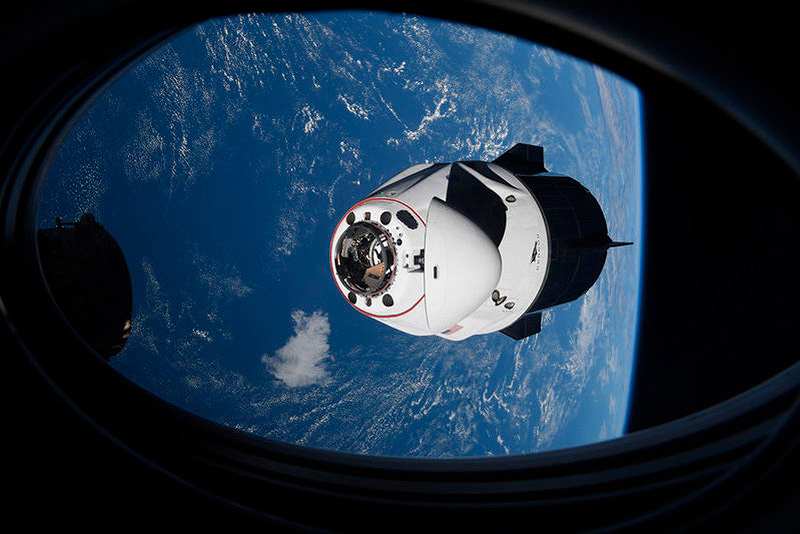
FILE – In this April 24, 2021 file photo made available by NASA, the SpaceX Crew Dragon capsule approaches the International Space Station for docking. Space junk is threatening the seven astronauts aboard the International Space Station and forcing them to seek shelter in their docked capsules. The U.S. Space Command says it’s tracking a field of orbiting debris, the apparent result of some satellite break-up event. The astronauts retreated into their docked capsules on Monday, Nov. 15, 2021 after being informed of the threat. (NASA via AP, File)
November 17, 2021
MOSCOW (AP) — Russian officials on Tuesday rejected accusations that they endangered astronauts aboard the International Space Station by conducting a weapons test that created more than 1,500 pieces of space junk but a White House official said the move by Russia would threaten activities in space “for years to come.”
U.S. officials on Monday accused Russia of destroying an old satellite with a missile in what they called a reckless and irresponsible strike. They said the debris could damage the space station, an assessment backed by NATO’s chief.
Astronauts now face four times greater risk than normal from space junk, NASA Administrator Bill Nelson told The Associated Press. The defunct Russian satellite Cosmos 1408 was orbiting about 40 miles (65 kilometers) higher than the space station.
The test clearly demonstrates that Russia, “despite its claims of opposing the weaponization of outer space, is willing to … imperil the exploration and use of outer space by all nations through its reckless and irresponsible behavior,” U.S. Secretary of State Antony Blinken said.
White House spokesperson Andrew Bates said Tuesday that Russia’s action demonstrated its “complete disregard for the security, safety, stability and long-term sustainability of the space domain for all nations. This debris will continue to pose a direct threat to activities in outer space for years to come and puts at risk satellites all nations rely on for national security, economic prosperity and scientific discovery.” He said the United States would work with its allies “as we seek to respond to this irresponsible act.”
Even a fleck of paint can do major damage when orbiting at 17,500 mph (28,000 kph). Something big, upon impact, could be catastrophic to the space station.
Russia’s Defense Ministry on Tuesday confirmed carrying out a test and destroying a defunct satellite that has been in orbit since 1982, but insisted that “the U.S. knows for certain that the resulting fragments, in terms of test time and orbital parameters, did not and will not pose a threat to orbital stations, spacecraft and space activities.” It called remarks by U.S. officials “hypocritical.”
Defense Minister Sergei Shoigu said the strike was carried out “with surgical precision” and posed no threat to the space station. Foreign Minister Sergey Lavrov also charged that it is “hypocrisy” to say that Russia creates risks for peaceful activities in space.
The Russian space agency Roscosmos wouldn’t confirm or deny that the strike took place, saying only that the “unconditional safety of the crew has been and remains our main priority.”
Once the situation became clear early Monday morning, those on board the International Space Station — four Americans, one German and two Russians — were ordered to immediately seek shelter in their docked capsules. They spent two hours in the two capsules, finally emerging only to have to close and reopen hatches to the station’s individual labs on every orbit, or 1 1/2 hours, as they passed near or through the space debris.
NATO Secretary-General Jens Stoltenberg agreed that Russia’s actions endangered the space station.
“This was a reckless act by Russia to actually shoot down and destroy a satellite as part of a test of an anti-satellite weapons system,” which created a lot of space debris, Stoltenberg told reporters in Brussels.
He said it was of additional concern “because it demonstrates that Russia is now developing new weapons systems that can shoot down the satellites, can destroy important space capabilities for basic infrastructure on Earth, like communications, like navigation, or like early warning of missile launches.”
The German Foreign Ministry also said it was “very concerned” by the test, which it said resulted in “additional risks” for the astronauts on the ISS.
“This irresponsible behavior carries a high risk of miscalculations and escalation,” the ministry said, adding that the test underlines the urgency of an international agreement on rules for the peaceful use of space.
NASA Mission Control said the heightened threat could continue to interrupt the astronauts’ science research and other work. Four of the seven crew members only arrived at the orbiting outpost on Thursday night.
A similar weapons test by China in 2007 also resulted in countless pieces of debris. One of those threatened to come dangerously close to the space station last week. While later the risk it posed was dismissed, NASA had the space station move anyway.
Anti-satellite missile tests by the U.S. in 2008 and India in 2019 were conducted at much lower altitudes, well below the space station, which orbits about 260 miles (420 kilometers) high.
___
Marcia Dunn in Cape Canaveral, Florida, Lorne Cook in Brussels, Geir Moulson in Berlin and Darlene Superville in Washington D.C. contributed to this report.






Most Read
Most read in the last 24 hours
-

Shifts Startup Focus to Nurturing Global Winners
-

Princess Aiko Enjoys Imperial Court Music, Dance; Production, Cos...
-

Bibimbap with Spring Vegetables and Asari Clam Miso a Rich Taste ...
-

Mother Supports My Sister Too Much, Gives Her Kids Much More Than...
-

Umami History: Kyoto Chef Murata Worked to Share Japan’s Scientif...
-

Appeal of Japanese Food: Make Good Use of ‘Discoveries’ by People...
-
Official App to Help Startups Meet Other Participants
-

Okinawa Gubernatorial Election: Candidates Should Advocate Realis...
Most read in the last 7 days
-
Earthquake Hits Japan's Tohoku Region; 3-meter Tsunami Warning Is...
-

China, South Korea Object to Japanese PM Takaichi's Ritual Offeri...
-

Trump Extends the Ceasefire with Iran but Keeps the Blockade
-

India's Arms Indigenization Quest for Self-Reliance / New Delhi S...
-

¥1,000 Coins to Be Issued to Mark Anniversary of Beginning of Jap...
-

Most Serious Cyberattacks against the UK Now from Russia, Iran an...
-

Trump Opposes United–American Merger, Signals Support for Spirit
-

System Malfunction in Haneda Airport Causes 83 Flight Cancelation...
Most read in the last 30 days
-
Earthquake Hits Japan's Tohoku Region; 3-meter Tsunami Warning Is...
-
Police Find Child's Shoe During Search for Missing Boy in Nantan,...
-
Body Found in Nantan, Kyoto Prefecture, During Search for 11-Year...
-
China, South Korea Object to Japanese PM Takaichi's Ritual Offeri...
-

Cherry Blossoms, Rapeseed Flowers Perform Colorful ‘Duet’ in Niig...
-
Trump Extends the Ceasefire with Iran but Keeps the Blockade
-

Olympic Gold Medal-Winning Figure Skaters Riku-Ryu Announce Retir...
-

Japanese Prime Minister Takaichi Speaks to Pakistani Prime Minist...
Top Articles in News Services
-
Trump Extends the Ceasefire with Iran but Keeps the Blockade
-
Most Serious Cyberattacks against the UK Now from Russia, Iran and China, Cyber Chief Says
-
Trump Opposes United–American Merger, Signals Support for Spirit
-

Florida Launches Criminal Probe into OpenAI and ChatGPT over Deadly Shooting
-

Trump Picks a University of Minnesota Professor to Lead His Economic Council
JN ACCESS RANKING
-
Earthquake Hits Japan’s Tohoku Region; 3-meter Tsunami Warning Issued (Update 1)
-
Police Find Child’s Shoe During Search for Missing Boy in Nantan, Kyoto Prefecture
-
Body Found in Nantan, Kyoto Prefecture, During Search for 11-Year-Old Boy in Area (Update 1)
-
China, South Korea Object to Japanese PM Takaichi’s Ritual Offering to Yasukuni Shrine
-
Cherry Blossoms, Rapeseed Flowers Perform Colorful ‘Duet’ in Niigata
Most read in the last 24 hours
-
Shifts Startup Focus to Nurturing Global Winners
-
Princess Aiko Enjoys Imperial Court Music, Dance; Production, Cos...
-
Bibimbap with Spring Vegetables and Asari Clam Miso a Rich Taste ...
-
Mother Supports My Sister Too Much, Gives Her Kids Much More Than...
-
Umami History: Kyoto Chef Murata Worked to Share Japan’s Scientif...
Most read in the last 7 days
-
Earthquake Hits Japan's Tohoku Region; 3-meter Tsunami Warning Is...
-
China, South Korea Object to Japanese PM Takaichi's Ritual Offeri...
-
Trump Extends the Ceasefire with Iran but Keeps the Blockade
-
India's Arms Indigenization Quest for Self-Reliance / New Delhi S...
-
¥1,000 Coins to Be Issued to Mark Anniversary of Beginning of Jap...
Most read in the last 30 days
-
Earthquake Hits Japan's Tohoku Region; 3-meter Tsunami Warning Is...
-
Police Find Child's Shoe During Search for Missing Boy in Nantan,...
-
Body Found in Nantan, Kyoto Prefecture, During Search for 11-Year...
-
China, South Korea Object to Japanese PM Takaichi's Ritual Offeri...
-
Cherry Blossoms, Rapeseed Flowers Perform Colorful ‘Duet’ in Niig...