
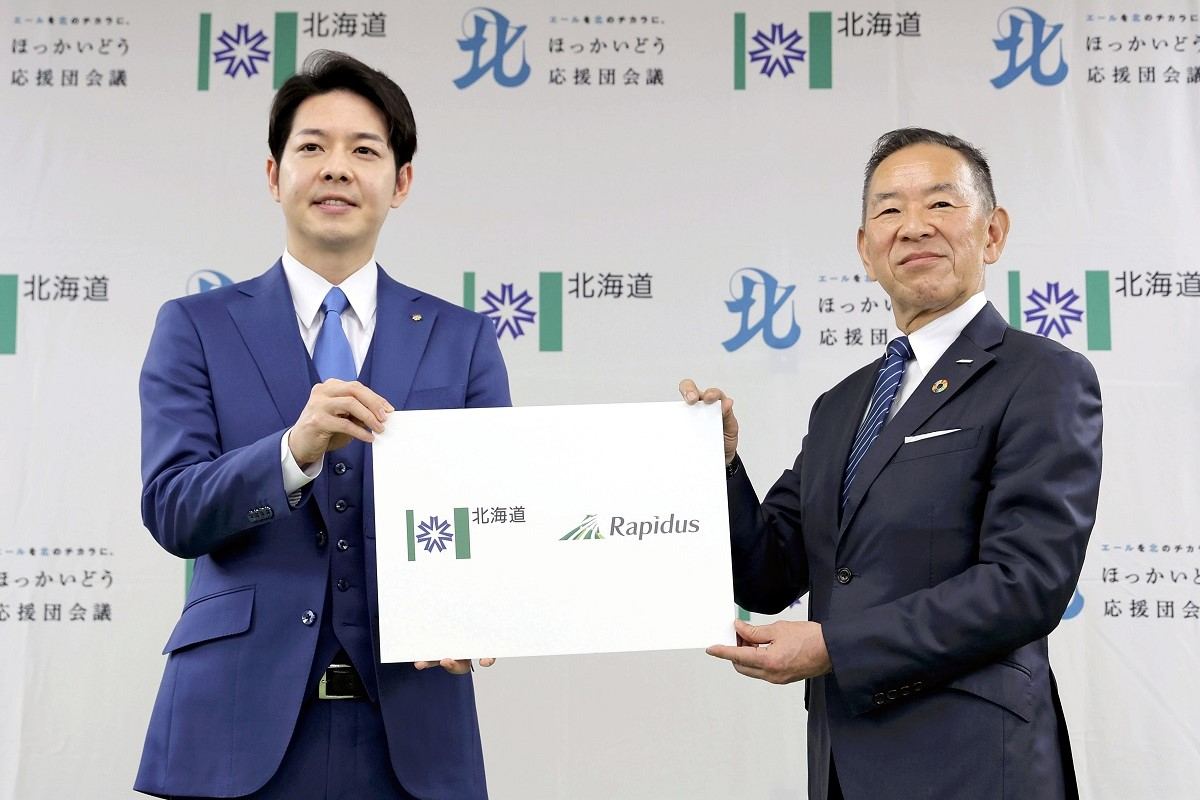
Hokkaido Gov. Naomichi Suzuki, left, and Rapidus President Atsuyoshi Koike at the Hokkaido prefectural government office in Sapporo on Monday.
21:00 JST, March 2, 2023
Chipmaker Rapidus Corp. has selected Chitose, Hokkaido, as the proposed site for a factory but is expected to face a number of challenges on the way to achieving mass production.
Aiming to domestically produce next-generation semiconductors, Rapidus decided to build a plant in Chitose after receiving approval for government subsidies and other measures. The company intends to start full-scale preparations for the start of mass production in 2027.
Competition to win project
“We will build an unprecedented semiconductor plant that will astonish the world,” Rapidus President Atsuyoshi Koike told the press on Monday after a meeting with Hokkaido Gov. Naomichi Suzuki at the Hokkaido prefectural government office.
The Tokyo-based newly created chipmaker selected Chitose because it has water resources essential for semiconductor production and convenient transportation. The industrial complex is only a five-minute drive from New Chitose Airport, with smooth connections to an expressway and a rail line to Sapporo. Several municipalities competed behind the scenes to bring in the factory, according to a source close to the project.
Rapidus was established last summer and is funded by eight Japanese companies, including Toyota Motor Corp. and NTT Corp.
The goal is to produce the most advanced semiconductors, known as the 2-nanometer generation, which are expected to become the brains of artificial intelligence and supercomputers. However, production technology for these semiconductors has not yet been devised.
‘Last chance’
Taiwan Semiconductor Manufacturing Company (TSMC) leads the world in semiconductor manufacturing, while Japan relies on overseas procurement for almost all of its advanced semiconductors.
Semiconductors are becoming increasingly important from the perspective of economic security. In June 2021, the government said it would “tackle [the semiconductor issue] as a national strategy” and support Rapidus’ initiatives through subsidies and other means.
“This will be the last chance for Japan to work on cutting-edge semiconductor products,” a source close to the project said.
Rapidus has no expertise in manufacturing advanced semiconductors, and will collaborate with IBM Corp. of the United States and imec (Interuniversity Microelectronics Centre), a Belgian research and development organization, to dispatch researchers and other personnel to learn the technology.
“This is a symbolic project of Japan-U.S. collaboration, and I welcome its progress. The government will provide the necessary support,” Economy, Trade and Industry Minister Yasutoshi Nishimura said at a press conference on Monday.
Problems remain
However, there are still many issues to tackle.
Producing advanced semiconductors requires microscopic processing, which will need an investment of ¥2 trillion to establish the technology and ¥3 trillion to prepare the mass production line.
Nearly 1,000 engineers must also be recruited for the production line before it is ready to go into operation.
Koike said only that he would explain the financing plan once the firm had a clear prospect for fundraising.
Even if Rapidus successfully begins operation, it is essential to continue to invest in the development of new technologies that are evolving day by day.
Semiconductors are subject to repeated boom-bust cycles, known as the silicon cycle, and it is difficult to predict whether the company will be able to meet customer demand after it starts operations.
“Rapidus’ project will flounder unless the companies that use the semiconductors, including those that have invested in Rapidus, draw up a strategy for what kind of products they will create using the cutting-edge semiconductors,” Meisei University Prof. Masahiko Hosokawa said.





Most Read
Most read in the last 24 hours
-
Tokyo Vice Governor: SusHi Tech Tokyo Garners Tangible Business O...
-

Iran's Top Diplomat Briefly Returns to Pakistan but Trump Says th...
-
Japan to Host Leaders from Major Cities from Around the World for...
-

DC Gala Shooting Suspect Aired Grievances against Trump in Writin...
-

Sabastian Sawe of Kenya Becomes First Person to Run a Sub-2-hour ...
-
M6.1 Earthquake Hits Hokkaido, Japan; No Tsunami Expected
-

Students’ ‘ITAMAE’ Project Boosts Interest in Starting Small Busi...
-
Japanese Police Storm Bus to Arrest Man with Knife; No Injuries R...
Most read in the last 7 days
-

China, South Korea Object to Japanese PM Takaichi's Ritual Offeri...
-

Trump Extends the Ceasefire with Iran but Keeps the Blockade
-

India's Arms Indigenization Quest for Self-Reliance / New Delhi S...
-

¥1,000 Coins to Be Issued to Mark Anniversary of Beginning of Jap...
-

Most Serious Cyberattacks against the UK Now from Russia, Iran an...
-

Trump Opposes United–American Merger, Signals Support for Spirit
-
System Malfunction in Haneda Airport Causes 83 Flight Cancelation...
-

Florida Launches Criminal Probe into OpenAI and ChatGPT over Dead...
Most read in the last 30 days
-
Earthquake Hits Japan's Tohoku Region; 3-meter Tsunami Warning Is...
-
Police Find Child's Shoe During Search for Missing Boy in Nantan,...
-
Body Found in Nantan, Kyoto Prefecture, During Search for 11-Year...
-
China, South Korea Object to Japanese PM Takaichi's Ritual Offeri...
-

Cherry Blossoms, Rapeseed Flowers Perform Colorful ‘Duet’ in Niig...
-
Trump Extends the Ceasefire with Iran but Keeps the Blockade
-

Olympic Gold Medal-Winning Figure Skaters Riku-Ryu Announce Retir...
-
Japanese Prime Minister Takaichi Speaks to Pakistani Prime Minist...
Top Articles in Business
-
Foreign Tourists Set New Record in March; 30% Drop in Visitors from Middle East
-

Japan’s ANA to Introduce Fuel Surcharges to Domestic Flights from Fy27, Driven by Rising Fuel Costs, Declining Profits
-
Toyota Motor to Begin Full-Scale Hydrogen Production in May; Mass Production and Sales of Equipment Planned to Start in 2029
-
Middle Powers Should Create Alternative to WTO, Says Research Group
-
Airborne Cellular Stations to Be Tested in Ishikawa, Miyagi; Aim to Ensure Communication During Disasters
JN ACCESS RANKING
-
Earthquake Hits Japan’s Tohoku Region; 3-meter Tsunami Warning Issued (Update 1)
-
Police Find Child’s Shoe During Search for Missing Boy in Nantan, Kyoto Prefecture
-
Body Found in Nantan, Kyoto Prefecture, During Search for 11-Year-Old Boy in Area (Update 1)
-
China, South Korea Object to Japanese PM Takaichi’s Ritual Offering to Yasukuni Shrine
-
Cherry Blossoms, Rapeseed Flowers Perform Colorful ‘Duet’ in Niigata
Most read in the last 24 hours
-
Tokyo Vice Governor: SusHi Tech Tokyo Garners Tangible Business O...
-
Iran's Top Diplomat Briefly Returns to Pakistan but Trump Says th...
-
Japan to Host Leaders from Major Cities from Around the World for...
-
DC Gala Shooting Suspect Aired Grievances against Trump in Writin...
-
Sabastian Sawe of Kenya Becomes First Person to Run a Sub-2-hour ...
Most read in the last 7 days
-
China, South Korea Object to Japanese PM Takaichi's Ritual Offeri...
-
Trump Extends the Ceasefire with Iran but Keeps the Blockade
-
India's Arms Indigenization Quest for Self-Reliance / New Delhi S...
-
¥1,000 Coins to Be Issued to Mark Anniversary of Beginning of Jap...
-
Most Serious Cyberattacks against the UK Now from Russia, Iran an...
Most read in the last 30 days
-
Earthquake Hits Japan's Tohoku Region; 3-meter Tsunami Warning Is...
-
Police Find Child's Shoe During Search for Missing Boy in Nantan,...
-
Body Found in Nantan, Kyoto Prefecture, During Search for 11-Year...
-
China, South Korea Object to Japanese PM Takaichi's Ritual Offeri...
-
Cherry Blossoms, Rapeseed Flowers Perform Colorful ‘Duet’ in Niig...